
Industry urges MassDEP to revisit costly financial‑assurance rules for engineered barriers
Get AI-powered insights, summaries, and transcripts
Subscribe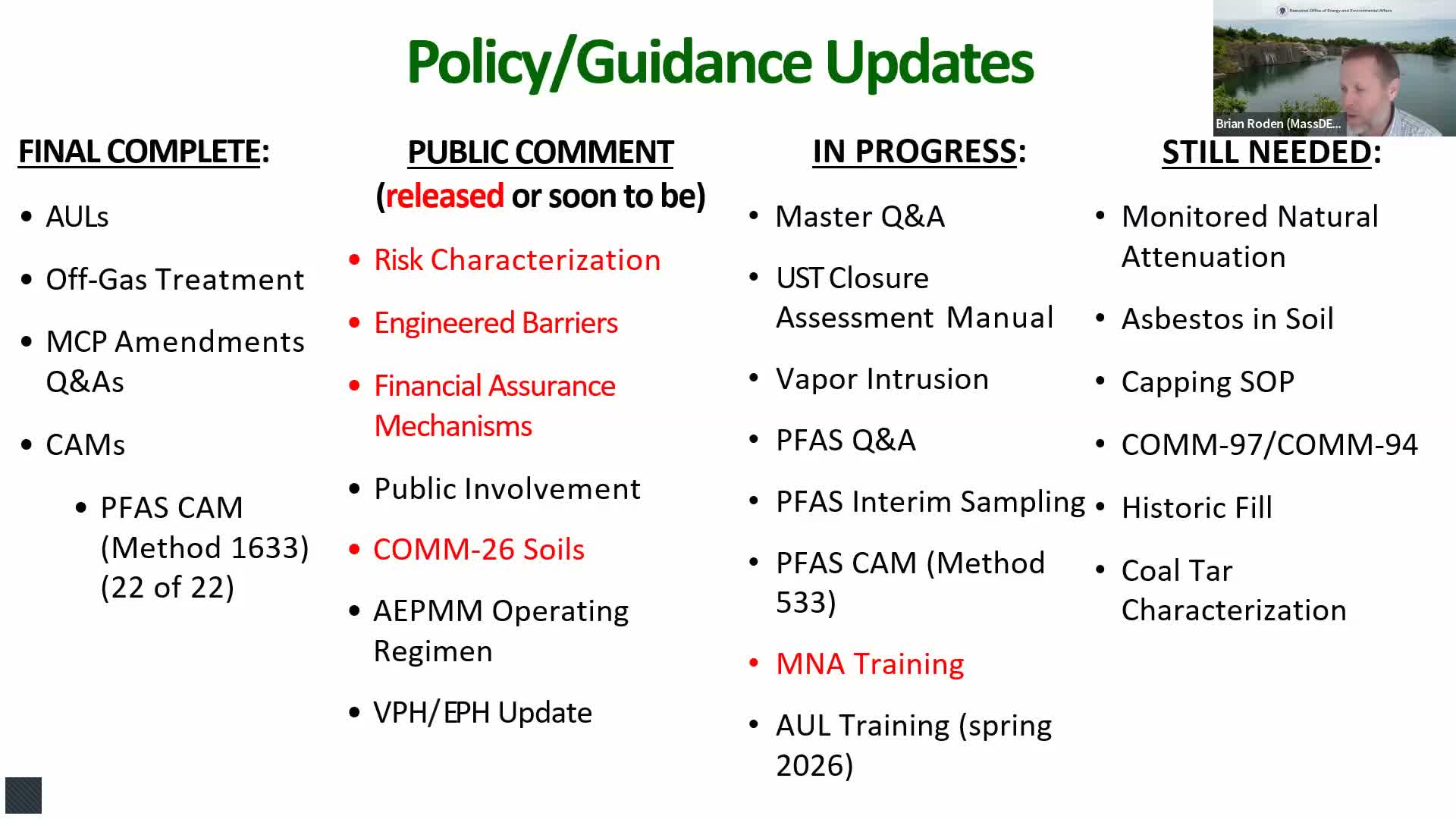
Summary
Consultants and advisory members told MassDEP the draft financial‑assurance mechanism (FAM) guidance makes common, low‑maintenance engineered barriers economically burdensome by excluding self‑insurance or parent guarantees used in other states. MassDEP said regulatory change may be needed and asked for written examples from other jurisdictions.
Assistant Commissioner Millie Garcia Serrano opened MassDEP’s quarterly Waste Site Cleanup Advisory Committee meeting and turned to a suite of guidance under development, including a draft financial‑assurance mechanism (FAM) guidance for sites using engineered barriers.
During the discussion, advisory member Steve Sharon pressed MassDEP on whether the guidance unnecessarily rules out industry‑standard instruments such as self‑insurance and parent guarantees. Sharon said he has worked in multiple states where remediation‑based or permit‑linked financial assurance options are used and that, for his projects, the cheapest available corporate bond or surety ‘‘can cost almost as much over 30 years as the maintenance itself,’’ creating a prohibitive burden that has stalled projects for months.
An industry presenter added that for a simple engineered control—essentially a concrete pad—the anticipated annual maintenance costs are about $10, while available assurance products can cost $4,000–$5,000 per year and total $120,000–$150,000 over 30 years. The commenter requested that MassDEP revisit allowable instruments or explain the regulatory basis for excluding self‑tests and parent guarantees.
MassDEP staff acknowledged the concern but said the FAM guidance must work within the existing MCP regulations. Brian Roden (MassDEP) told the committee that some proposed alternative instruments would likely require regulatory change, which cannot be accomplished by guidance alone. Roden invited stakeholders to submit links and documentation on other states’ programs so staff can consider concrete examples.
Assistant Commissioner Millie Garcia Serrano said the bureau tailored the FAM guidance to reflect that 21E sites are not landfills and to align assurances with the presence of bona fide engineered barriers; she encouraged written comments to be submitted promptly so they can be considered before finalization.
Next steps: MassDEP staff will collect written examples of alternative FAM instruments from commenters and take the feedback to the working group; the department signaled it may consider whether regulatory amendments are required to broaden allowable financial instruments.