Get Full Government Meeting Transcripts, Videos, & Alerts Forever!
Get email alerts on the Legislative Technology And Process topic
No spam. Unsubscribe anytime.
Select Committee on Technology and Process adopts interim topics; public urges LSO to standardize bill “catch” titles
Summary
At a March 5 meeting, the Select Committee on Technology and Process agreed to proceed with a draft interim-work letter covering legislative technology, process, public-television tower review and facilities; Marguerite Herman of the League of Women Voters urged that the Legislative Services Office draft concise, accurate bill "catch" titles. Members also discussed the digital journal’s ordering, statute hyperlinks and in-chamber microphones.
The Select Committee on Technology and Process on March 5 reviewed a draft interim-work letter and agreed to proceed with a program of interim meetings to study legislative technology, process changes, the Wyoming Public Television tower system and facilities issues.
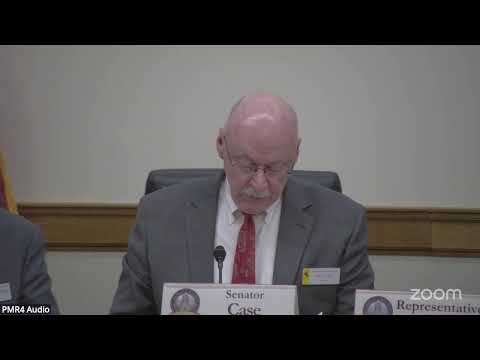
Chairman Case opened the meeting and, after roll call confirmed a quorum, guided members through the draft letter that lists the committee’s 2026 priorities, including a review of the legislature’s information strategy and potential participation in selecting legislator laptops. The panel tentatively scheduled two interim meetings and asked staff to circulate a proposed calendar for a June session and a later meeting in October.
During public comment Marguerite Herman of the League of Women Voters urged the committee to ask the management council to direct the Legislative Services Office to prepare bill "catch" titles. "I would suggest that LSO, with their expertise and, you know, neutral third party, that they're going to be as accurate as possible," Herman said, arguing the public often relies on short catch titles and may not read full bills.
A director on the panel said LSO historically has had discretion over catch titles and that catch titles are not an "official" part of a bill document. The director added that management council could adopt a policy if members wanted to constrain or standardize catch-title wording. "LSO was given a broader discretion at that point in time to decide on the catch title and make sure it was germaneous," the director said, describing the current practice as generally collaborative but sometimes reflecting sponsors' preferences.
Chief Clerk Thompson described a separate technology issue: the legislature’s newer electronic journal groups entries by bill action rather than strictly in chronological order. Thompson said Mason's section 6-95 specifies that the journal should be arranged chronologically and recommended making a chronological version available or otherwise ensuring the digital journal complies with the statutory requirement. "The digital journal, however, grouped bills by reading or by action," Thompson said, calling the digital format "much more user friendly" but noting the potential compliance question.
Members and staff discussed time stamps and roll-call visibility. Staff explained roll calls are time-stamped and visible in the live system, but other journal entries do not uniformly carry time stamps and an entry timestamp could reflect when material was posted rather than when an event actually occurred. Staff said correcting entries after posting can alter modified timestamps, complicating any effort to reconstruct a strictly chronological sequence.
The committee also explored adding hyperlinks from bill pages to the statutes they reference. Jamie Schwab, an IT staff member, said the legislature currently relies on a third-party provider (Folio) for statute hosting and that annual statute updates complicate long-term archival links. "We utilize the Folio, for that," Schwab said, explaining that links could point to the current statutes for the session but that archival accuracy would require additional work or a different hosting approach.
Members raised and discussed more technical approaches, including a dynamic database or XML-driven system that would support persistent links. Some members briefly asked if AI tools could automate statute linking; staff warned that relying on AI for authoritative statutory references risks returning incorrect results and that a modern, maintained statute database would better address the problem than an AI-only solution.
Representative Larson proposed installing microphones at each desk in the House chamber to ease access and encourage more members to participate. The proposal drew support from committee members and was added to the list of topics the committee will consider during interim work.
Staff also reported on wayfinding changes: a large monitor listing meetings was replaced by kiosks that contain the same meeting information, but members noted inconsistent meeting-room naming (for example, Wind River Basin Room and Public Meeting Room 4 being used interchangeably) can confuse the public.
On routine technical operations, staff reported progress on email delivery. The director said the legislature and its email service provider adjusted spam settings such that messages rated at a spam level of 5 or higher are delivered to inboxes, and that only a vanishingly small share of legitimate messages are being moved to junk—an effort members asked to track in a follow-up report at the committee's next meeting.
The committee concluded by agreeing to move forward with the draft interim letter and the proposed schedule, asking staff to refine logistics and circulate calendars. Chairman Case adjourned the meeting with plans for further interim sessions to examine the digital-journal format, statute-linking options, in-chamber audio, and wayfinding improvements.
Next steps: staff will provide a more detailed report on email delivery and the committee will continue the digital-journal, hyperlinking, and in-chamber microphone discussions at the planned interim meetings.