Get Full Government Meeting Transcripts, Videos, & Alerts Forever!
Get email alerts on the School Budget Accreditation topic
No spam. Unsubscribe anytime.
Charlottesville schools warn new state accountability rules could put four elementary schools "off track," ask council for $7.9 million
Summary
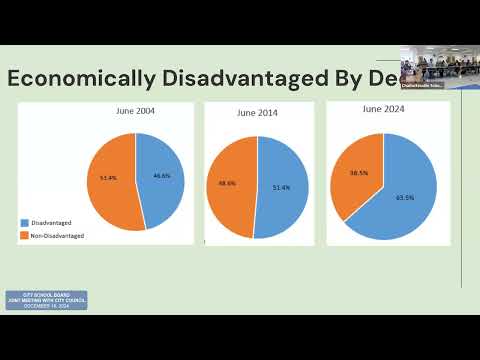
Dr. Gurley told a joint council–school-board session that changes to state accreditation — including counting ELL students’ SOL scores after three semesters instead of 11 — and rising student need (63.5% directly certified) require targeted staffing and a preliminary $7.9 million operating request.
Dr. Gurley, speaking for Charlottesville City Schools, told a joint session of the school board and city council that a change in state accountability rules will accelerate when student test scores count toward accreditation and will leave four of six elementary schools “off track” under the new system.
The superintendent said the division’s direct-certification figure is 63.5% — students directly eligible for benefits such as TANF, Medicaid or SNAP — and that the number of English-language learners has risen to roughly 757 students receiving direct services. “We have gone from 11 semesters to 3,” Dr. Gurley said of how long ELL students previously had before their SOL tests would affect accreditation, adding that the shorter timeline “is a stressor” for teachers and specialists and requires urgent changes in how supports are deployed.
Why it matters: The change means the spring 2025 test results will feed into the 2025–26 accreditation ratings. Dr. Gurley emphasized that the shift reflects a different weighting of growth, chronic absenteeism and advanced-course measures and said the division cannot assume additional state funding will follow. When asked whether the state is providing money to meet the new standards, Dr. Gurley replied, “They are not. No money comes with this.”
Budget asks and staffing: The division’s preliminary operating request totals about $7.9 million so far, Dr. Gurley said. That includes compensation and benefits (with a salary action for collective bargaining “baked into” estimates), a projected $1.1 million increase in health insurance costs tied to claims experience, and nondiscretionary increases such as maintenance and transportation. Student-improvement requests detailed in the presentation included 5.5 ESL FTEs, one additional reading specialist, three behavioral support technicians, a half-time health/medical sciences instructor, and a full-time restorative justice education specialist (filling a newly focused role).
Data points presented: as of Dec. 1, 2024 the division reported 568 students receiving special-education services; 757 students were reported receiving direct ELL services (with an overall ELL population around 800 when monitored students are included); and roughly 63.5% of students are directly certified for benefits under CEP.
Council questions and context: Council members pressed for clarity on measurement changes and whether older free-and-reduced metrics were retroactively adjusted; staff explained state definitions differ and that counts are not directly equivalent year-to-year. Dr. Gurley said the division would need to reallocate human capital and instructional resources across schools to respond to the changed timeline and rising needs.
Next steps: The school division and council will continue budget conversations in upcoming work sessions and a joint meeting scheduled for Feb. 10, 2025. The superintendent said the figures were preliminary and might be adjusted before formal adoption. The school board’s next regular meeting is Jan. 9, 2025.