
DNR tells lawmakers deferred‑maintenance crisis needs $30 million in NRAP and targeted investments for public safety and accessibility
Get AI-powered insights, summaries, and transcripts
Subscribe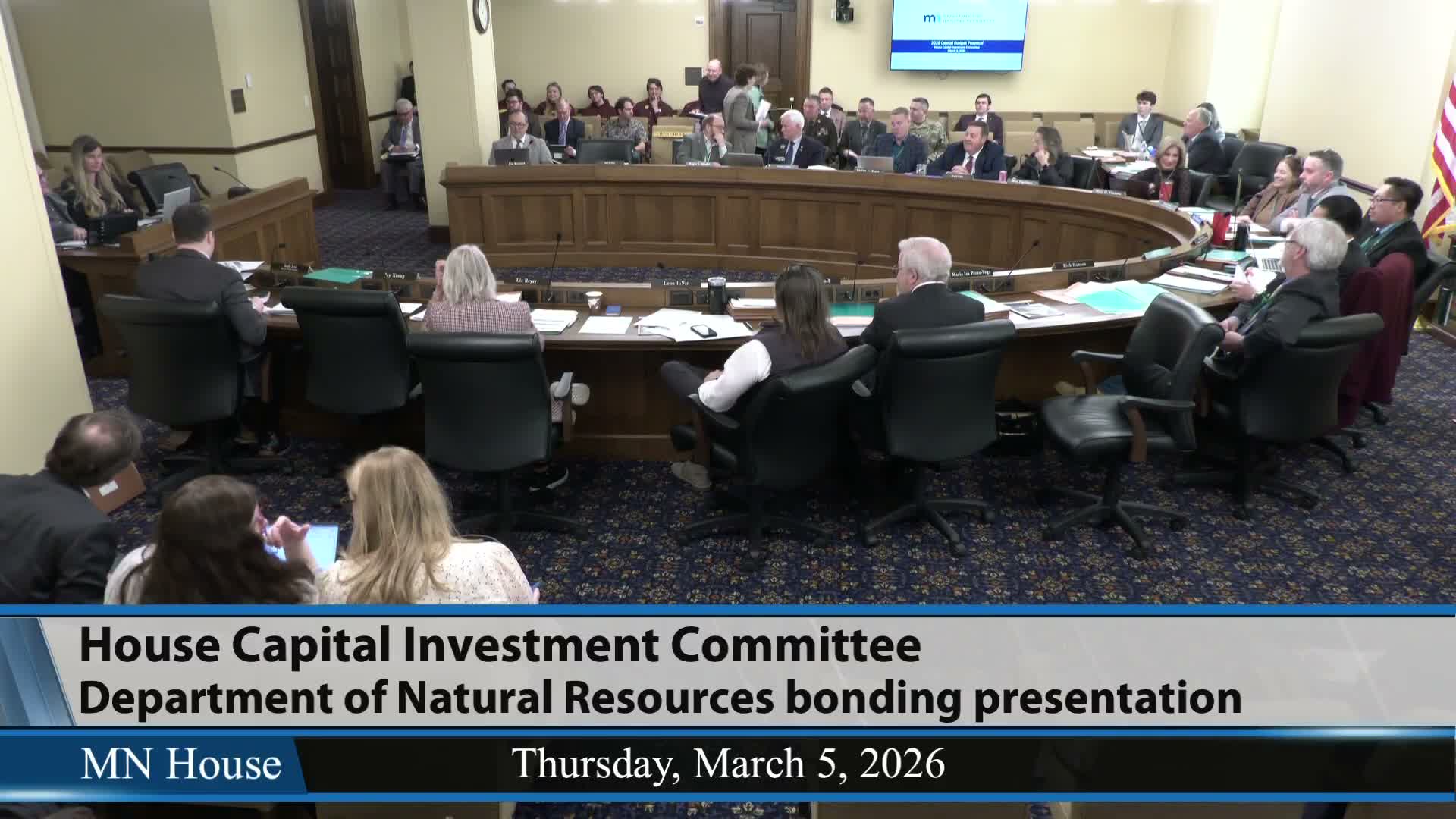
Summary
The Department of Natural Resources outlined a sweeping 2026 capital proposal — $30 million for Natural Resources Asset Preservation (NRAP), $3 million for betterment, and additional funding for wildfire response, flood mitigation, land acquisition and trails — and described a growing backlog of degraded assets.
Commissioner Sarah Stroman told the Capital Investment Committee on March 5 that the Department of Natural Resources needs substantial capital investments to address a widening deferred‑maintenance backlog across parks, hatcheries, roads and other public lands infrastructure.
Stroman said DNR manages a diverse statewide portfolio that includes more than 2,800 buildings and 5.6 million acres. "Our built assets have a current replacement value of $4,360,000,000," she told the committee, and the agency has a growing deferred‑maintenance challenge. She said DNR’s 10‑year capital asset need report guides priorities and that a programmatic, statewide approach helps the agency pivot when individual projects stall.
For 2026, Stroman described the governor’s proposal of $30,000,000 for Natural Resources Asset Preservation to repair or replace degraded infrastructure; $3,000,000 for betterment to support projects such as designing a Saint Paul fish hatchery and modernizing visitor centers; $2,000,000 for public‑lands acquisition or betterment; $5,000,000 in targeted wildfire and emergency‑response improvements at Brainerd Regional Airport; and $1,000,000 for local and regional trail grants. She also noted $213,000,000 in flood‑hazard mitigation applications awaiting funding.
Lawmakers pressed the agency on how project lists were selected and why some projects funded after the 2025 appropriation differed from earlier priority lists. Stroman said flood hazard mitigation is a competitive grant program governed by statute and that project priorities are reassessed when applications are received. She offered to provide the committee with spreadsheets and additional documentation on prioritization, matching funds, and land acquisitions.
Members raised concerns about regional balance — whether the metro receives proportionate investment compared with Greater Minnesota — and about matching practices that combine bonding, general fund and LCCMR dollars. Commissioner Stroman said DNR uses multiple funding sources strategically and that the agency can provide more written detail on fund layering and metro‑focused projects.
The committee did not take votes on DNR’s package during the hearing and invited written follow‑up.