
Minnesota National Guard requests design funding for Duluth hangar and state asset‑preservation dollars
Get AI-powered insights, summaries, and transcripts
Sign Up Free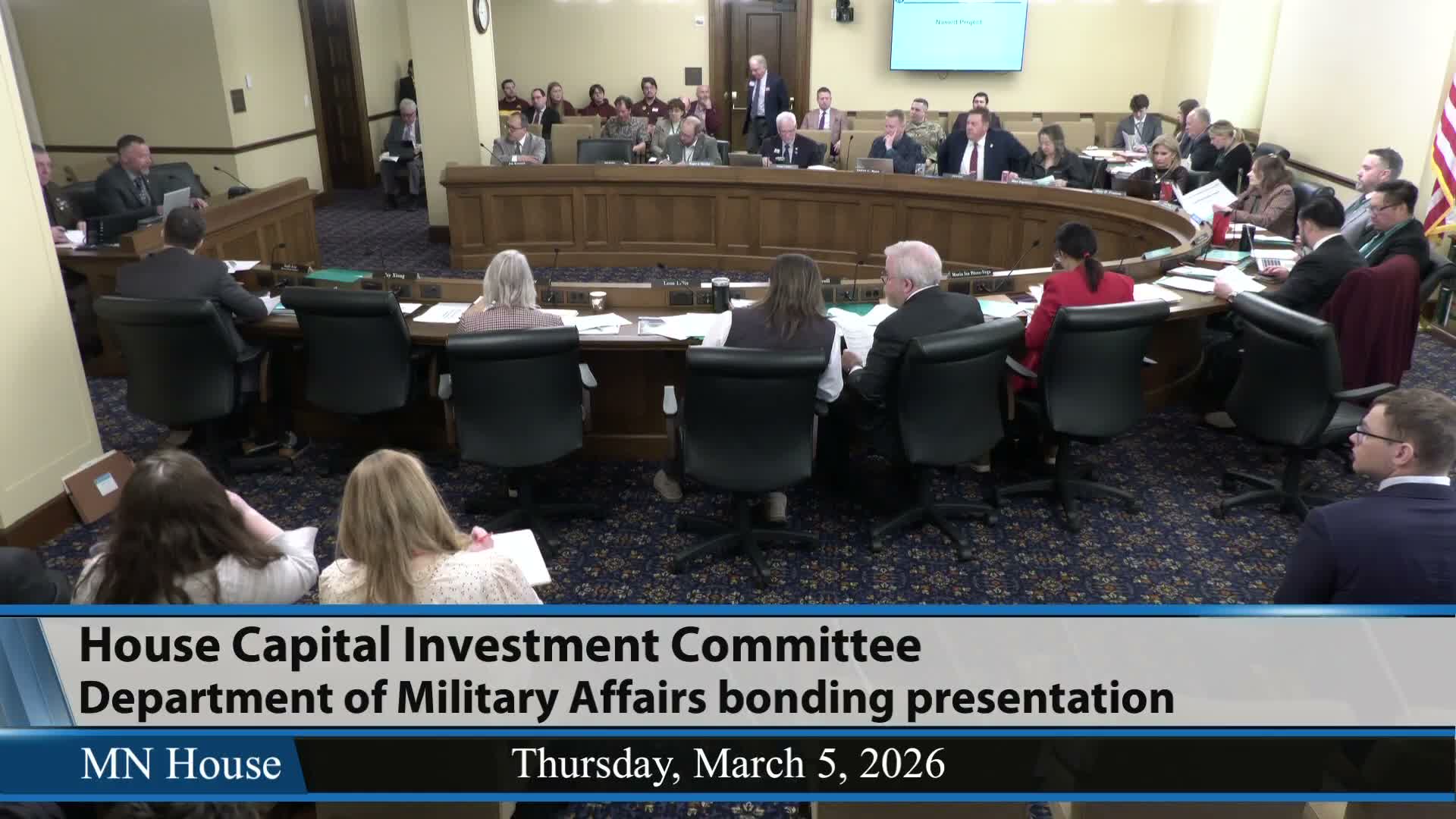
Summary
The Department of Military Affairs asked lawmakers for $3.5 million to design a new hangar at Duluth’s 148th Fighter Wing and $2.5 million for asset preservation across Guard facilities, citing aged hangars built in 1958 and a high proportion of facilities older than 60 years.
Major General Sean Manky and Scott Roehder told the Capital Investment Committee on March 5 that the Minnesota National Guard needs funding for hangar design and facility preservation across the state.
Roehder said the three hangars at the 148th Fighter Wing were built in 1958 for earlier, smaller aircraft and now suffer structural issues, water infiltration and inadequate lightning protection. "The design for this project will cost $3,500,000, and if funded, will significantly increase the scoring to compete for federal military construction funding," he said, adding that a modern hangar would make the site competitive for future aircraft missions.
Manky told lawmakers the Guard also seeks $2,500,000 in state asset‑preservation funds to leverage federal matches for repairs across roughly 60 army facilities; the department said 45% of facilities are more than 60 years old and six exceed 100 years. He said state appropriations help the Guard compete for federal construction dollars and preserve readiness assets such as local fire departments and explosive ordnance teams.
Several legislators urged caution and requested documentation showing how a state investment improves the likelihood of receiving federal construction funds. Representative Sexton asked for the referenced letter from the Air Force that was cited on slides and suggested the department coordinate with the military committee on funding structure.
The department said the $3.5 million request is for a design to reach 35% completion so the project scores better in federal funding competitions and invited follow‑up conversations and site visits.