
Committee hears proposal to authorize roughly $2 billion in transportation bonds
Get AI-powered insights, summaries, and transcripts
Sign Up Free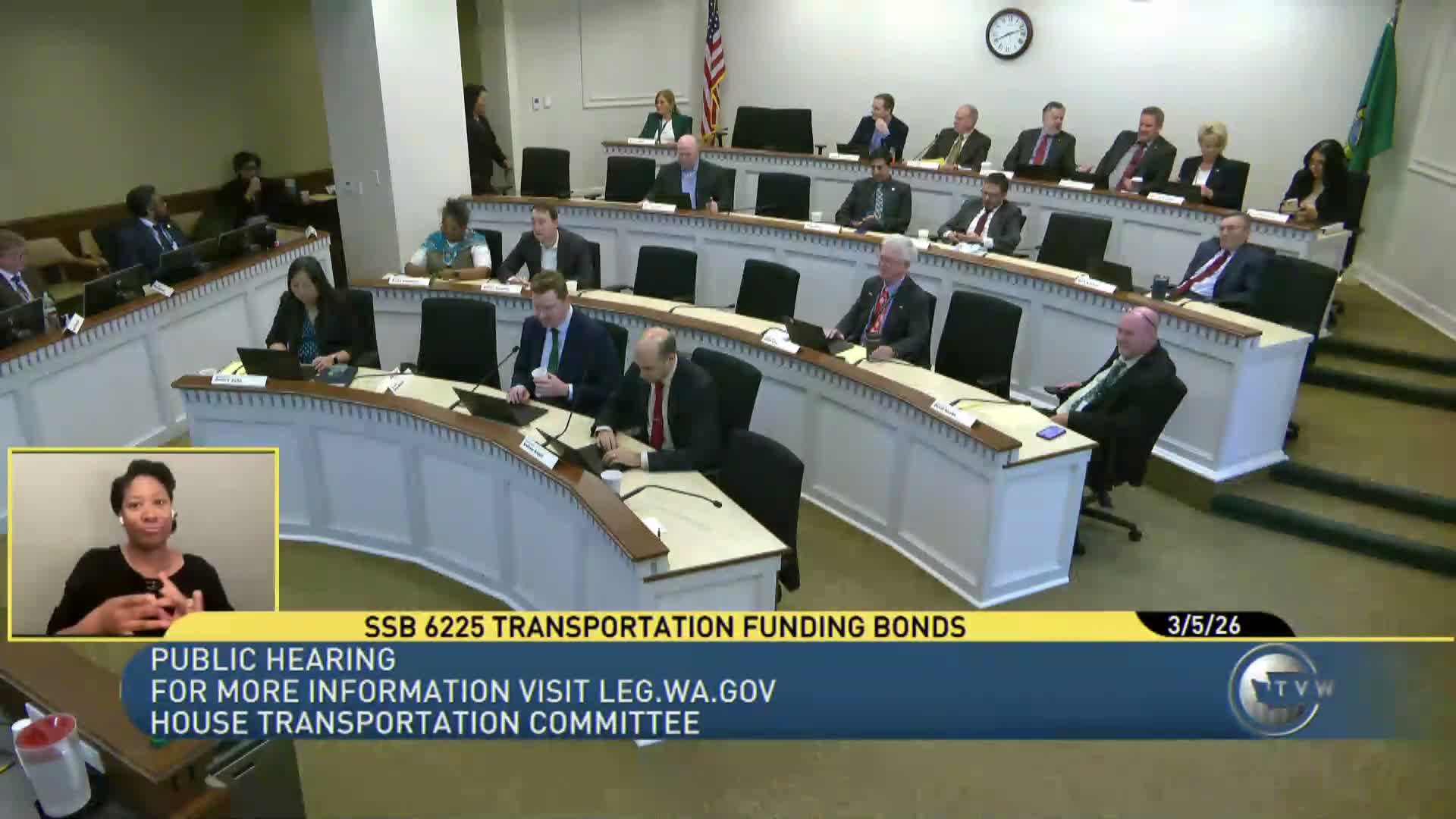
Summary
Staff briefed Substitute Senate Bill 6225, which would authorize roughly $1.1 billion in general obligation bonds plus $400 million for Move Ahead Washington projects and $500 million for SR 520—totaling about $2 billion in authorizations; members requested more detail on debt service and project allocations.
David Monicki, staff to the committee, briefed members on Substitute Senate Bill 6225, which would authorize multiple general obligation bond issuances for transportation purposes. Monicki described three components: a $1.1 billion general authorization to be deposited in the Move Ahead Washington account, $400 million targeted to complete Move Ahead Washington highway projects with construction‑cost overrun needs, and a $500 million increase in the SR 520 bond authorization. He said proceeds must be appropriated before bonds are offered and that the bonds would be primarily repaid from motor vehicle fuel excise taxes and vehicle fees and secondarily by the state’s full faith and credit.
Representatives pressed staff for a project‑level breakdown and estimates for debt service. Amy Skay (staff present for fiscal questions) told the committee that transportation bonds are typically 25‑year structures and that initial debt service would be relatively small but rise as issuance occurs. She and staff said they could provide more specific debt‑service and spending‑plan numbers for committee members by follow up.
Labor and business witnesses urged action to secure preservation funding. Billy Wallace, political legislative director for the Washington & Northern Idaho District Council of Labor, said predictable multi‑year funding — ‘‘that 6‑year level’’ — is important to retain apprentices and plan work. Ken Short of the Association of Washington Business supported limited bonding focused on preservation to provide predictability for maintenance investments.
Committee members also asked about the total arithmetic of the authorization; staff explained the package contains three authorizations that sum to about $2.0 billion and noted there are some previously authorized, partially unissued bonds that the bill would direct the State Finance Committee not to issue after June 30, 2026. No vote was taken; staff agreed to provide follow‑up numbers on debt service and project‑level allocations for the committee to review.