
Buncombe County staff outline plan for single fire tax district to spread resources across departments
Get AI-powered insights, summaries, and transcripts
Subscribe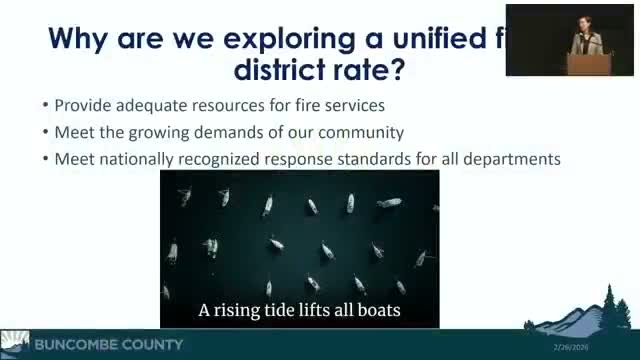
Summary
County staff proposed creating a single unincorporated fire tax district to equalize funding across local fire departments, described response standards (including a 22-firefighter response benchmark), and set a public timeline that includes a March 17 board presentation and an April 21 hearing; exact tax impacts will be set when commissioners adopt the budget in June.
Buncombe County staff presented a proposal Thursday for a single unincorporated fire tax district intended to equalize funding across local fire departments while preserving existing department operations and elected boards. Staff said the change would create a single rate on property tax bills for unincorporated residents while funds would be allocated to departments to support response standards and contracts.
County staff described response standards the fire chiefs discussed and adopted: for suburban areas, 22 firefighters on scene within 10 minutes 80% of the time; for rural areas, 22 firefighters on scene within 25 minutes 80% of the time; and a baseline of four firefighters on scene within eight minutes 80% of the time for all locations. Staff said the 22-person figure reflects the personnel believed necessary to adequately respond to a two-story, roughly 2,000-square-foot home.
The presentation emphasized that the proposal is a tax-district consolidation rather than an operational consolidation. "We're not looking to take away power from the small departments, nor are we looking to consolidate all the departments," an agency official said, adding that departments would continue to provide service under their own boards and contracts. Robin Ramsey, of the Fairview Fire Department, asked whether voters would still elect their fire-district board and whether auxiliary groups would be affected; staff replied that elections and auxiliaries would remain in place and that auxiliaries typically operate outside the department's budget.
Staff also addressed how the money would be handled. They described the structure as a single special tax district that would collect property tax receipts and then allocate funds to department service contracts; they said the county does not intend to divert the funds to unrelated county services. The presenters stressed that departments will continue to submit budgets and the Board of Commissioners will set tax rates during the normal budget process, so the exact rate and homeowner impacts are unknown until the commissioners adopt the budget in June.
Residents asked practical questions about administration and staffing. In response, staff said the county does not plan to add a new position to manage the fund and that the finance office would distribute funds in the same way it currently does (for example, dividing annual budgets into monthly or regular payments). Other questions focused on whether the change could create competition for limited resources; staff said ongoing countywide planning with fire chiefs aims to reduce competition by identifying long-term needs across departments.
Staff laid out a public-engagement timeline: the proposal will be presented to the board during a finance report on March 17; letters to property owners will begin mailing March 18; a public hearing with the commissioners is planned for April 21; and the commissioners could adopt an ordinance afterward. All meetings were scheduled for 5:00 p.m. at 200 College Street in Asheville. Staff encouraged residents to attend and offered to remain after the Skyland meeting to take one-on-one questions.
No formal motion or vote was recorded at the Skyland meeting. The next formal steps are the March 17 presentation to the Board of Commissioners and the April 21 public hearing, followed by the county budget adoption process in June, when any tax-rate changes would be finalized.