Get Full Government Meeting Transcripts, Videos, & Alerts Forever!
Get email alerts on the Public Finance topic
No spam. Unsubscribe anytime.
Midland council backs new stormwater charge but orders audit and review after massive public opposition
Summary
Faced with heated public testimony that the proposed charge amounts to a "rain tax," the council approved a plan tied to school‑related roadway work but directed a drainage‑enterprise audit and a formal council review in 12–18 months to seek offsets or rate reductions.
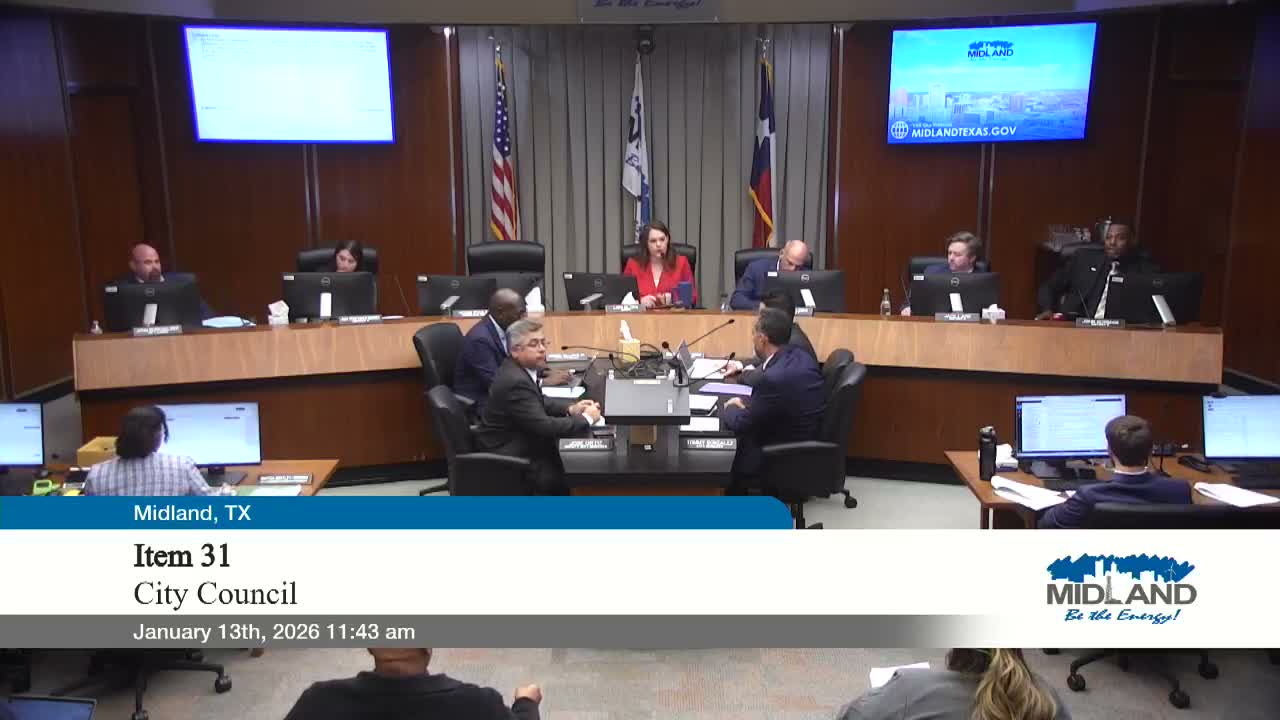
The council heard an hours‑long public hearing on an ordinance to create a municipal stormwater/drainage charge intended to fund accelerated right‑of‑way and drainage improvements tied to two Midland ISD school projects. City staff said the work is contractually linked to MISD and that after credits and internal allocations the outstanding need is "a little over $13,000,000" to complete right‑of‑way improvements and related drainage work.
Isaac Garnett of Community Development and public‑works staff walked the council through a spending and funding breakdown: the original infrastructure need was roughly $28,000,000; MISD agreed to contribute more than was required by code (about $9,000,000); the city applied $1,500,000 from the water fund and absorbed $3,000,000 in permit fees, bringing the remaining amount to approximately $13,000,000 that needs an ongoing revenue source to finance pay‑as‑you‑go work and planned payments in 2027–2029.
Speakers across the political and demographic spectrum told the council the proposal would act like a tax, that it lacked a proportional cost‑of‑service study and that it would disproportionately affect seniors and small businesses. "This is not a fee. This is a tax," said Christina Rodriguez (speaker 16). Legal and procedural concerns were raised in detail by Stanley Smith (speaker 37), who argued the charge may not meet Texas legal standards for a regulatory fee because it appears to replace general revenue obligations and lacks proportionality, avoidability and a clear cost‑of‑service link.
Council response and action
Council members acknowledged the public outcry and expressed frustration with the timing and budget choices that left the city with a funding gap. Several members said they wanted an audit of the drainage enterprise and a review of other possible offsets — including MDC funding and reallocation of existing revenue — before permanently locking in rates.
On a motion that staff pursue an audit and present options to reduce the rate and that the council consider reductions within 12–18 months, the motion passed 6–0. Councilmember comments make clear staff will move forward with the charge now but return with a detailed audit and recommended adjustments based on additional funding mixes. Council and staff repeatedly stressed contractual obligations tied to the MISD agreement and warned that unilateral refusal to pay could have legal consequences.
Key facts and next steps
- Staff estimate remaining infrastructure need after credits at about $13,000,000; payments tied to the MISD agreement are scheduled in Jan. 2027, 2028 and 2029. - The council voted 6–0 on a motion that included passing the measure with the commitment that staff will perform a drainage‑enterprise audit, explore MDC and other funding, and return within 12–18 months with recommendations to reduce rates where possible. - Residents pressed for alternatives including use of the rainy‑day fund, sale or use of city landholdings, reallocation of budget items, or requiring MISD to absorb more costs.
Voices from the meeting
- Opponents: "This is a tax — calling it a drainage fee doesn’t make it honest," said Christina Rodriguez; Stan Smith raised legal concerns about proportionality and avoidability under Texas law. - Staff and council: Staff outlined the funding math and said the city absorbed permit fees and water fund transfers to reduce the obligation; Councilmembers said they do not want to issue additional public debt and sought an audit and funding 'cocktail' to bring rates down.
What to watch for
Staff committed to a drainage‑enterprise audit and to returning to council within 12–18 months with funding options and potential rate reductions. Citizens should expect detailed reporting on audit results and funding mixes before any final permanent rate increases are made.