Get Full Government Meeting Transcripts, Videos, & Alerts Forever!
Get email alerts on the Transit Dart topic
No spam. Unsubscribe anytime.
Richardson council backs DART governance changes and authorizes GMP interlocal agreement
Summary
The Richardson City Council unanimously approved a resolution supporting a proposed DART governance framework and authorized the city manager to negotiate an interlocal agreement for a six‑year General Mobility Program intended to return funds to member cities.
The Richardson City Council on Feb. 16 unanimously approved a resolution supporting a proposed change to Dallas Area Rapid Transit (DART) governance and authorized the city manager to negotiate an interlocal agreement (ILA) to participate in a six‑year General Mobility Program (GMP).
City staff framed the measures as part of a regional effort to rebalance DART governance and return a portion of sales‑tax revenue to member cities. Don Magner, who presented the briefing, described a city‑manager working group that recommended each member city have a board seat and a weighted voting structure designed so no single city holds a majority. He said any change to DART’s governance would require the Texas Legislature to amend Chapter 452 of the Transportation Code.
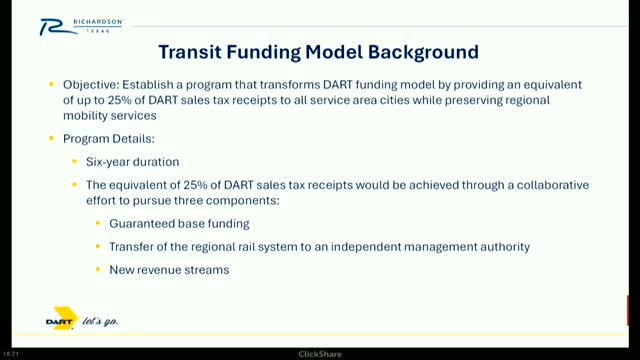
Magner told the council the GMP is a six‑year program intended to deliver a guaranteed base level of funding to member cities while preserving a regional mobility strategy. The working group’s example displayed an estimated six‑year return to all member cities totaling about $435 million, and Richardson’s estimated share was about $26.1 million over six years. Magner also summarized ILA provisions: cities must be in good standing to receive funds; funds are only eligible for DART‑approved projects consistent with Chapter 452; projects must be submitted annually by June 30; and DART retains a clawback right if terms are violated.
Gary Slagle, the DART board representative in attendance, and staff warned the council that returning large sums to member cities will have service implications. “You can’t give up $360,000,000 over the course of 6 years and not have to make some changes,” Slagle said, urging public engagement in upcoming DART hearings on proposed service changes.
Council members pressed staff on mechanics and timing. Staff explained the GMP payout uses a two‑year lookback to compute the October 1 disbursement (for example, FY26 payouts use audited receipts from earlier fiscal years). Council members asked how the funding gap might be closed; staff cited several possibilities discussed by regional partners, including transferring regional rail debt to a separate authority, county or regional taxes, state contributions, or federal funding as potential components of a broader funding strategy.
The council then moved two action items: a resolution approving the proposed amended governance structure and authorization for the city manager to negotiate and execute the GMP ILA with DART. Both motions passed unanimously.
The city will host an informational meeting on March 17 at Huffines Recreation Center and DART will hold a boardroom hearing March 24; councilmembers urged residents to attend and comment on service proposals.
What’s next: With council approval, Richardson staff will pursue the ILA negotiations and continue to participate in regional working groups; any final governance changes would require state legislative action. The DART public comment schedule and ILA details now shape local budget discussions and staff reporting requirements.