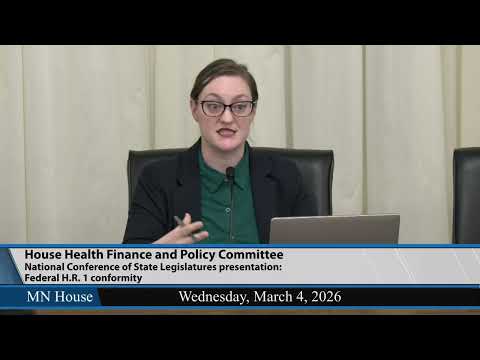
Committee ties on HF3439 conformity bill after heated debate; motion left on the table
Loading...
Summary
House File 3439, legislation to align Minnesota's Medicaid rules with the 2026 federal law, drew extensive testimony from NCSL, counties and advocacy groups; a roll-call on whether to recommend the bill tied 11-11 and the motion was left on the table for further work.
The Minnesota House Health Finance and Policy Committee heard author remarks, expert testimony and county concerns about House File 3439, a bill drafted to conform Minnesota statute to federal Medicaid changes in the 2026 law (referred to in the hearing as OB3/HR1).
Representative Nadeau, the bill author and vice chair of the committee, framed HF3439 as a committee bill intended to guide state implementation and said she was open to oral amendments and technical fixes. She walked members through provisions that would change expedited eligibility, shorten retroactive eligibility for the expansion population, require periodic review of the Social Security death master file, limit noncitizen eligibility to categories allowed under the federal law and incorporate six-month redeterminations for expansion enrollees.
Scott Centorino, a visiting fellow at FGA Action who worked on federal welfare provisions, urged the committee to support the bill as a way to reduce improper payment rates and limit state fiscal exposure to federal recoupment. County witnesses from the Association of Minnesota Counties warned that the bill would substantially increase county workloads, strain outdated technology and impose new local costs: Angela Jungerberg, a county consultant, estimated a recurring county expense in the range of $6 million to $10 million per year to handle the added renewals and manual work if automation is not possible.
Opponents and skeptical members argued the bill was being rushed and risked denying care to lawfully present refugees, asylees and other noncitizen categories. Representative Liebling objected on the record to moving the bill quickly and vowed to vote no, saying the bill "is not about covering anybody or helping anybody access care" but instead would cut coverage.
After debate, the committee conducted a roll-call vote on the motion to recommend HF3439 to the Human Services Finance and Policy committee; the vote tied 11-11. The chair said the motion was tied and directed that the bill be left on the table (laid open) rather than advanced.
The hearing record shows significant outstanding questions — including timelines for the death-master-file process, the scope of exemptions for native populations, and county-level fiscal impacts — which members said should be resolved before any final recommendation.
The committee will consider additional work and possible amendments when it reconvenes.