Nebraska senators adopt committee amendment to raise cigarette, vaping taxes amid debate over regressivity and cash‑fund protections
Loading...
Summary
After hours of floor debate over equity and oversight, the Nebraska Legislature adopted Revenue Committee amendment AM 22‑53 to LB 11‑24, adding $1 to the cigarette pack tax and a 30% wholesale tax on vaping products while creating a Medicaid expense offset cash fund; the amendment was adopted 29–9.
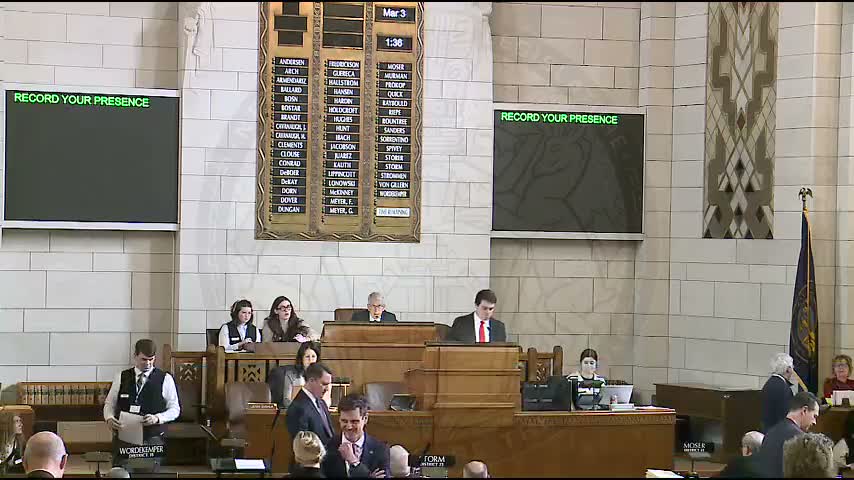
The Nebraska Legislature on March 3 adopted a revenue committee amendment (AM 22‑53) to LB 11‑24 that would raise the state cigarette tax by $1 per pack and impose a 30% wholesale tax on vaping products, creating a new Medicaid expense offset cash fund to be administered by the Department of Health and Human Services.
The measure’s sponsor and committee supporters argued the change targets the health‑care costs linked to tobacco and nicotine use. “We can expect nearly $45,000,000 in annual revenue to help offset Medicaid expenses and approximately $8,000,000 in new general fund revenues,” Senator Von Gillen told the body while opening on the amendment. He asked colleagues to advance the bill to select file after adoption of the amendment.
Opponents pressed two central objections: (1) the tax is regressive and would fall hardest on lower‑income Nebraskans and (2) the newly created cash fund lacks durable guardrails to prevent future sweeps into the general fund. “This is about balancing the budget on the backs of those who can least afford it,” Senator Conrad said during debate. Senator Duncan warned the body that prior cash funds, including the Managed Care Organization Excess Profit Fund, had reporting gaps and argued the legislature needs clearer oversight before directing new revenues into a separate account.
Senator Sorrentino, the bill’s floor introducer, explained the revenue design on the floor: roughly 97¢ of each added dollar would flow to the Medicaid expense offset cash fund and 3¢ would remain in the general fund to cover administrative costs. “There are certain administrative expenses that I didn't want to hoist upon the general fund, so we allocated just a small amount,” he said while noting the updated fiscal note was not yet posted on the floor when members were asking for details.
The amendment also folded in Senator Hughes’ proposal to simplify and raise the tax on electronic nicotine delivery systems. Hughes explained that replacing Nebraska’s bifurcated vape tax with a uniform 30% wholesale rate would reduce complexity and bring retail parity closer to cigarettes: “One milliliter of vaping liquid is equivalent to nicotine about a pack of cigarettes,” she said, noting the amendment reduced her earlier 40% proposal to 30% after stakeholder discussions.
Floor action included a series of procedural votes. A motion to indefinitely postpone the bill (IPP) failed earlier in debate (the body did not adopt IPP). Later, after extended floor discussion and a brief period when the chamber was placed under call for a roll‑call to cease debate, the legislature voted 29–9 to adopt AM 22‑53. Following adoption, sponsors indicated intent to advance LB 11‑24 to select file.
Supporters framed the proposal as a user‑pays approach that addresses Medicaid costs generated by tobacco use; critics said the fiscal note and allocation language require clarification and that protecting health‑directed revenues from being swept later is essential. Multiple senators asked for a revised fiscal note to reconcile allocations (for example, existing distributions such as the 64¢ current tax allocation and whether funds like the Nebraska Public Safety Communication System cash fund were properly accounted for).
What happens next: With AM 22‑53 adopted, sponsors asked that LB 11‑24 be advanced to select file for further floor consideration and amendments. Several senators said they would pursue changes to tighten earmarks and reporting, or to revisit the distribution between the new cash fund and the general fund before a final vote on the bill.
Quotes (selected)
“97¢ of the total dollar…goes to the Medicaid expense offset cash fund,” Senator Von Gillen said in his opening on the amendment.
“This is about balancing the budget on the backs of those who can least afford it,” Senator Conrad said opposing the bill.
“One milliliter of vaping liquid is equivalent to nicotine about a pack of cigarettes,” Senator Hughes said explaining the vape‑tax change.
Actions at a glance
- Motion: Indefinitely postpone LB 11‑24 (IPP). Outcome: not adopted (IPP failed). (Floor roll calls occurred during debate; clerk recorded votes on procedural motions.) - Motion: Adopt committee amendment AM 22‑53 (Revenue Committee). Outcome: adopted, 29 ayes, 9 nays; sponsors asked to advance LB 11‑24 to select file.
Context and key numbers drawn from debate
- Appropriations/financial context cited on the floor: an original budget shortfall of $471,000,000 in January, an additional $175,000,000 reduction in forecasts (totaling about $646,000,000) before committee actions; the Appropriations Committee reported finding roughly $520,000,000 in adjustments, leaving an estimated $125,000,000 shortfall in the budget as debated on the floor. - Senator Von Gillen’s floor estimate for the amended bill: approximately $45,000,000 annually directed to the Medicaid expense offset cash fund and about $8,000,000 in new general‑fund revenue from the change.
Why it matters
The floor action shows the Legislature is wrestling with how to close a projected budget gap while also responding to public‑health concerns about tobacco and youth vaping. The debate highlighted competing priorities: raising revenue to help cover Medicaid and other state obligations, protecting low‑income Nebraskans from regressive tax burdens, and ensuring that any new cash fund includes enforceable oversight to keep money flowing to the intended health purposes.
Sources: Floor debate and clerk roll calls during the March 3, 2026 session of the Nebraska Legislature (George W. Norris Legislative Chamber).