San Juan County to seek state HB2015 grant to fund two deputy positions and training
Loading...
Summary
County staff told the council they plan to apply for HB2015 funds to support two deputy positions, outlining a proposed $531,600 request covering wages, equipment, training and vehicle upfitting; council discussed long‑term funding options including a sales‑and‑use tax.
Deputy County Manager Tillery Williams briefed the council on the state HB2015 public‑safety grant program, which the Washington State Criminal Justice Training Commission opened in January and will run in multiple rolling funding rounds.
Williams said the program can cover hiring, retention and training of law‑enforcement officers and co‑response behavioral‑health personnel and that jurisdictions must meet state model policy, training and data‑reporting standards to receive awards. She said the program is largely reimbursement‑based, and staff noted the verification process will be administratively heavy.
"So what we would be asking for for this funding round would be about a total of $531,000 which would cover 2 additional deputy positions," Williams told the council, providing a per‑position breakdown: wages and benefits about $150,000, uniforms roughly $3,000, equipment and training, and vehicle upfitting (total about $265,800 per person).
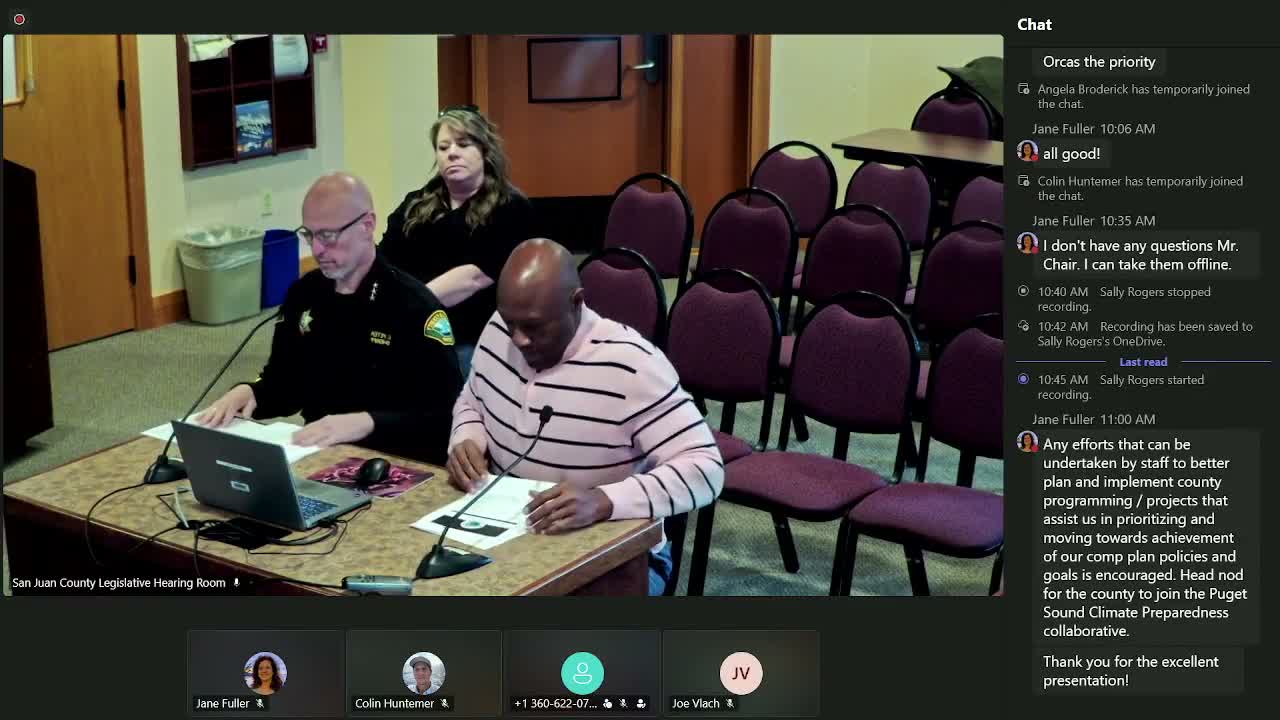
Sheriff Eric Peter described the department’s training and staffing gaps and the operational constraints of sending officers to required courses. “We need 4 more deputies because we need 25% of our staff to go through the 40‑hour scribe intervention training,” the sheriff said, and outlined instructor and defensive‑tactics course schedules the office has been organizing.
Council members pressed staff on sustainability and long‑term funding if positions are created with one‑time grant money. Williams and the sheriff said the sales‑and‑use tax option included in the law is intended to allow jurisdictions to fund positions long term, but the tax must be implemented locally and there are tradeoffs to consider. Councilmember McVay asked whether the state intends to allow jurisdictions to return annually for operating funds; staff said the sales‑and‑use tax was designed to be a local option to sustain positions once grant money ends.
Council did not take a formal roll‑call vote during the presentation but confirmed prior direction to staff to complete the grant authorization process so the county can apply. Williams said staff will keep the auditor’s office informed and bring any required budget amendment forward if funds are received.
Next steps: staff will complete the application and continue working with the sheriff to assemble verification materials; if the county is awarded funds, staff will return with a recommended budget amendment and implementation plan.