
Pierce County executive notifies council it may tap $180,000 contingency after pass-through grantee rejects federal terms
Get AI-powered insights, summaries, and transcripts
Subscribe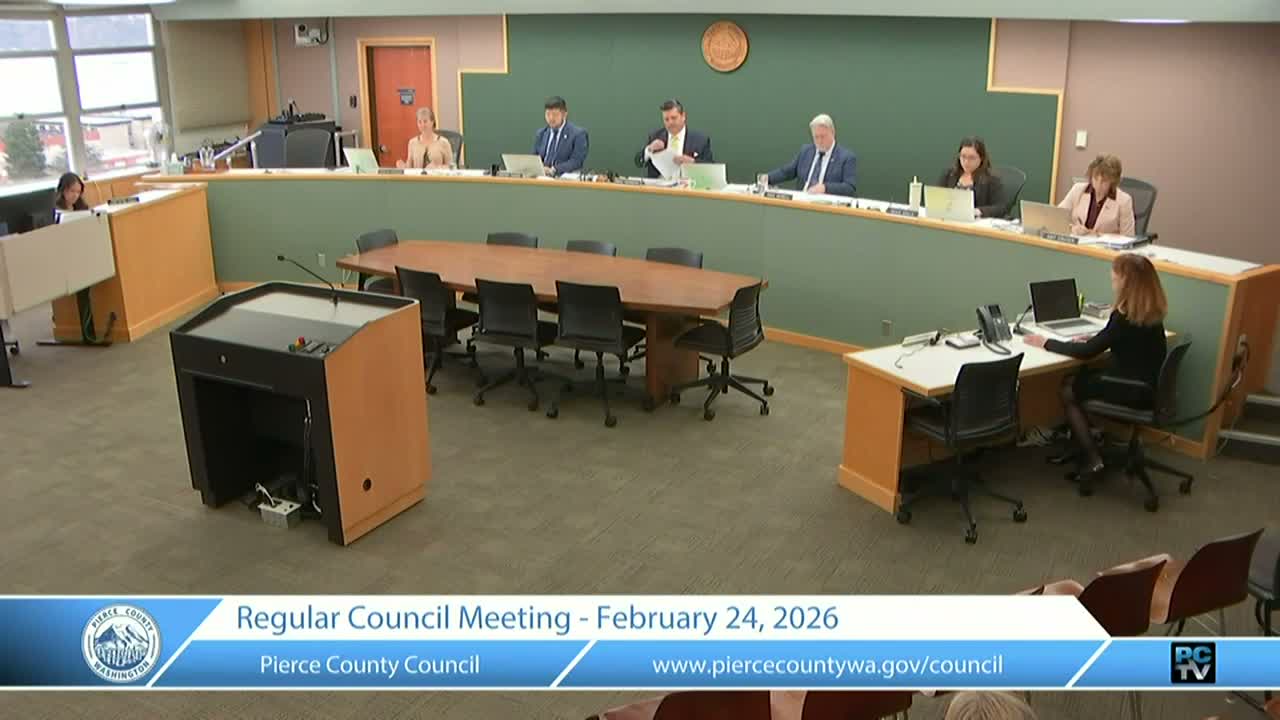
Summary
Julie Murray told the council the executive plans to allocate up to $180,000 from a federal funding contingency to the juvenile court after a nonprofit pass-through grantee declined grant terms tied to a federal executive-order condition; the action is a notification, not a council approval.
The Pierce County executive notified the County Council on Feb. 24 that it intends to allocate up to $180,000 from miscellaneous current expense federal funding contingency to the juvenile court after a pass-through grantee declined funding tied to contested federal conditions.
Julie Murray, counsel to the executive, said the county returned a subrecipient agreement after a nonprofit implementing partner would not accept a special condition the county viewed as objectionable. "We have a preliminary injunction that enjoins Health and Human Services from requiring us to comply with certain objectionable executive orders," Murray said, describing litigation in Turner v. King County and related cases.
Murray told the council the particular condition referenced what she described as "the executive order on gender ideology" and other requirements that could affect forms, employee resource groups and trainings. She described a months-long negotiation with the nonprofit and said the county chose to use contingency funding rather than litigate the partner into compliance: "Rather than do that, we chose to access this funding that's available because we just couldn't meet, you know, make meeting of the minds with our grantor."
Council members probed whether using contingency funds in this way sets a precedent and asked about the county's dependency on federal grants. Murray said the county receives many federal awards across agencies — ‘‘When you consider the money that we get, for our roads and infrastructure... we've compiled that data last year. It's about $100,000,000 a year’’ — and explained the county's approach for asserting its preliminary-injunction rights at application or award stages.
Murray warned that the federal government's practices vary by program and that the Ninth Circuit appeal in the Turner-related litigation could change the county's options. "If we lose the preliminary injunction in its entirety, there are going to be some awards that we have to reject because of like a legal impossibility," she said, noting that an adverse ruling could force the county to decline certain federal funds or use contingency funds to preserve services in the short term.
Vice Chair Herrera read the executive's message into the record as a notification; the council did not take an approval vote because the notice was informational. Murray said the county will continue to assert its injunction in direct-recipient awards and will evaluate each pass-through situation on a case-by-case basis.