
Education First outlines elementary recommendations for Rochester Public Schools' 2030 strategic plan
Get AI-powered insights, summaries, and transcripts
Subscribe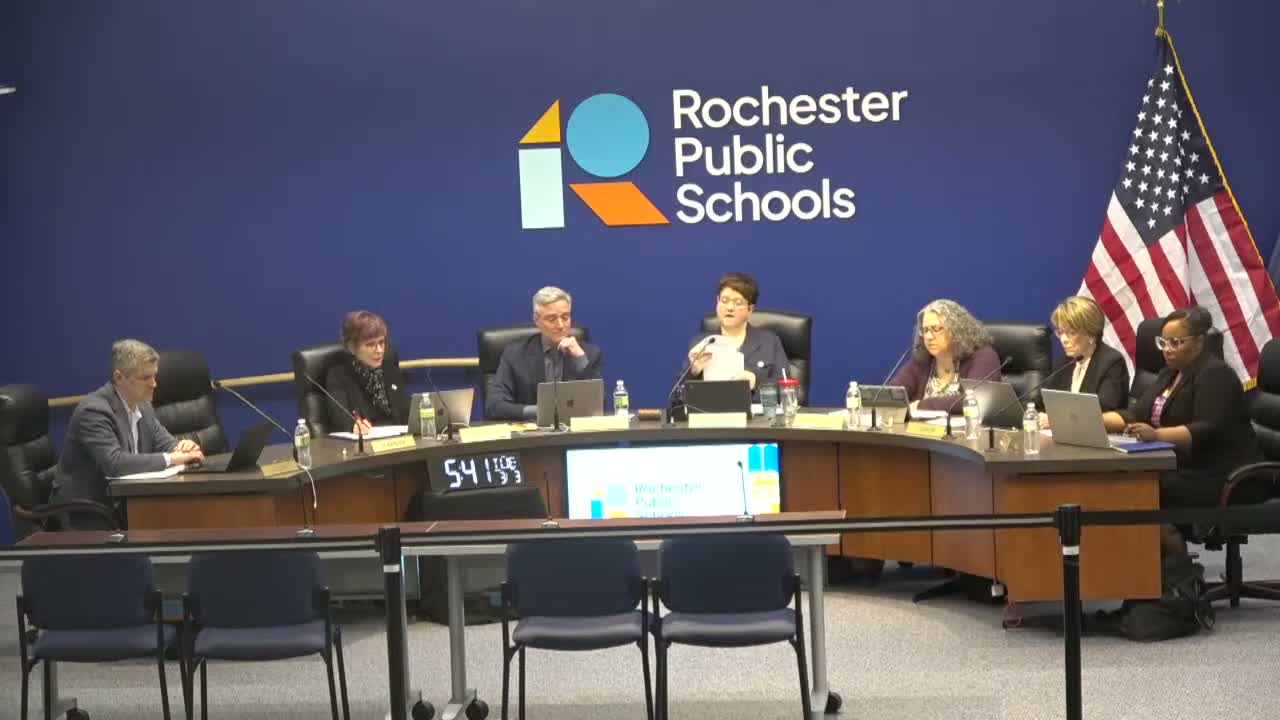
Summary
Education First consultants presented RPS' elementary and early childhood recommendations focusing on four priorities — academic rigor, navigation supports, engaging offerings, and relationships — and the board discussed feasibility, class‑size targets and possible expansion of K–8 options.
Consultants from Education First presented the elementary and early childhood recommendations for Rochester Public Schools' RPS 2030 strategic plan at the board's March 3 meeting, urging the district to strengthen core instruction while improving transitions and family access to programs.
"We found the problems and solutions generally fell into four priority areas," Joe Anderson, the Education First facilitator, told the board, listing academic rigor and relevance; navigation supports; engaging offerings; and relationships and belonging as the plan's organizing priorities. Anderson said the elementary committee relied on interviews with 46 district and community stakeholders and 319 public survey responses to shape 43 proposed strategies.
The consultants recommended boosting multi‑tiered systems of support (MTSS) for math and literacy, standardizing progress monitoring and assessments, expanding play‑based learning in kindergarten and first grade, increasing job‑embedded professional development for teachers, and auditing the district's assessment load. Anderson also said the committee recommended studying the feasibility and family interest in expanding K–8 school options and in creating specialized program models (for example, language immersion, STEM or arts schools).
Superintendent Kent Picow said the recommendations aim to build on existing work — including recent literacy materials and an upcoming math adoption — and to produce an implementation plan with priorities and cost estimates before the end of the school year. "We will be taking these recommendations ... and working toward presenting you with a high level set of priorities by the end of this school year and a detailed plan by next fall," Picow said.
Board members pressed on implementation and cost. Director Cook asked whether the committees had considered the financial reality of proposed strategies; Anderson replied that the design teams used a feasibility lens and had ballpark cost ranges but did not perform a full financial analysis. Picow said the board will be asked to approve high‑level priorities in May and staff will use the summer to translate them into human‑capital and budget options.
Several members focused on class size and staffing trade‑offs. Picow noted current bargaining language limits some workload measures and said the district's labor‑management committee is mapping class‑size distribution as part of future decisions. Director McLaughlin and others said the navigation‑supports concept — better advising and coherent transitions from early childhood into K‑1 — was a valuable reframing of the district's priorities.
Board members and the consultant emphasized combining committee recommendations with practical constraints. Anderson urged distinguishing between system and school actions and suggested codifying model practices already succeeding in district schools so they can be scaled. The board took no formal action on the recommendations at the meeting; the strategic plan process will continue with additional presentations for middle and high school options in upcoming meetings.