Get Full Government Meeting Transcripts, Videos, & Alerts Forever!
Get email alerts on the Housing Element topic
No spam. Unsubscribe anytime.
Environmental Action Network tells Island County draft housing element risks GMA noncompliance
Summary
Marnie Jackson of Environmental Action Network told the Island County Board of Commissioners the 2025 draft housing and land-use elements include provisions that could be found noncompliant with the Growth Management Act, urging restored mandatory language and limits on rural clusters and ADUs.
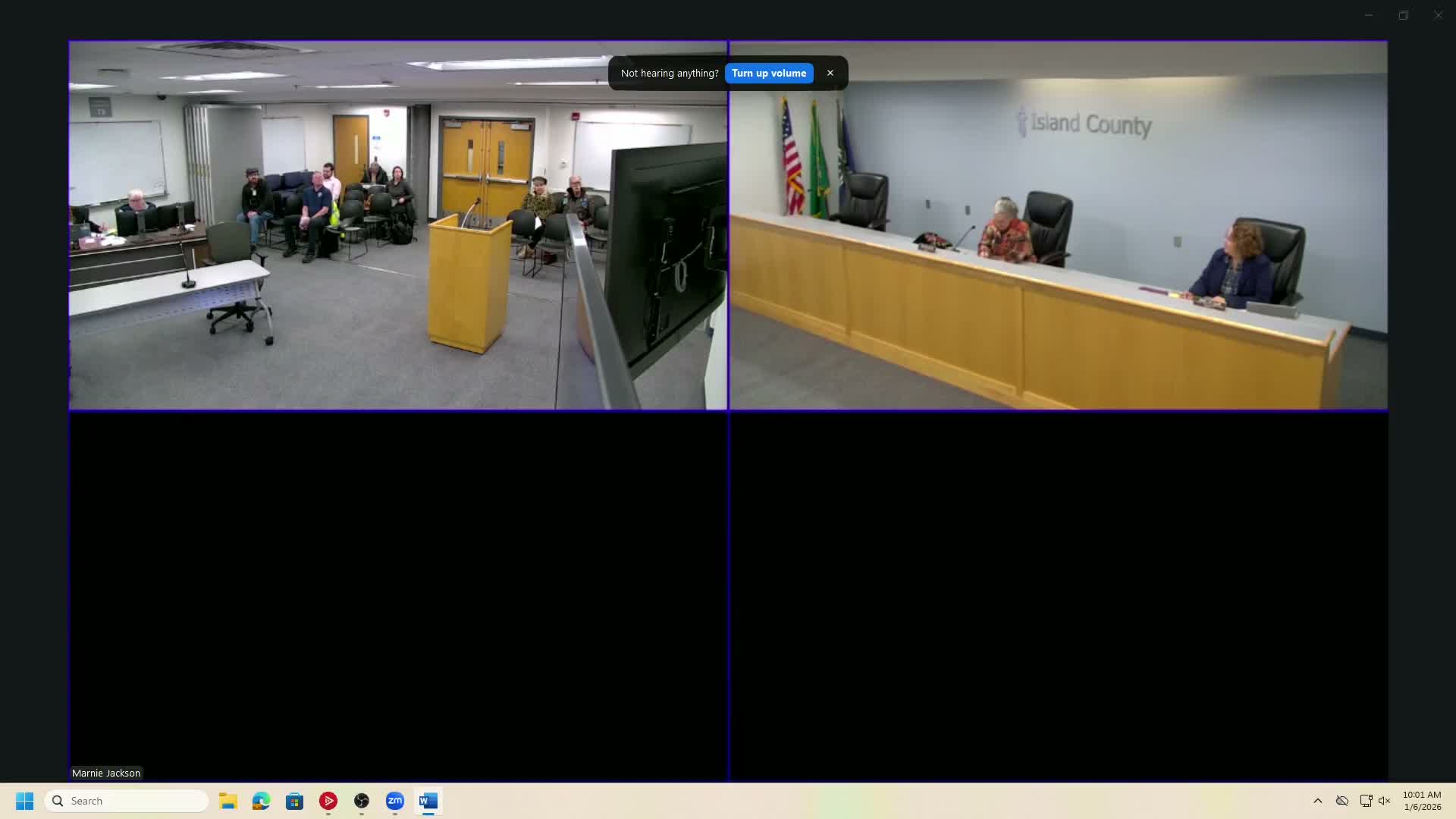
Marnie Jackson, a member of Environmental Action Network, told the Island County Board of Commissioners on Jan. 6 that the county's 2025 draft housing and land-use elements contain a "poison pill" that could trigger a finding of noncompliance under state growth-management law.
"The proposal for rural clusters with a density of 4 units per acre in rural and resource zones violates the GMA's bright line against rural sprawl," Jackson said, urging the board to limit rural clusters to deed-restricted affordable housing and to retain mandatory policy language that would allow the county to deny quasi-urban development.
Jackson cited what she described in the meeting as "RCW 36.708 0.07," and argued that replacing mandatory protections with discretionary language (she pointed to a strike of "policy 1.4") would render county safeguards unenforceable. She also warned that permitting additional detached accessory dwelling units and unit-lot subdivisions could fragment landscapes without guaranteeing affordability.
County commissioners acknowledged receipt of Jackson's emailed recommendations. One commissioner said the board would review Jackson's table of revisions with staff at a work session scheduled the next day and encouraged the public to consult the comprehensive planning webpage and the posted public-input compendium.
A commissioner who spoke during the meeting described the board's broader constraint: meeting state-mandated housing allocations while trying to protect rural character. That commissioner said the board had voluntarily adopted a climate element and has directed staff to embed climate, health and equity considerations across policies and budget proposals rather than to pursue a symbolic declaration.
The board did not take immediate action on the housing element during the Jan. 6 session; staff and commissioners said they would address public comments in the upcoming work session and subsequent hearings.