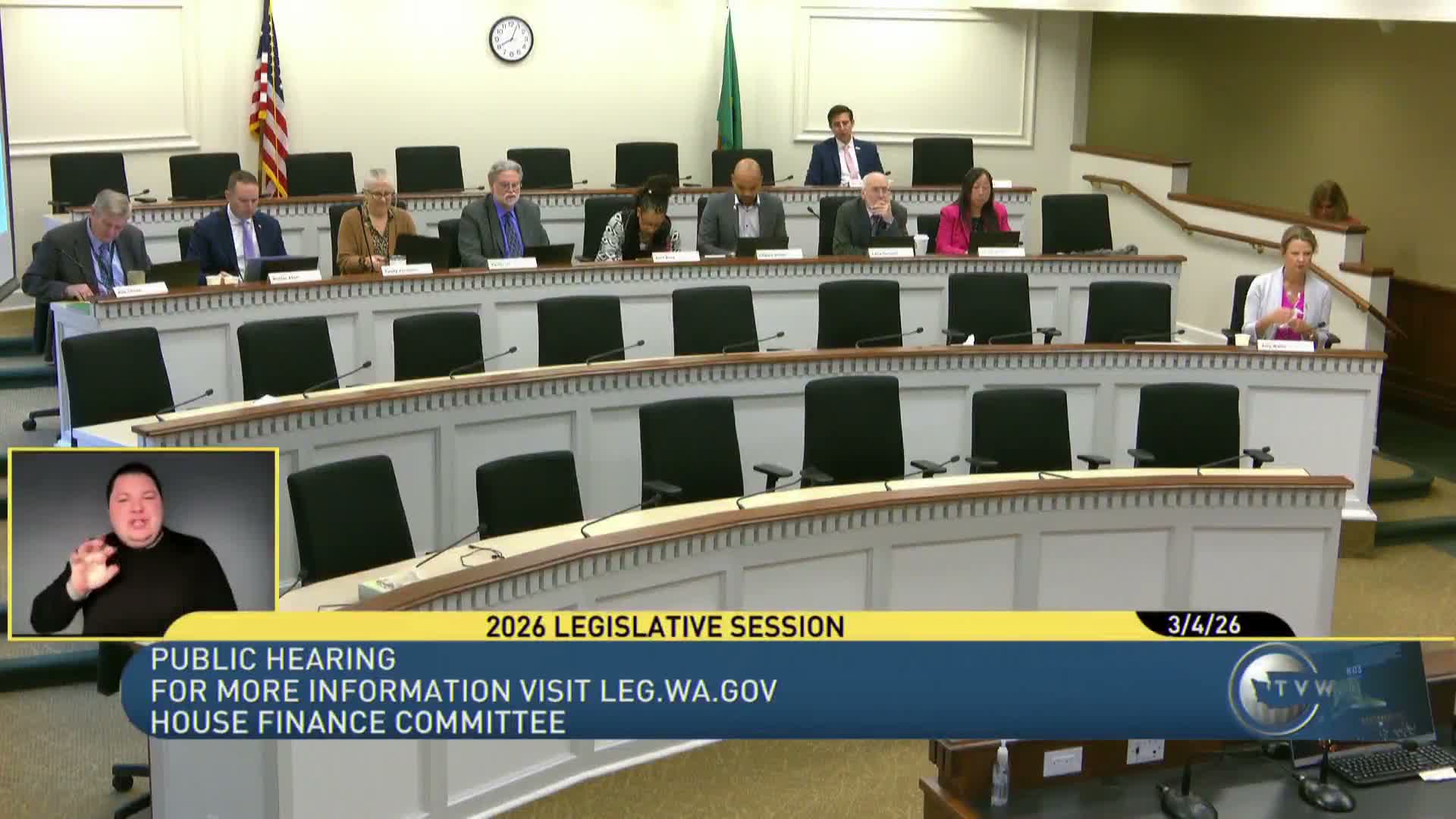
Committee hears split testimony on bill to raise cigarette and nicotine taxes, restore public-health funding
Loading...
Summary
House Finance heard detailed staff and sponsor briefings on SB 61-29, which would raise the cigarette tax to $5 a pack, impose a 95% tax on nicotine products by price, and direct up to $10 million a year to youth prevention; public-health groups supported the bill while retailers and some industry groups warned of regressivity and illicit-market risks.
Senators and staff told the House Finance Committee on March 4 that engrossed substitute Senate Bill 61-29 would raise taxes on cigarettes and other nicotine products and realign revenue to public-health accounts.
Rochelle Harris, committee staff, outlined the mechanics: the bill adds an additional cigarette tax of 9.8575¢ per cigarette — raising the tax to a $5 pack of 20 effective Jan. 1, 2028 — and, beginning Jan. 1, 2027, replaces the existing per-milliliter and OTP rates with a single tax set at 95% of the taxable selling price for products containing nicotine or a nicotine analog. The measure also caps and redistributes vapor-product revenue among the Andy Hill Cancer Research account and the Foundational Public Health Services account, and sets aside the first $10,000,000 from the new cigarette tax each fiscal year for a youth tobacco and vapor-products prevention account, Harris said.
Sponsor Sen. June Robinson told the committee the bill is intended to fix an "unintended diversion" of public-health funding and to tax nicotine products more equitably, with the public-health benefit of discouraging youth initiation. "My goals in this legislation are to fix the revenue filing for the foundational public health services account and the Andy Hill care fund account," Robinson said during her brief remarks.
Public-health and medical groups largely supported the measure. Dr. Beth Ebel, representing Washington pediatricians, urged passage and cited modeling testimony provided to the committee: "An increase by $2 will bring down youth smoking by 13%. Five thousand seven hundred kids will not start, thanks to you," Ebel said. Tim McAfee, a physician with tobacco-cessation experience at the federal level, said the $10 million annual prevention allocation is especially important in the current federal-policy environment.
Advocates argued that higher prices reduce youth initiation and that restoring targeted revenue will stabilize prevention and cessation programs statewide. Megan Moore of the Washington State Public Health Association told the committee that a Department of Revenue ruling had cost the foundational public-health services account an estimated $21 million per year and that the bill would help return funding.
Retailers, trade groups and some industry witnesses opposed aspects of the bill. Max Martin of the Association of Washington Business warned the proposal may be regressive and could push consumers to cross-border or illicit purchases. Crystal Leatherman of the Washington Retail Association raised a practical concern about holding retailers responsible if a distributor becomes unlicensed: "A retailer can place an order with a licensed distributor in the morning. That distributor becomes unlicensed later that day. Why would the retailer be held responsible for making a good-faith purchase?" she asked.
Speakers also disagreed about the treatment of vapor products. Staff said SB 61-29 narrows the vapor-product tax to certain products and sets distribution caps for the Andy Hill and Foundational Public Health Services accounts, while opponents warned the proposal could drive sales underground and impose disproportionate costs on lower-income consumers.
The committee did not take action on the bill. Chair Berg closed testimony and announced amendment deadlines; any next steps will be set by the committee schedule.