CDTFA seeks new funding to police illicit cannabis and flavored tobacco sales
Loading...
Summary
CDTFA asked the Assembly Budget Subcommittee for targeted funding to support enforcement of cannabis, intoxicating-hemp and flavored-tobacco rules, citing continuing illicit market activity and recent laws (AB195, AB8, AB3218, SB1230) that expand seizure and penalty authority.
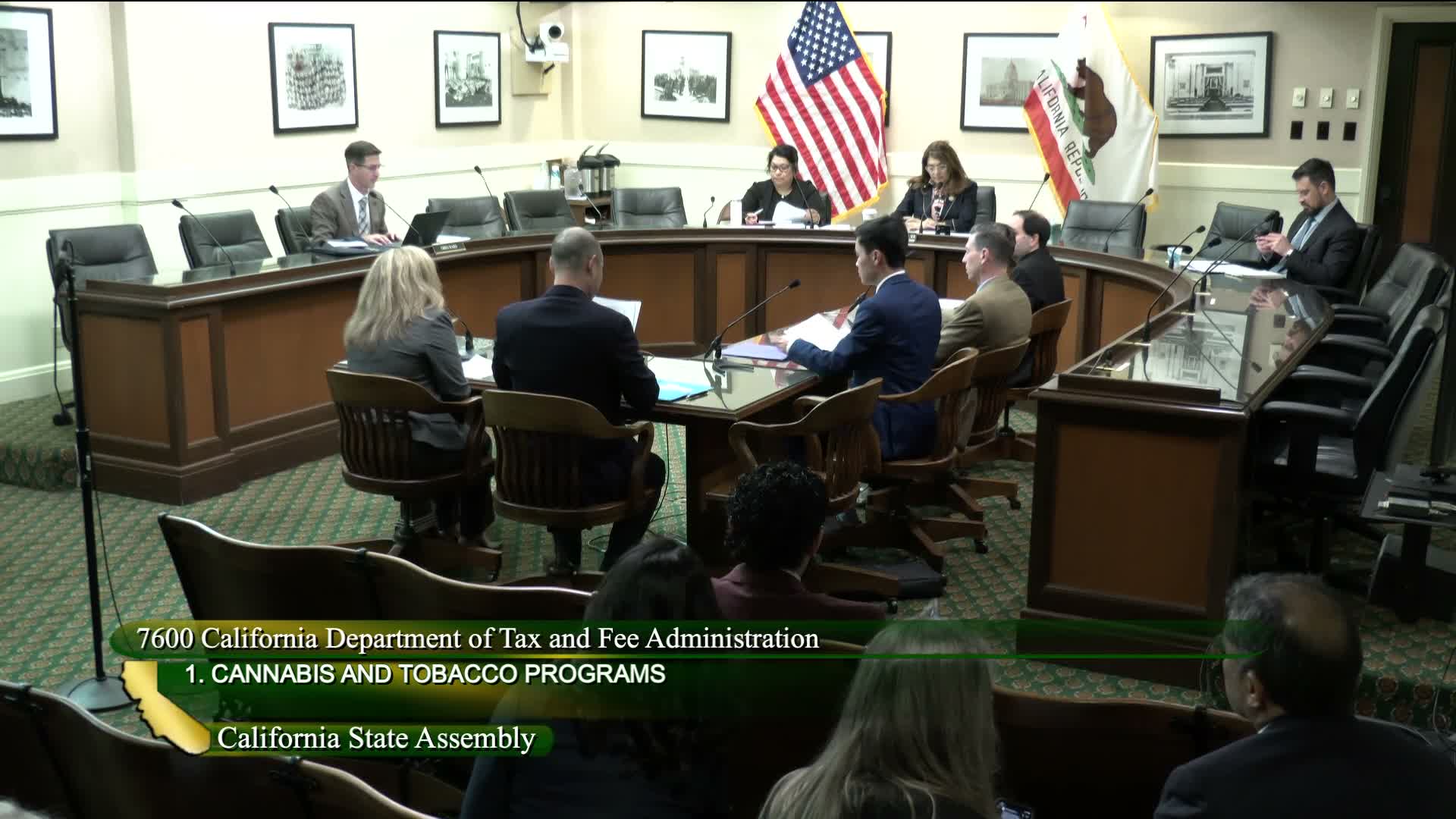
The California Department of Tax and Fee Administration told the Assembly Budget Subcommittee it needs additional resources to enforce new cannabis and flavored-tobacco laws and to shrink a persistent illicit market.
"We have steadily improved our efficiency," said Trista Gonzalez, director of CDTFA, but the agency described ongoing challenges bringing illicit sellers into the legal market while ensuring collectors remit the correct taxes. Jason Mallett, CDTFA chief financial officer, said the department administered 42 tax and fee programs that generated about $98,000,000,000 in FY24–25 and that enforcement protects roughly $1 billion in cannabis revenues and broader public-health interests.
CDTFA proposed a $5,600,000 budget change proposal (BCP) from the cannabis tax special fund to cover enforcement activities and to eliminate an annual shortfall the general fund had previously covered. For AB8 implementation — which bans tobacco licensees from possessing or selling cannabis or intoxicating hemp and phases intoxicating hemp into the cannabis tax framework — CDTFA requested $3,300,000 in 2026–27 split between the cigarette and tobacco compliance fund and the cannabis tax special fund to cover inspections, citations, seizures and due-process work.
The Legislative Analyst's Office cautioned that how much the state should spend on these enforcement activities is a policy decision and raised equity and efficiency concerns about relying on general fund support for cannabis tax program operations. "We recommend the legislature adopt the proposal with modifications," LAO analyst Seth Kerstein said, urging the Legislature to shift cannabis program funding from the general fund to the cannabis tax fund and to reduce general-fund appropriations accordingly.
Committee members pressed CDTFA on enforcement metrics and fund use. CDTFA said it conducted roughly 590 cannabis inspections last fiscal year (about 440 at tobacco retailers and convenience stores and 150 at cannabis dispensaries) and reported retail seizure values of about $17,000,000 last year. Agency officials said many seizures originate from referrals by the public, lawmakers and law enforcement.
Public comment included industry support for stronger enforcement: Amy O'Gorman Jenkins of the California Cannabis Operators Association said her group "strongly supports the proposed investments in cannabis tax compliance" and urged continued focus on illicit-market activity.
The hearing produced no formal vote; members asked follow-up questions and LAO recommended several budget and statutory changes to align funding with legislative intent. The committee moved on to other agenda items with requests that agencies provide additional detail in follow-up materials.