
Assembly committee advances bill to limit local officers' secondary work with DHS amid broad debate
Get AI-powered insights, summaries, and transcripts
Subscribe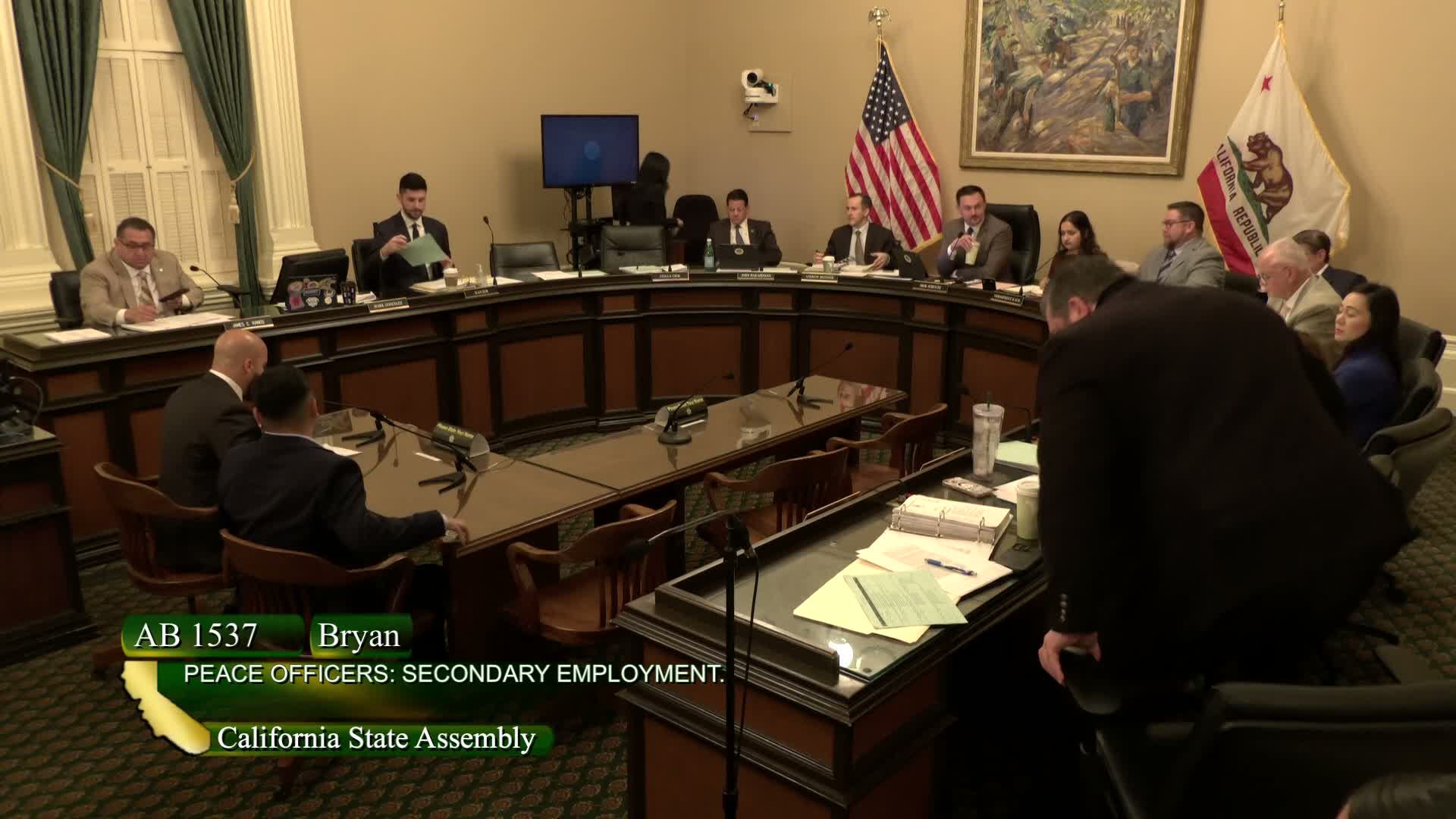
Summary
A contentious Assembly Public Safety Committee hearing advanced AB 15 37 to require disclosure and restrict local law‑enforcement secondary employment with Department of Homeland Security entities. Supporters cited community safety and transparency; law‑enforcement associations warned the language is overly broad and could hamper vital partnerships.
The Assembly Public Safety Committee on Thursday voted to send AB 15 37 to the Appropriations Committee after a heated hearing where community groups urged restrictions on local law‑enforcement side jobs with the Department of Homeland Security and public‑safety groups warned of unintended consequences.
Assemblymember Isaac Bridal introduced the bill as a response to community reports that federal immigration enforcement operations have terrorized neighborhoods. Bridal told the committee he wanted “transparency and a clear message that local officers should not be moonlighting for agencies that carry out abusive enforcement,” and said his measure would require disclosure of such secondary employment and, in some cases, prohibit it.
Supporters — including Hector Pereira of the Inland Coalition for Immigrant Justice and Willie Lupka of Buenavacino — said local communities have seen raids and militarized tactics and need assurance that local officers are not participating in them. Pereira said the coalition’s rapid‑response hotline had documented hundreds of immigration‑enforcement incidents and asked the committee for an “I” vote to move the bill forward.
Opposition came from major law‑enforcement organizations. Brian Marvel, president of PORAC, told the committee the bill “slams the door on vital public‑safety partnerships” and warned it would bar officers from serving with agencies such as the U.S. Coast Guard, FEMA or in mutual‑aid roles. Jonathan Feldman of the California Police Chiefs Association said the bill’s current language could be read to prohibit reservists and many mutual‑aid arrangements and would impose difficult enforcement problems for departments.
Committee members pressed both sides on scope and enforcement. Some members, while sympathetic to community concerns, said the text needs narrowing so it targets immigration‑enforcement collaborations rather than a broad set of federal partners. Vice Chair and others encouraged further negotiations before floor consideration.
The committee chair recommended the bill be moved to Appropriations so sponsors and opponents can refine the language. The motion to advance AB 15 37 passed on a committee roll call.