
House advances DES continuation after floor fight over SNAP and eligibility reforms
Get AI-powered insights, summaries, and transcripts
Subscribe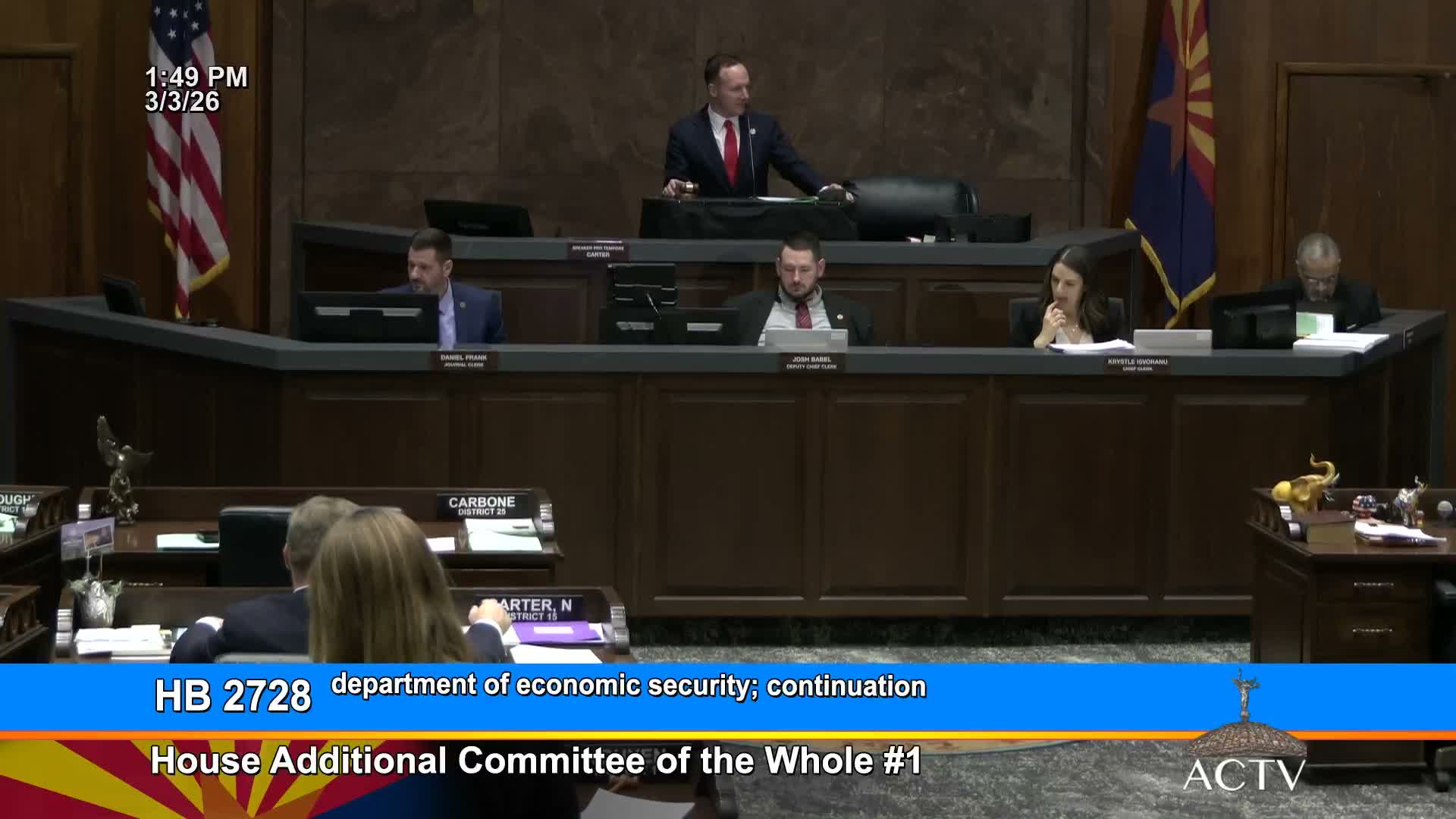
Summary
The Arizona House on March 3 advanced House Bill 27-28, a continuation of the Department of Economic Security (DES), after an extended floor fight over amendments touching SNAP eligibility, verification and work requirements. Lawmakers voted to move the amended bill out of committee and later passed it on third reading.
The Arizona House advanced and later passed House Bill 27-28, a continuation of the Arizona Department of Economic Security (DES), after extended floor debate over provisions affecting SNAP eligibility and other program rules.
Rep. Selena Bliss, the floor sponsor of the amendment, told colleagues the changes were necessary to “ensure it operates with integrity, accountability, and compliance with federal law,” adding that “continuation … without reform is negligence.” Bliss also noted the agency’s fiscal scale, saying DES oversees more than $10.6 billion in funds across programs.
Opponents said the package of changes would do real harm to Arizonans who rely on public benefits. The minority leader argued the amendment was “a hodgepodge of bills” that would “kick people off of SNAP” in the midst of an affordability crisis. Rep. Aguilar warned the proposal would “kick thousands and maybe millions of Arizonans off of DES benefits,” and urged members to vote no.
The floor process split the Bliss amendment into two segments. The House adopted the first segment by voice. On the second segment a division was requested and the Committee of the Whole reported a recorded division of 32 ayes and 25 nays to advance the measure as amended with a due‑pass recommendation.
Rep. Patty Contreras offered an alternative floor amendment described on the floor as a “clean, continuation for 8 years for the Department of Economic Security,” which the House adopted during committee consideration before the measure was sent back to the House calendar.
On third reading the House recorded the final passage of HB 27-28 as amended. The clerk recorded 32 ayes, 22 nays, 5 not voting and 1 vacant; the bill passed and the clerk was instructed to convey it to the Senate.
What happens next: The House’s action sends the amended continuation to the Senate for consideration; sponsors and opponents signaled the need for follow‑up work in the budget process and on implementation details such as verification, reporting and federal compliance.
Speakers quoted and roles - Rep. Selena Bliss (floor sponsor): “DES cannot be continued without being equipped to do its job properly.” - Rep. Aguilar (commenting member): warned the amendments could cut access to benefits and urged a no vote. - Minority leader (unnamed in the transcript): described the amendment as addressing issues “very poorly.” - Rep. Patty Contreras (floor sponsor of alternative amendment): moved a clean 8‑year continuation.
Formal action and vote tallies - Committee action: Committee of the Whole advanced HB 27-28 as amended (recorded division on the Bliss amendment segment: 32 ayes, 25 nays). (Committee action recorded during floor consideration.) - Final third reading: HB 27-28 as amended passed the House on third reading by a recorded vote of 32 ayes, 22 nays, 5 not voting, 1 vacant.
Context and significance DES administers SNAP, workforce programs, unemployment insurance and related eligibility services for Arizonans. Sponsors argued that continuation without structural reforms would leave the agency unable to meet federal compliance and program integrity expectations; opponents said the amendments would add barriers to food and cash assistance for vulnerable people during an affordability crisis. Lawmakers flagged follow‑up work on budget implications, federal requirements and how operational changes would be implemented.
Notes and clarifications - The $10.6 billion figure was stated on the floor by the sponsor when summarizing the agency’s budget scale. - The transcript shows multiple procedural steps (division, committee of the whole reports, and adoption of competing floor amendments) that altered the bill before final passage.
Ending HB 27-28, as amended, now moves to the Senate. Sponsors said they would continue discussions around funding, verification processes and federal compliance as the measure advances.