
Committee advances resolution requiring parental permission for pronoun use and restroom accommodations; opponents call it discriminatory
Get AI-powered insights, summaries, and transcripts
Subscribe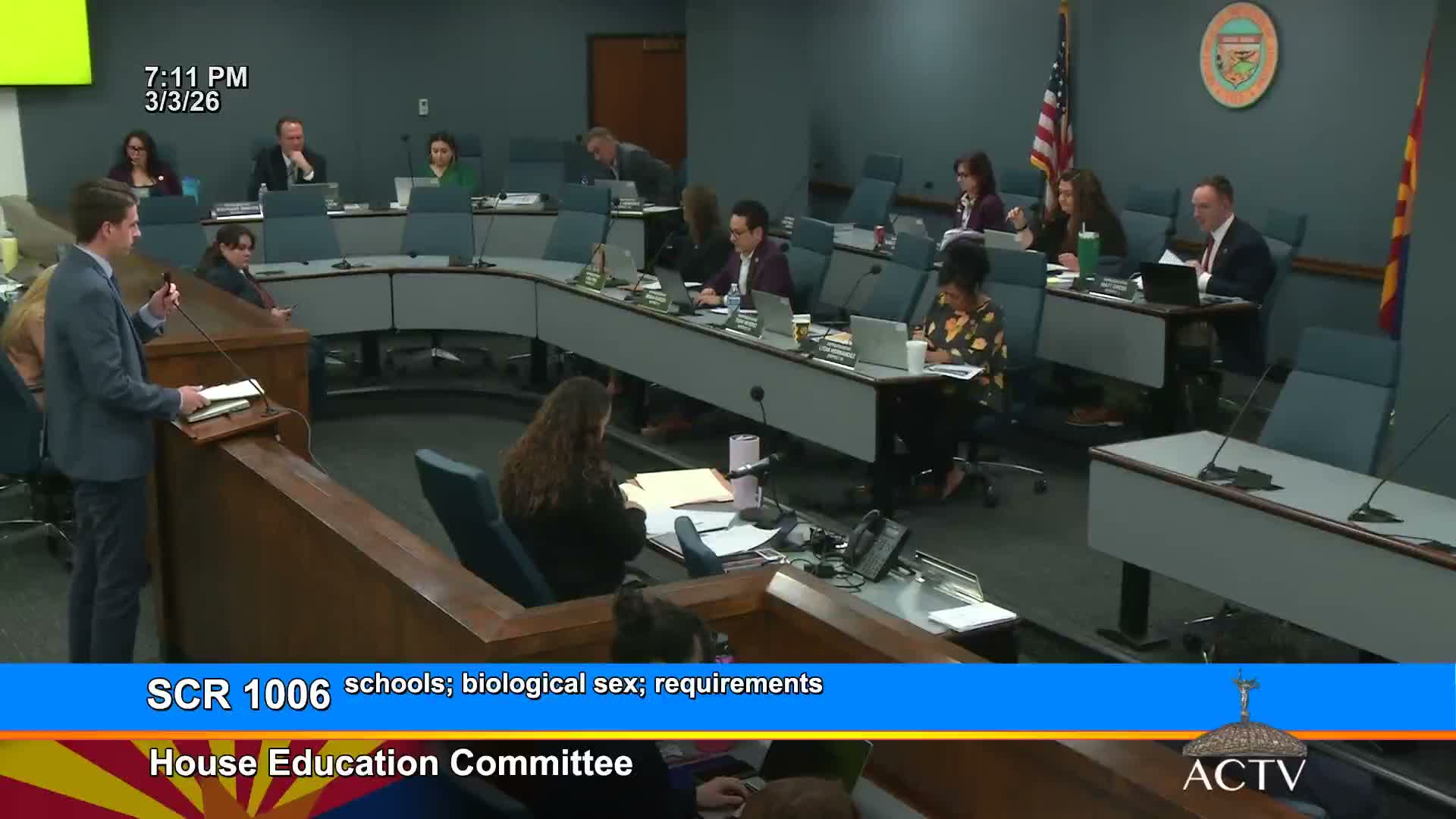
Summary
The Committee on Education voted 7–5 to give Senate Concurrent Resolution 1006 a 'do pass' recommendation. Sponsor Senator Kavanaugh framed the measure as protecting parental rights and modesty; opponents including the ACLU and parents argued it would harm transgender and nonbinary students and invite litigation.
The Arizona Committee on Education voted to give Senate Concurrent Resolution 1006 a "do pass" recommendation after testimony that sharply divided the panel and public commentators. Senator Kavanaugh, the sponsor, said the two-part measure protects parental rights on name/pronoun changes and requires reasonable accommodations in cases where a student will not use a multi-occupancy restroom or changing facility aligned with their biological sex. "The purpose of this is parental rights and student safety," Kavanaugh said.
Chase, the staff presenter, described the referral as directing the Secretary of State to submit the resolution to voters, creating a statutory cause of action if a written accommodation request is denied and prohibiting school employees from using pronouns or a name different from official school records without written parental permission. "The school must also provide reasonable accommodation," Kavanaugh said, adding the measure includes accommodations such as separate locker rooms, restrooms or hotel rooms for overnight activities.
Speakers in opposition included former educator Paul Bixler, Gene Woodbury of the ACLU of Arizona and licensed therapist and parent Hazel Heinser. Paul Bixler testified that in 35 years he had seen "no incidents involving pronouns or facility use by transgendered students" in schools where he worked and said the bill presupposes malicious intent. "This bill is unnecessary," Bixler said, and urged members to vote no.
Gene Woodbury, representing the ACLU of Arizona, told the committee the resolution singles out transgender students and amounts to discrimination. "SCR 1006 takes two of our most fundamental human experiences — going to the bathroom and being called by our names — and says to the kids to whom dignity in those areas matters most that they should be denied that dignity," Woodbury said, urging a no vote and warning the bill’s private enforcement mechanism would lead to litigation and social harms.
Hazel Heinser, who identified herself as the parent of nonbinary children and a licensed marriage and family therapist, said honoring students’ names and pronouns at school supports their well-being and that the measure would make life harder for vulnerable youth.
Supporters, including the bill sponsor, argued the measure would preserve parental rights and protect students’ modesty. Kavanaugh said the resolution does not force school employees to disclose a student’s identity to parents and that the accommodation requirement prevents exclusion. After members explained their votes, the committee reported a recommendation of "do pass" by a vote of 7 ayes and 5 noes.
The committee referred the resolution for consideration as a ballot referral; the secretary of state would place it before voters if it continues to advance through legislative procedures. The hearing produced sharply contrasting views: the sponsor framed the measure as parental‑rights and modesty protections, while opponents characterized it as discriminatory and potentially harmful to students and schools.
The committee did not take immediate statutory or fiscal action beyond the committee recommendation; the measure’s proponents said it would be submitted to voters if the referral process continues.