
Clay County commissioners deny petition to shrink cannabis setbacks and commercial lot sizes
Get AI-powered insights, summaries, and transcripts
Subscribe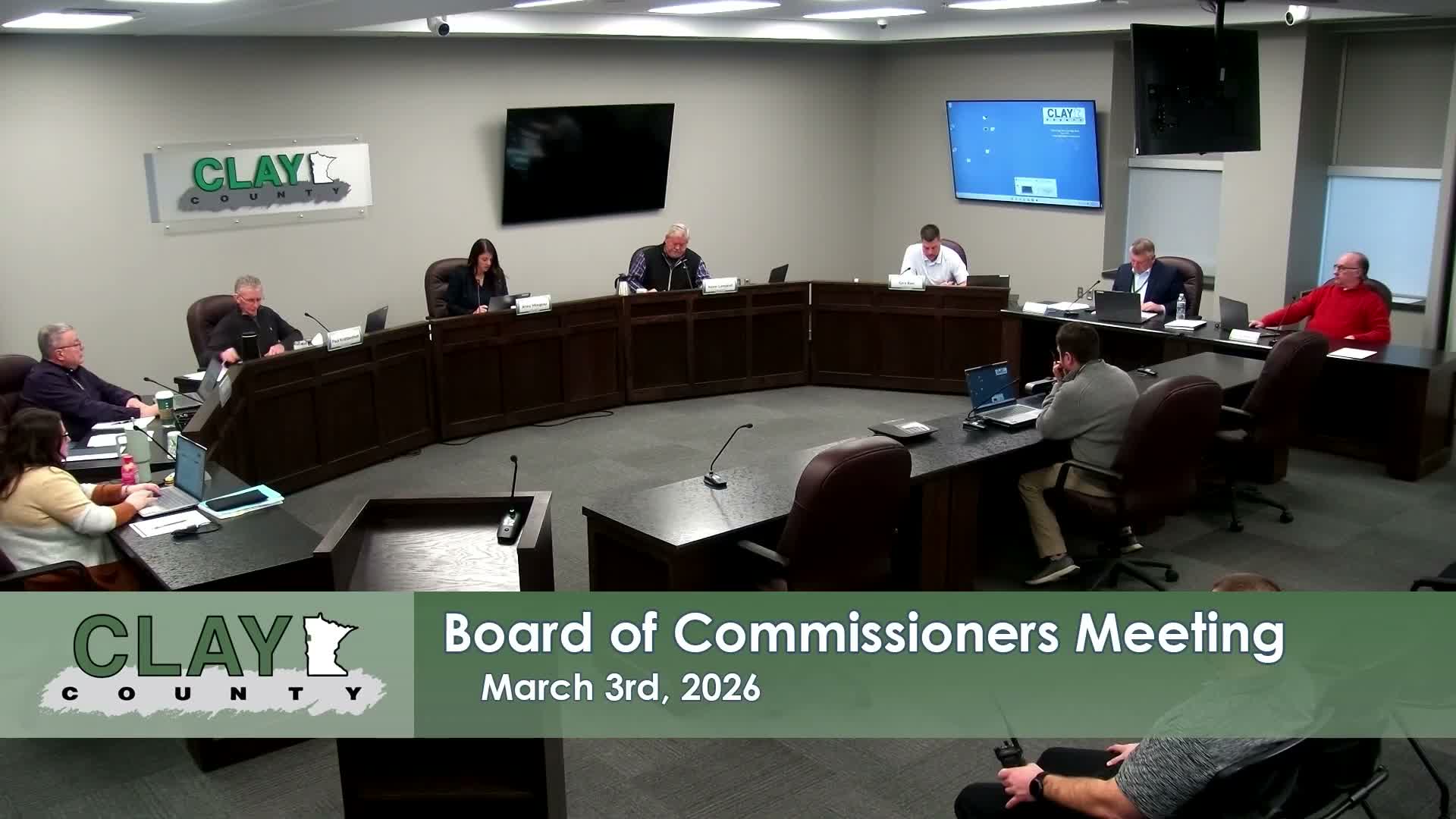
Summary
After a public hearing with strong local opposition and a unanimous planning commission recommendation to deny, the Clay County Board of Commissioners voted unanimously to reject a petition to reduce cannabis‑to‑residence setbacks from 500 to 250 feet and to lower the minimum commercial lot size in Agricultural Service Center districts from 1.0 to 0.5 acres.
The Clay County Board of Commissioners voted unanimously to deny a petition that would have reduced the county's cannabis business residential setback from 500 feet to 250 feet and cut the minimum commercial lot size in Agricultural Service Center (ASC) zoning districts from 1 acre to 0.5 acre.
Planning and Zoning Director Matt Jacobson summarized the petition and the planning commission's unanimous recommendation to deny, citing concerns about compatibility with primarily residential ASC districts, potential nuisance impacts (traffic, odor, lighting, security), limited room for on‑site sewage and parking on smaller lots, and inconsistency with the county's comprehensive and transportation plan. Jacobson told the board the planning commission found the amendments would "diminish established dimensional standards that function to provide separation, buffering and impact mitigation," and could not be adequately addressed through conditional‑use conditions.
Applicant Scott Doms, who identified himself as an architect and owner of the Baker Elevator property, urged the board to consider historical development patterns and the need for adaptive reuse of compact, historically commercial parcels. "This amendment addresses 2 structural issues," Doms said, arguing that ASC districts were originally platted for compact commerce and that broad rural setbacks have functionally prevented reasonable commercial reuse.
Residents and local officials who spoke during the hearing urged denial. Joel Hildebrand, a planning commission member, asked the board to "give careful consideration to the findings of fact" and warned of environmental and infrastructure constraints on smaller lots. Baker residents raised concerns about emergency response times, traffic on gravel roads and impacts on community character. Kathy Song asked, "Why should the rules be broken or changed for 1 person?" and other speakers said opposition was widespread in Baker.
Several commissioners noted the county had recently rewritten its ordinances and that applicants can seek variances or pursue conditional‑use permits where warranted. Commissioner Campbell said the board's earlier decision to permit cannabis businesses in certain zones was intended to be applied through the conditional‑use process and that changing the ordinance-wide setback would open the door to many conflicts. Commissioner Ebinger moved to deny the amendment based on the planning commission findings; Commissioner Bair seconded. The roll call vote was recorded as unanimous in favor of denial.
The action preserves the county's 500‑foot residential setback for cannabis businesses and maintains the 1‑acre minimum commercial lot size in ASC districts. Planning staff noted the county and the planning commission can still review site‑specific variance or conditional‑use applications under existing procedures. The denial followed a March hearing in which the board accepted written comments into the record in addition to in‑person testimony.
Next steps: the planning and zoning office will continue to process any site‑specific applications under current ordinance standards and advise prospective applicants on variance and conditional‑use pathways.