
Tax committee advances many supplemental budget conformity items, records mixed straw‑polls on depreciation and charitable deduction
Get AI-powered insights, summaries, and transcripts
Subscribe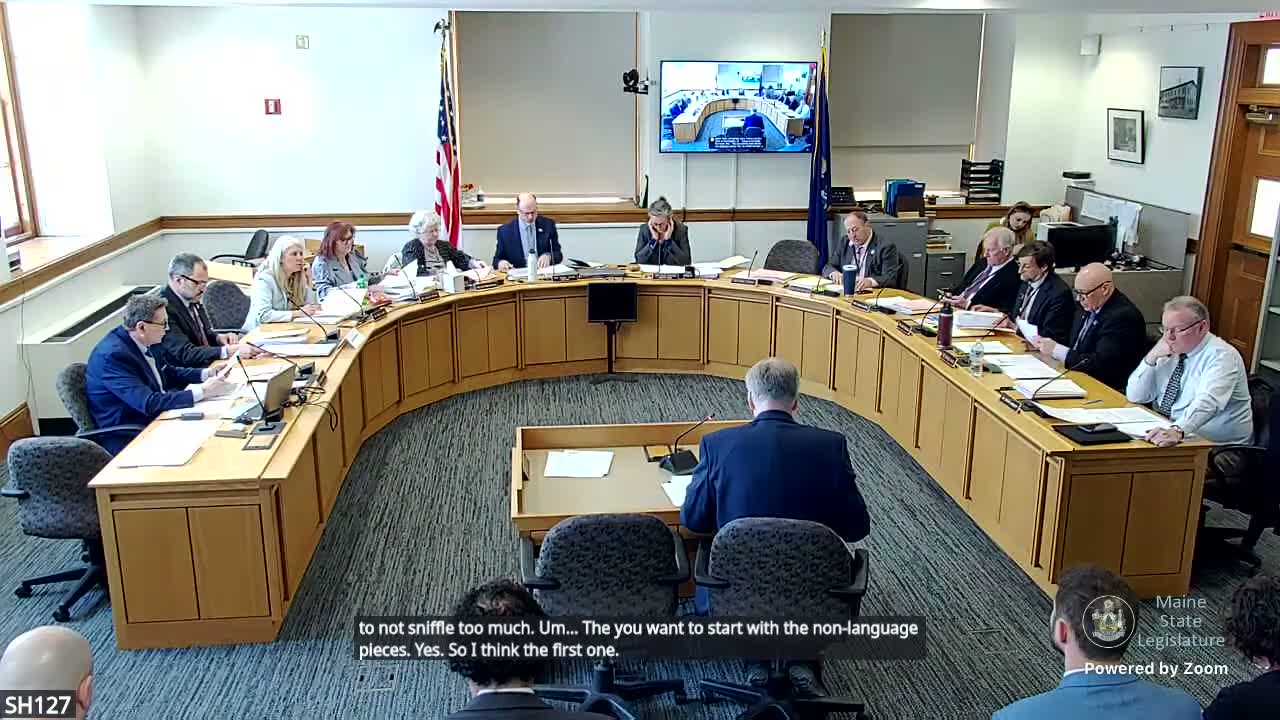
Summary
The Joint Standing Committee on Taxation recommended numerous conformity items from the governor’s supplemental budget into its memo to appropriations, but members split on bonus/accelerated depreciation and a new nonitemizer charitable deduction; several items (R&D phase‑in, QSBS, opportunity zones) were held for further study.
The Joint Standing Committee on Taxation met in work session and moved a set of the governor’s proposed tax conformity items into its report to appropriations, but recorded split positions on several high‑profile measures.
Committee chair Sen. Nicole Grohowski opened the session and the panel took up the tax report‑back document. After staff explanation, the committee voted to move reference number 3 (a $5 million deappropriation/federal‑to‑general‑fund technical correction) into the budget; Sen. Bruce Bickford made the motion and it was seconded and carried in a recorded straw‑poll of members present.
On direct conformity for individual income tax, the committee agreed to the governor’s items 1–7 as proposed. Michael Allen, associate commissioner for tax policy, told members that the changes would take effect for the 2026 tax filing year and that most taxpayers would realize the benefit when they file next year.
The committee diverged on business‑tax conformity. Items 8 and 9 — bonus depreciation and accelerated depreciation for qualified property — drew extended staff caution about administrative complexity. Dan Pittman of the Office of Tax Policy warned that implementing one piece (item 9) without the broader bonus‑depreciation system would be “very, very complicated” to administer. After debate and a procedural reconsideration, members recorded support for continuing Maine’s historic decoupling on these depreciation items consistent with the governor’s supplemental filing (i.e., maintain state nonconformity), while a minority favored full conformity.
Charitable giving provisions drew sharp disagreement. The governor proposed phasing in a federal‑level deduction for nonitemizers (up to $1,000 for single filers, $2,000 joint). Representative Brett Freeman moved to zero out the governor’s proposal for the state budget, arguing the state should not subsidize that deduction; the motion carried in a recorded straw‑poll with a divided panel. Senator Rickford and others pushed back, saying even modest deductions help local nonprofits and lower‑income donors.
Several other indirect conformity items (including the phased standard deduction proposal) were carried as the governor proposed, while items that would meaningfully alter R&D expensing (item 10), the expansion of the qualified small business stock exclusion (item 19), and the opportunity‑zone expansion (item 24) were left for further staff analysis and caucus. Daniel D’Alessandro (deputy tax policy counsel) and Michael Allen emphasized the timing and fiscal‑note complexities for those items.
The committee also advanced a package of items commonly called the “big beautiful bill” elements — a block that included temporary provisions on tips/overtime/other items — with members split on whether the changes should be short‑term pilots or permanent.
What happens next: the committee will send its report and the straw‑poll results to the appropriations committee and has asked staff for additional fiscal detail on R&D, QSBS, and opportunity zones before taking final action on those items.
Representative Dan Pittman of the Office of Tax Policy summarized technical constraints: “We have not studied what it would take to implement 9 while continuing to decouple from bonus depreciation… it would be extraordinarily complicated.” Chair Grohowski said members should expect additional report‑back material before the next vote.
Votes at a glance (selected): reference #3 — moved into budget (motion: Sen. Bruce Bickford); items 1–7 (direct conformity to individual income tax) — recommended as proposed; items 8–9 (bonus/accelerated depreciation) — committee signaled continuing decoupling consistent with the governor’s approach after reconsideration; item 27 (phased standard deduction) — moved as proposed; item 29 (charitable nonitemizer deduction) — motion to exclude from state budget carried in straw poll; items 30–33 — debated as a block with mixed outcomes; part M (homestead/veterans/blind exemption consolidation) — adopted (see separate article).
The committee adjourned after scheduling follow‑up information requests and planning to resume the work session the next day.