Committee approves amendment to bar sweeping two‑week payment delay tied to housing stabilization repeal

Minnesota Senate Committee on Health and Human Services · March 2, 2026

Get AI-powered insights, summaries, and transcripts

Subscribe
AI-Generated Content: All content on this page was generated by AI to highlight key points from the meeting. For complete details and context, we recommend watching the full video. so we can fix them.

Summary

The Senate Health and Human Services committee amended and forwarded SF3755, which repeals the housing stabilization services statute and strengthens legislative oversight after alleged fraud; an A4 amendment that prevents a $53 million forecasted payment‑timing shift from being treated as one‑time savings was adopted on a roll call.

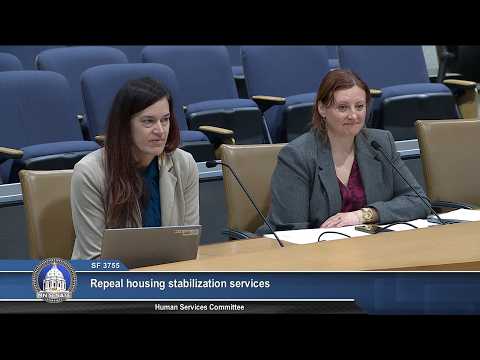
Chair Hoffman opened the committee and said Senate File 3755 addresses program integrity and the balance of executive and legislative powers as it seeks to repeal the housing stabilization services statute after credible allegations of fraud. "The language in that author's amendment stipulates that the executive branch may not terminate a statutory program until authorized to do so by the legislative branch," the chair said.

Christy Graham of the Department of Human Services told the committee the A2 amendment contains technical corrections and a policy provision directing DHS to work with communities and the Legislature to redesign a possible Medicaid housing service with stronger program‑integrity controls and to report back with recommendations in September 2027. "We would report back to the legislature in September 2027," Graham said.

Members raised sharply different concerns. Several senators said agency action had been necessary when they found credible allegations of fraud; others warned that agency actions had disrupted legitimate providers and harmed people receiving services. Elise Bailey, DHS budget director, spelled out the forecast impact after the termination of housing stabilization: "The net impact was 21,500,000.0 savings in fiscal year 26, 41.8 in fiscal year 27, 48.1 in fiscal year 28, and 49.9 in fiscal year 29," she said, adding those numbers total roughly $160 million across the period.

Senator Abler offered an A4 amendment to prevent an unannounced two‑week timing shift used in the forecast from acting as a $53 million one‑time savings taken from providers. Dan Pollock, representing the Autism Treatment Association of Minnesota, testified in support, saying the committee should not allow legitimate providers to bear the cash‑timing consequences of a prepayment review. "That is an enormous amount of money," Pollock said of the $53 million figure.

DHS counsel warned the amendment could interact with existing prepayment and denial processes and asked for technical work to ensure it does not require repayment of legitimately denied claims; Bailey said the amendment could have broader forecast impacts beyond the single $53 million line item. The committee held a roll call on the A4 amendment and the chair announced the amendment passed; the chair then moved SF3755 as amended and the motion carried. The committee recommended the bill to pass and re‑referred it for further consideration.

Next steps: SF3755 was recommended to pass as amended and will proceed to the next committee identified by the chair for further consideration of program integrity and implementation details.