
Texas Supreme Court weighs whether missing attorney general approval voids PID bond contracts
Get AI-powered insights, summaries, and transcripts
Subscribe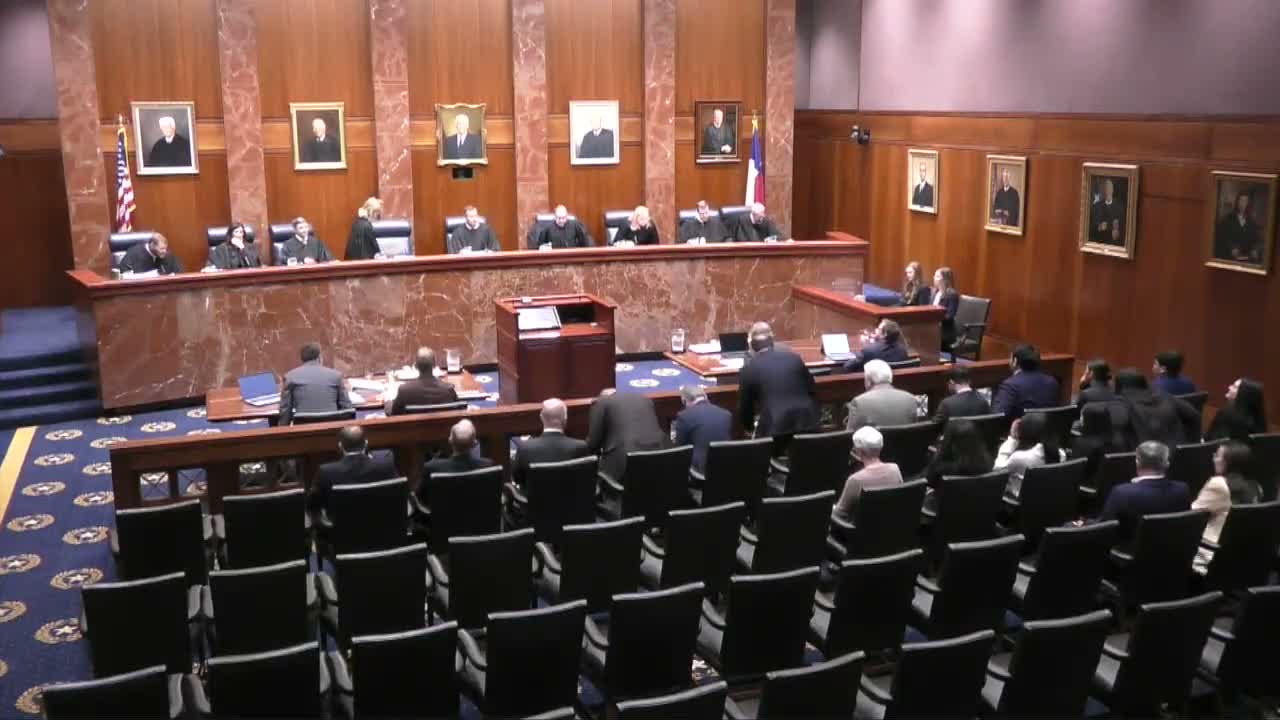
Summary
At oral argument in River Creek Development Corp. v. Preston Hollow Capital, counsel debated whether failure to submit bonds or notes to the Texas attorney general, as required by statute, should render public improvement district (PID) financing contracts void, with justices probing statutory text, precedent and market consequences.
The Supreme Court of Texas on Monday heard argument over whether a statutory requirement to submit certain bonds or notes to the attorney general should automatically invalidate public improvement district (PID) financing contracts that were issued without that approval.
Counsel arguing for the position that the contracts may be void (identified in the transcript here as "Counsel (Speaker 1)") told the court that PIDs create assessment liens on property for infrastructure such as water and sidewalks and that, under the statute, a corporation "shall submit a bond or note authorized under section 431.071 to the attorney general." That counsel said contracts that fail to meet statutory requirements can be illegal and therefore void, and that private property owners bear the cost of assessments when a PID finances improvements.
Opposing counsel (recorded here as "Counsel (Speaker 4)") urged the court not to read an automatic invalidation remedy into the statute. Counsel pointed to the court's prior applied-remedy cases and argued that when a statute is silent about consequences, courts should look to the statute’s purpose and existing processes (for example, contests filed before bonds are issued) rather than inferring a sweeping remedy of voiding completed transactions.
The justices focused on two interlocking questions: (1) whether the statute's text and purpose authorize an implied remedy of invalidation when AG approval is not obtained, and (2) what practical consequences would follow if the court were to void transactions after the fact. One justice asked, "Why would we read that into a rule, into a statute that doesn't provide for that type of consequence?" (Questioner, Speaker 3).
Counsel pressing for voiding pointed to the attorney general’s historical role in protecting market confidence — "the duty imposed upon the general attorney is important" — and argued that lack of review can leave purchasers and taxpayers exposed. Opposing counsel responded that market mechanisms, taxpayer suits and pre-issuance contests provide avenues for policing transactions and that the statute's silence on an express remedy counsels against inserting invalidation.
The argument also addressed practical stakes. Counsel warned of the difficulty of unwinding large post-issuance transactions, noting the case concerns roughly a $17,000,000 financing and that voiding could wipe out significant economic adjustments already made: "it's a $17,000,000 transaction" and undoing it could create broad market disruption (Counsel, Speaker 4). The court examined whether equitable remedies such as restitution could make parties whole if contracts were set aside, with counsel noting amendments to state law have limited certain equitable recoveries.
Both sides discussed provisions of the PID Act (discussed in argument as including section 372.026) and whether indebtedness issued to finance an improvement project may include costs the corporation or a financing authority incurred. Questioners probed how "authorization" should be defined under section 431.071 and whether authorization is a precondition to submission or an inquiry the attorney general performs.
The court heard extended exchanges about precedent (citing cases the advocates described as applied-remedy decisions) and the balance between protecting taxpayers and preserving municipal capacity to finance infrastructure. After argument and several rounds of questioning, the court thanked counsel and adjourned the session.
The court did not issue a ruling at the hearing; the matter will be decided after the justices confer and circulate opinions.
Quotes from the record include: "So I'll come in with a petition and say, I would like a public improvement district," (Counsel (Speaker 1)), and "If you get AG approval and you get an incontestable transaction, people pay more for that," (Counsel (Speaker 4)).
The transcript shows sustained debate over statutory text (including references to section 431.071 and PID Act provisions described in briefing) and practical market consequences; the case raises whether textual silence about a remedy should yield an implied remedy of invalidation or whether existing legal and market mechanisms suffice.