Get Full Government Meeting Transcripts, Videos, & Alerts Forever!
Get email alerts on the Budget topic
No spam. Unsubscribe anytime.
North Miami CRA previews amended FY24–25 budget, proposes $1M West Dixie façade pilot and expanded housing aid
Summary
At a budget workshop, North Miami CRA staff reported a roughly $57 million projected carryover, higher interest earnings driven by new loan proceeds, proposed a $1 million block‑by‑block façade pilot for West Dixie, and asked the board whether to fund an additional 12 residential rehab lottery applicants.
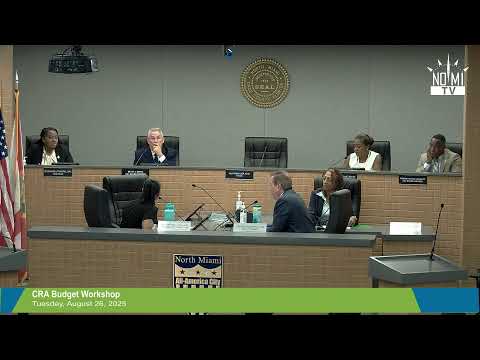
The North Miami Community Redevelopment Agency on Wednesday reviewed an amended FY24–25 budget that reflects a larger-than-expected carryover and proposed spending priorities, including a $1 million pilot for façade improvements on West Dixie Highway and continued investment in housing and commercial programs.
The agency’s Executive Director (S5) told the CRA board the fiscal year produced an unanticipated carryover increase of about $1.2 million and interest earnings of $578,300, up from an estimate of $200,000. “We have the $52,000,000 worth of loan money that we didn't have before,” the Executive Director said, noting that the higher cash balance is generating more interest and allows the agency to reallocate funds toward housing and commercial projects while presenting a balanced amended budget.
The presentation named several bond‑funded projects supported by the Redevelopment Revenue Bond Series 2024, including Nomi Square (Nomi Village), Cloud Pepper Parks redevelopment, and mixed‑use developments the Executive Director summarized at the workshop. Staff also confirmed a carryover reserve of $5,000,000 set aside for permitting on the Allure project; excluding that reserve, the flexible carryover is about $1.2 million, she said.
On programmatic priorities, the Executive Director reported the CRA completed 20 residential rehabilitation projects in the prior fiscal year and funded 25 new projects this year ($750,000). Because 37 applicants entered the lottery and only 25 were funded, she asked the board whether to authorize a second phase that would fund the remaining 12 applicants. Board members expressed support for funding the additional applicants if the board chooses to do so.
On commercial support, S5 said the agency funded 16 small businesses with a total of $2,085,000, combining awards from the West Dixie tech program and the Northwest 7th Avenue business boost. She acknowledged a typo in the meeting materials and promised corrected figures at the September meeting.
Staff proposed a $1,000,000 increase to the West Dixie corridor capital line to pilot a block‑by‑block façade improvement program, starting at a plaza near 140th Street. “I was really hoping I’d have renderings for you tonight. The renderings will be available at the luncheon,” the Executive Director said, adding that contractors would perform the work and that the program would not require a property‑owner match. Several board members supported the block‑by‑block approach as a way to produce visible, concentrated improvements.
Staff also updated the board on Pioneer Boulevard, describing the design phase as nearly complete and the project as moving through permitting. The Executive Director said consultants recommended finishing permitting before issuing construction documents to avoid reissuing RFPs and to speed contractor mobilization once the project is permitted.
Legal and compliance issues arose in discussion. A staff member who spoke for the agency (S7) advised the board that grant agreements include conditions precedent and dates—such as site‑plan or building‑permit approvals—that, if unmet, give the CRA the legal right to terminate agreements and reallocate funds. That same staff member said the governor-declared state of emergency tolling statute cited by some developers “does not apply to community redevelopment agency agreements,” because CRA incentives are not development agreements under the statute as they understand it. The staff member also cautioned that the Live Local Act and property‑tax abatement programs can complicate CRA TIF expectations and may trigger termination clauses in some agreements.
The Executive Director said staff will produce district-specific project updates and briefing materials on timelines and compliance so the board can consider reallocations or take formal direction before the September meeting. If the board provides direction, staff said it can incorporate changes into the amended budget and return with a proposed final budget for approval on Sept. 9.
A board member moved to adjourn at the end of the workshop; the motion was seconded and passed on a voice vote. The Executive Director said staff will schedule follow-up briefings to provide additional detail on the proposed allocations and project timelines.