
Audit: Rocco finds inconsistent special-education supports, urges new leadership and end to CERT meetings
Get AI-powered insights, summaries, and transcripts
Sign Up Free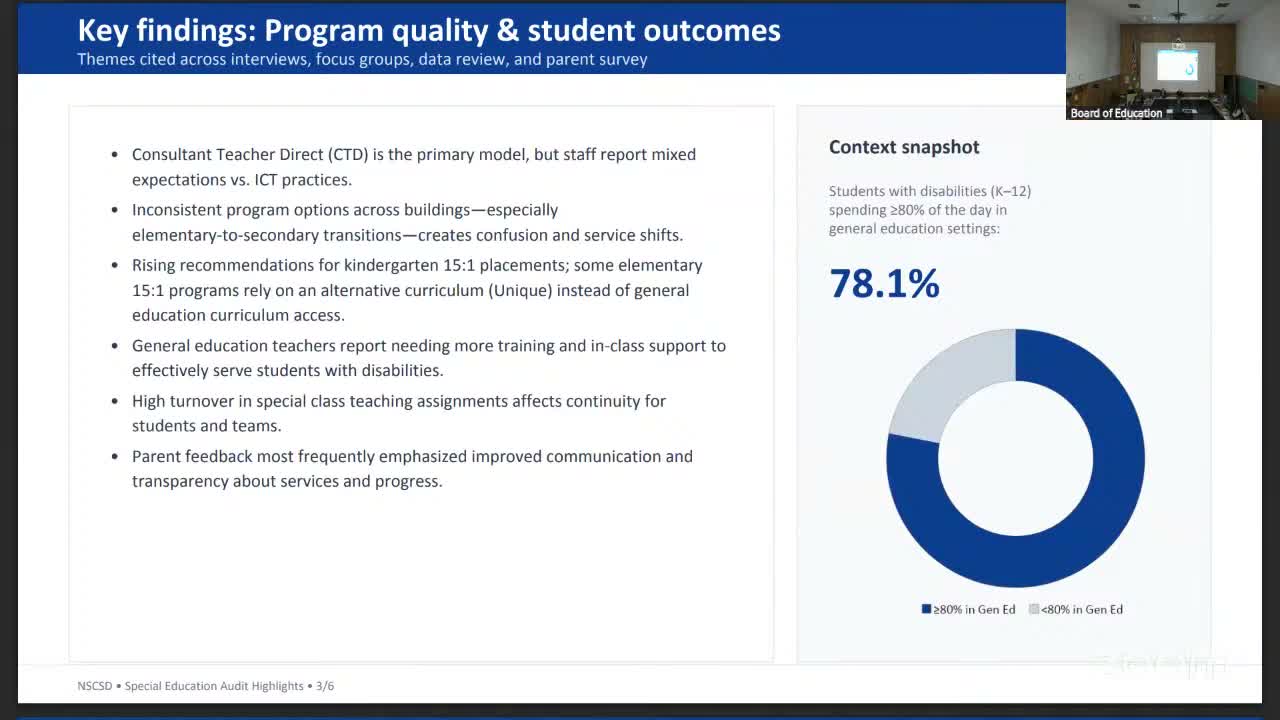
Summary
An independent audit presented to the North Syracuse Central School District board found inconsistent delivery of special-education services across grade levels, rising recommendations for self-contained placements, and recommended eliminating CERT meetings and creating district-level oversight and a 504 coordinator.
Auditor Rocco told the North Syracuse Central School District Board that his special-education audit found both strengths and significant areas for change, and he recommended structural reforms to improve consistency and compliance.
Rocco said district and state data show broad inclusion: “over 78 percent of students with disabilities in all the grade levels ... are spending the majority of their day in general education settings,” which he described as commendable. At the same time, he told the board the audit uncovered mixed messages and uneven implementation of supports across elementary, middle and high schools.
Key findings Rocco highlighted included rising recommendations to place children in self-contained classes at the elementary level; inconsistent criteria and expectations for resource-room placements; and a pattern he described where services and supports fluctuate as students move between buildings. He said that some special-class curricula are an alternative curriculum that limits access to general-education content for students placed there.
Rocco also raised operational concerns about the district’s CERT meetings. He said those weekly building-level meetings consume substantial staff time and pull teachers and therapists from students, and that parts of the CERT process ‘‘can be perceived as, like, a CSC meeting without a parent being present,’’ which he called problematic and potentially risky for the district.
To address the issues, Rocco put forward three principal recommendations: eliminate the CERT process and route appropriate reviews through the district’s MTSS and student-support teams; create a single district administrator with oversight of special-education programs from preschool through grade 12 (with two directors under that role for elementary and secondary); and establish a 504 coordinator positioned outside special education because “504 isn’t special education” but is a general-education coordination need. He also recommended expanding integrated co-teaching models, investing in targeted professional development and coaching for general- and special-education teachers, and improving family communication; he noted that 282 parents responded to the district survey used for the audit.
During a follow-up exchange, board members asked for examples of the contractual or secondary-level duties that consume special-education teachers’ time. Rocco cited testing accommodations, progress monitoring tied to IEP goals and triennial reevaluations as tasks that reduce instructional time.
The board did not take formal action on the audit during the public portion of the meeting. The presentation concluded before the board proceeded to public comment and routine business; later in the session the board moved into executive session to review a personnel matter.