Committee advances proposal requiring proof of U.S. citizenship to register for state and local elections
Loading...
Summary
The House Committee on Election Integrity advanced a substitute to House Bill 47 65 that would require documentary proof of U.S. citizenship to register to vote; supporters said it protects lawful votes while opponents warned it would create barriers, incur costs for clerks and likely trigger litigation.
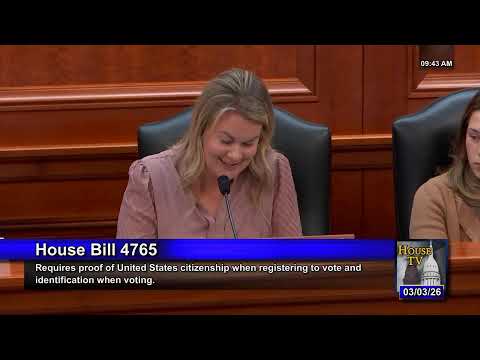
Chair Smith opened a hearing on House Bill 47 65 and heard testimony from Representative Daniel Wolford, Bill Richardson and public commenters before the committee adopted a substitute for the bill by a 5–3 roll-call vote.
Representative Daniel Wolford testified in strong support of the measure, saying that "every improper ballot cancels out the lawful vote of a Michigan citizen" and that noncitizens have been documented on voter rolls in Michigan and elsewhere. Wolford described the proposal as nonpartisan and said it would protect the "sacred" nature of citizenship; he invoked family and military-service examples to underscore the bill's purpose.
Bill Richardson, who identified himself as a township clerk in Jackson County, told the committee the bill would require documentary proof of U.S. citizenship to register for state and local elections and said audits have found non-U.S. citizens on Michigan’s voter rolls. Richardson cited local examples and federal activity he said supported the change, and described the state as having statutory provisions and federal momentum for such requirements.
Opponents said the bill would create substantial administrative burdens and risk disenfranchising eligible voters. Melanie Macy, policy and government affairs director for Promote the Vote, told the committee HB 47 65 is "an unnecessary and dangerous proposal" that would erect paperwork barriers that courts have invalidated elsewhere and that a standard Michigan driver’s license does not prove U.S. citizenship. Macy argued that audits show noncitizen voting is exceedingly rare and that imposing documentary requirements would disproportionately affect seniors, people with disabilities and others who lack readily available documents.
During questions, members pressed supporters on logistics and tradeoffs. Representative Song asked whether verification would occur through local clerks or the Secretary of State and whether seniors without birth certificates would be able to comply; Representative Colazar cited studies from Kansas and Arizona that, he said, showed tens of thousands of legal voters were denied ballots under similar systems. Representative Wooden highlighted that only an "enhanced" driver’s license verifies citizenship and said converting existing license holders to enhanced IDs could cost large sums and impose burdens on voters and administrators.
Chair Smith offered a substitute that would create a federal-only voter category allowing unverified applicants to register and vote in federal elections until citizenship is confirmed by database or documents. Representative Fox moved to adopt the substitute; the motion carried, 5 yeas to 3 nays.
Several organizations logged opposition in writing, including the Michigan Department of State, the ACLU of Michigan, the League of Women Voters and others. The chair also heard two brief public commenters in the hearing: Sherry Ritchie of Pure Integrity Michigan Elections supported the bill and asked why registration is treated differently from other activities that require proof of citizenship; Melanie Macy of Promote the Vote opposed it, warning of constitutional conflicts and administrative costs.
The committee’s action was procedural: the substitute was adopted in committee and the bill was advanced for further consideration; supporters say it strengthens election integrity, while opponents say it risks undue burdens and litigation. The committee took no immediate final action on state law; the substitute and the underlying bill remain subject to further legislative steps.