Michigan subcommittee hears case for weighted student funding to modernize school aid
Loading...
Summary
Presenters and education groups told a House Appropriations subcommittee that converting major categoricals into a weighted student funding formula would make school funding more predictable and target dollars to students with higher needs, while members pressed for statutory targets, accountability measures and clarity on special education funding.
Representative Kelly's House Appropriations Subcommittee on School Aid and the Department of Education heard three panels of education leaders on a proposal to shift Michigan's school funding system toward a weighted student funding formula, a change presenters said would make budgets more predictable and direct resources to students with higher needs.
Megan DeCracker, chief of external relations at National Heritage Academy, framed the proposal as a modernization of the School Aid Fund and said Michigan has not had a major overhaul of its funding system since Proposal A in 1994. "The backbone of all of this reform is a stable and predictable weighted student funding formula that funds students based on their specific needs," DeCracker said, adding that a formula should be transparent and year-to-year predictable.
Dan Beam, executive director of Education Advocates of West Michigan, described the mechanics: the approach would preserve a base foundation allowance and add weights for categories such as economically disadvantaged students, English learners and students with disabilities. Beam said the change would convert recurring categorical appropriations into a permanent weighting structure and recommended a phased, multi-year adoption with a three-year average pupil count to reduce budget volatility.
"A weighted student funding formula provides that predictability," Beam said. "When we have a funding system that responds to student needs rather than just 'here's money for schools,' we can bring interventions early and at the most effective stage."
Kevin Polston, superintendent of Kentwood Public Schools, emphasized demographic shifts since 1994, citing growth in special education, English-learner and economically disadvantaged populations. He said the current proliferation of categoricals creates administrative burden and uncertainty for districts. "We're asking for a stable, predictable movement toward adequacy for school funding in Michigan," Polston said, urging a multi-year strategy rather than an overnight change.
Speakers repeatedly cited the 2018 School Finance Research Collaborative (SFRC) study as the research basis for a target per-pupil amount and a system of weights. Committee members asked for specifics: Rep. Glanville asked whether predictability meant fixed dollars or a stable formula; presenters said it meant a durable formula (not a guaranteed dollar amount) and referenced the SFRC's adjusted 2018 recommendations as being in the range of "over $12,000" per pupil in today's dollars. In the hearing members also referenced the current foundation allowance (figures discussed in committee ranged around $10,050 to $10,500).
Lawmakers pressed presenters on potential downsides and implementation details. Rep. Beeson asked how a weighted system would handle a large share of students needing additional supports and whether districts would be able to hire the specialized staff required. Presenters said the formula itself reallocates existing resources to be more targeted, and that reaching SFRC targets would likely require additional revenues over time but would be guided by a clear statutory target and a disciplined, phased strategy.
Representatives of practitioner groups — Bob Kefchyan of the Michigan Association of Secondary School Principals and Matt Schuler of the Michigan Association of Superintendents and Administrators — urged statutory language that sets an adequacy target and recommended indexing that target to inflation through the state's consensus revenue estimating process. Schuler also warned that the state's school aid budget has grown more complex, expanding categoricals and reporting burdens, and said additional weights (special education, career and technical education, transportation, and isolated/rural district allowances) should be considered though some (notably special education) involve complex funding streams across federal, state and local sources.
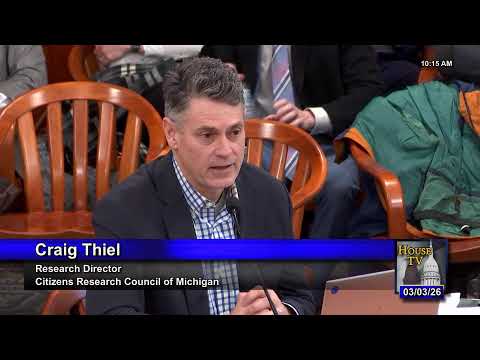
Craig Theel of the Citizens Research Council of Michigan reviewed the historical context and data: he described how Michigan moved to equalized foundation allowances after Proposal A and summarized how the SFRC estimated a base and tiers of weights in 2018; he also showed how recent appropriations increased at-risk per-pupil funding but left remaining gaps relative to the research targets.
Committee members repeatedly sought accountability guardrails: how would the state ensure weighted dollars reach the schools and students they are intended to help? Presenters suggested clearer statutory boilerplate removal, improved reporting to parents and the state and school-level transparency about where dollars are allocated. No formal votes on legislation were taken at the hearing.
The subcommittee requested written testimony (the Autism Alliance of Michigan's written testimony was noted as posted to the House Fiscal website) and adjourned without taking formal action on converting categoricals to weights. The conversation closed with members and presenters agreeing that a phased, transparent strategy with statutory targets and strengthened reporting would be necessary next steps.