Get Full Government Meeting Transcripts, Videos, & Alerts Forever!
Get email alerts on the Drinking Water topic
No spam. Unsubscribe anytime.
Michigan drinking‑water officials report progress on inspections and lead‑line inventory, warn of funding gap
Summary
EGLE officials told a House appropriations subcommittee the drinking water division has reduced permit backlogs and completed record sanitary surveys, but warned that expiring federal funds and projects routed directly to EPA threaten staffing and continued progress on lead service‑line replacement and monitoring programs.
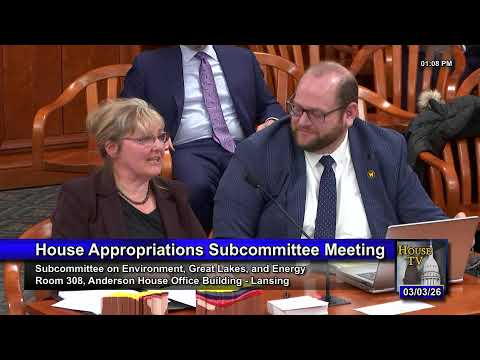
Eric Oswald, director of the Michigan Department of Environment, Great Lakes and Energy (EGLE) Drinking Water and Environmental Health Division, told the House Appropriations Subcommittee on Environment, Great Lakes and Energy that the division has nearly full staffing and has erased a backlog of permits while expanding inspections and contaminant monitoring.
Oswald said the division is “97% staffed,” credited recent FTE increases for allowing the agency to eliminate its permit backlog and said his team completed 483 sanitary surveys this year — the most in nine years. He also described Michigan’s early work on PFAS testing and other proactive contaminant monitoring, and said the division is exploring streamlining routine permitting for faster repair work.
Why it matters: Oswald said those gains are vulnerable because some federal funding streams that help pay for state oversight are ending or now bypass the state. “Congressional directed spending has come back. Those projects go directly to EPA with no pass through the state,” he said, adding that the IIJA funding that supplemented staff and program costs will end in 2027. He noted the public water supply fee covers only part of the program, funding roughly 20 staff positions, while other federal grants fund many of the remaining positions.
Key numbers and goals: Oswald gave the committee an inventory of service‑line materials based on EGLE data through October 2024: 203,000 confirmed lead service lines, about 61,000 galvanized lines that were connected to lead, and roughly 158,000 unknowns the agency expects will largely prove to be lead — “for a total of about 422,000 lead service lines in the state,” he said. He reiterated the state’s goal of removing lead service lines by 2037 and said the agency will continue corrosion control and household plumbing mitigation even after main‑line replacements are complete.
Local consolidation and capacity: Committee members asked whether the state can encourage consolidation of the roughly 10,000 public water supplies in Michigan; Oswald said regionalization could reduce that number by an estimated 30% but acknowledged limited state authority to force consolidation and strong local resistance tied to control of rates and assets. He said EGLE’s engineers provide technical assistance and compliance agreements to encourage partnerships among neighboring systems.
Other concerns raised: The division described responses to naturally occurring contaminants such as manganese — which it said can be a risk to infants when concentrations exceed safe limits — and flagged ongoing difficulties with campground permitting tied to local code compliance, water and sewage provision, and site sizing.
Next steps: Oswald asked the committee to consider budget implications as federal funds taper and to support the staffing and tools needed to maintain inspection and replacement momentum. The presentation concluded with committee follow‑up requests for lists of current projects and additional information on campground permitting challenges.