
Subcommittee adopts Department of Health FY27 BA report; debates cuts, federal receipt timing, and service funding
Get AI-powered insights, summaries, and transcripts
Subscribe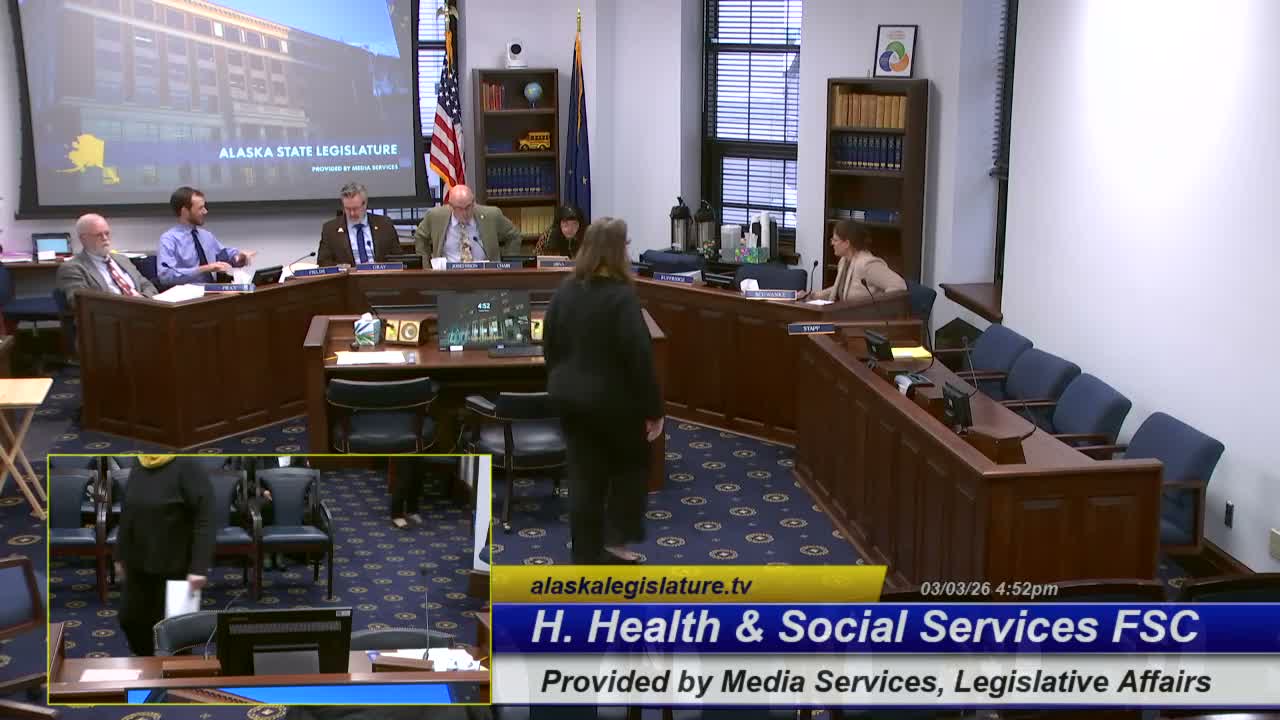
Summary
The subcommittee moved the Department of Health FY27 operating BA report out of committee after adopting targeted time-limited federal-receipt authorities and debating proposed position deletions and program cuts; members also approved restores for behavioral health grants, a GF match for the crisis call center, and one-time food-bank funding.
The House Finance Subcommittee adopted its FY27 budget action (BA) report for the Department of Health and considered multiple member amendments focused on federal receipt authority timing, vacant positions, and program-level funding.
Darren Page summarized the chair's DOH BA: the chair's recommendations include offsets to prior cuts in behavioral-health grants driven by declining designated and federal receipts, a general-fund match for the crisis call center at a 1:2 ratio to sustain operations, targeted increases to adolescent behavioral-health reimbursement rates, and one-time funding directed to Alaskan food banks and pantries (the chair proposed $3 million of a requested $5 million).
Representative Schwanke proposed a range of amendments to zero out or time-limit funding tied to vacant positions and to align federal receipt authority with grant periods; proponents argued a review and reallocation of positions could free funds for higher priorities, while opponents worried cuts risked weakening public-health capacity and would complicate the department's concurrent transformation work. Several time-limited federal-receipt authority items were adopted to match grant periods; narrower efforts to cut individual public-health positions failed or were withdrawn after members voiced concern about rural access and federal funding shares.
A large bundled package of amendments from Representative Prox (amendments 9–34), intended to press the department on Executive Budget Act compliance and measurable outcomes, was rejected, 2–6. Members who opposed the bundle said the Executive Budget Act requires a cooperative approach and that blunt across-the-board cuts would risk disrupting services during an ongoing transformation effort.
The subcommittee adopted several smaller technical amendments (for example, to limit federal receipt authority to the grant periods), and with no further amendments moved the DOH BA recommendation out of committee. The nonpartisan Legislative Finance Division was directed to make any necessary conforming or technical changes.
Throughout DOH debate members repeatedly raised the trade-off between short-term savings and downstream costs: some members noted that reducing funding now could shift costs to hospitals, food banks and other community supports; others said the size and growth in the DOH budget merit a deeper review of grants and program duplication.
The subcommittee concluded its work and adjourned at 5:31 p.m.