House subcommittee adopts DFCS FY27 BA report, adds training and child-advocacy funding
Loading...
Summary
The House Finance Subcommittee adopted the Department of Family and Community Services FY27 budget action report and approved several member amendments including $350,000 for in-person OCS training and $1.5 million to backfill child advocacy center grants; the panel also approved retention incentives and intent language to hire higher-level protective-services staff.
The House Finance Subcommittee voted to adopt its proposed FY27 budget action (BA) report for the Department of Family and Community Services and approved a set of member amendments after extended debate over training, foster-care recruitment and frontline worker pay.
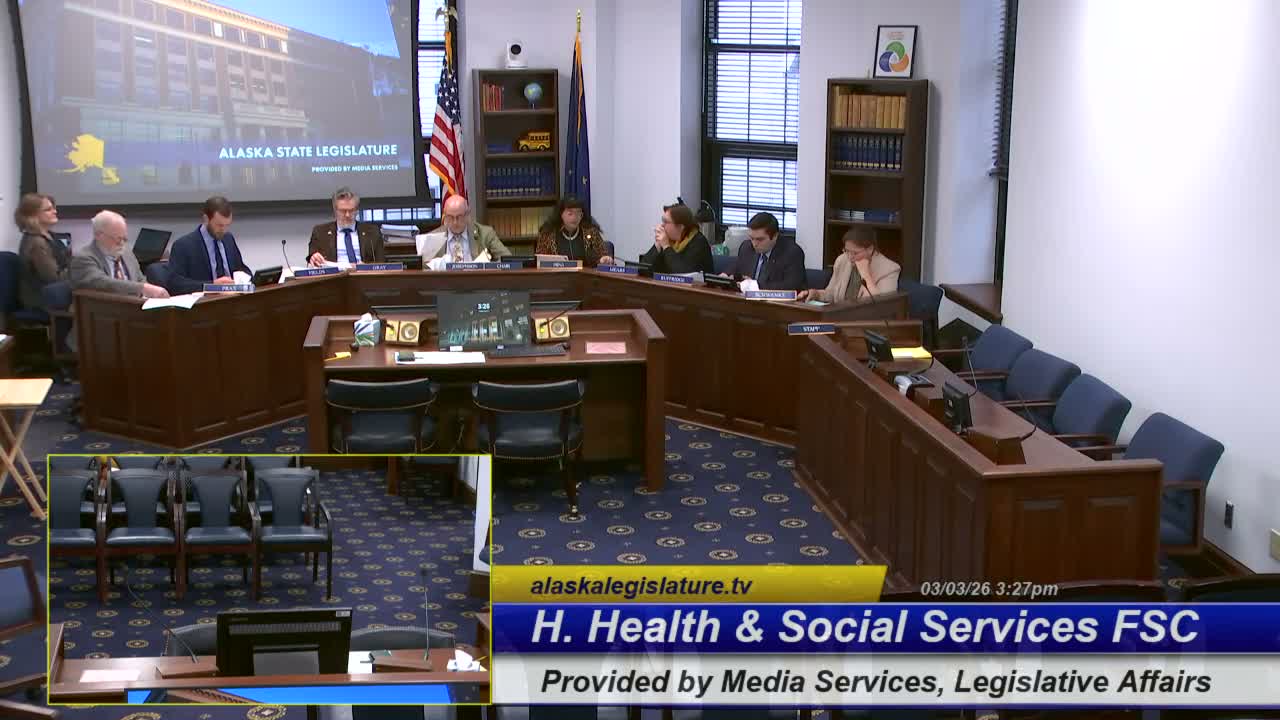
Chair Josephson opened the session and explained the BA report reflects the subcommittee's recommendations and largely restores the governor's requests. Erin Page, staff to the chair, told members the DFCS BA shows a small net increase over the governor's submission and highlighted two chair additions: a $350,000 unrestricted general fund increment intended to strengthen in-person training for Office of Children's Services (OCS) staff, and a $1.5 million general-fund increment to maintain grants to child advocacy centers after a decline in Victims of Crime Act (VOCA) federal receipts.
Representative Prox objected to the training increment as an ad hoc change that lacked clearly delineated goals and performance indicators; Prox and other members urged clearer metrics for how the funds would be measured. Supporters, including Representative Fields and Representative Mina, argued that improved in-person training and retention incentives could reduce expensive out-of-home placements and be cost-effective in the long run.
The committee adopted the DFCS BA report as the working recommendation by roll-call vote, 5–3.
Member amendments produced several notable outcomes. Representative Gray withdrew a broad proposal that would have raised frontline protective-support worker pay by 10% (an $8 million fiscal note he attributed to $5 million GF and $3 million federal receipts) after committee concerns the increase was too broad and not targeted to specific job classes. The subcommittee adopted Amendment 2, an incentive-pay measure intended as a retention bonus for protective-support staff, by a 5–3 vote; proponents said the modest bonus is one practical tool to try to improve retention while collecting data on effectiveness.
The panel also approved intent language to ‘‘flex'' protective-support specialist positions by hiring at higher (PSS-3) levels where appropriate, a tactic supporters said would broaden the recruitment pool without adding net positions (amendment adopted 7–1). Representative Gray's proposal to allocate $350,000 for a statewide foster-family recruitment media campaign was adopted 5–3; sponsors argued modern paid outreach and public-facing advertising are needed to recruit licensed foster homes lost since the pandemic. Representative Mears offered intent language directing OCS to document diligent searches for relatives and to report to the legislature by Nov. 15, 2026 on kinship placement rates; that amendment passed 6–2.
Several other member amendments—many focused on implementation and classification studies or time-limited federal receipt authority—were considered in bundles or individually; a packet of amendments addressing IT and classification costs (amendments 10–14) was bundled and rejected by the subcommittee. After completing amendment votes, the committee moved the DFCS BA report out of committee (vote 6–2) and directed the nonpartisan Legislative Finance Division to make any technical conforming changes.
The subcommittee's debate highlighted recurring themes: the tension between legislative intent language and appropriations, trade-offs between targeted versus broad pay increases, how to measure retention outcomes, and whether ad hoc increments are an acceptable tool when federal cuts create emergent needs. Supporters of the chair's additions said the targeted increments respond to urgent needs raised in testimony from advocates and agency leadership; critics said the committee should insist on clearer metrics and compliance with the Executive Budget Act when adding new funding.
The subcommittee recessed briefly before taking up the Department of Health budget.