DOT warns Marine Highway faces shortfall as FTA grant is delayed; offers bridge plan
Loading...
Summary
DOT told the House Finance Committee that a delayed Federal Transit Administration rural ferry grant has created a revenue shortfall for the Alaska Marine Highway System and outlined a bridge plan that would use state AMHS revenue and a one‑year swap of federal authority to avoid service disruption through August–September 2026.
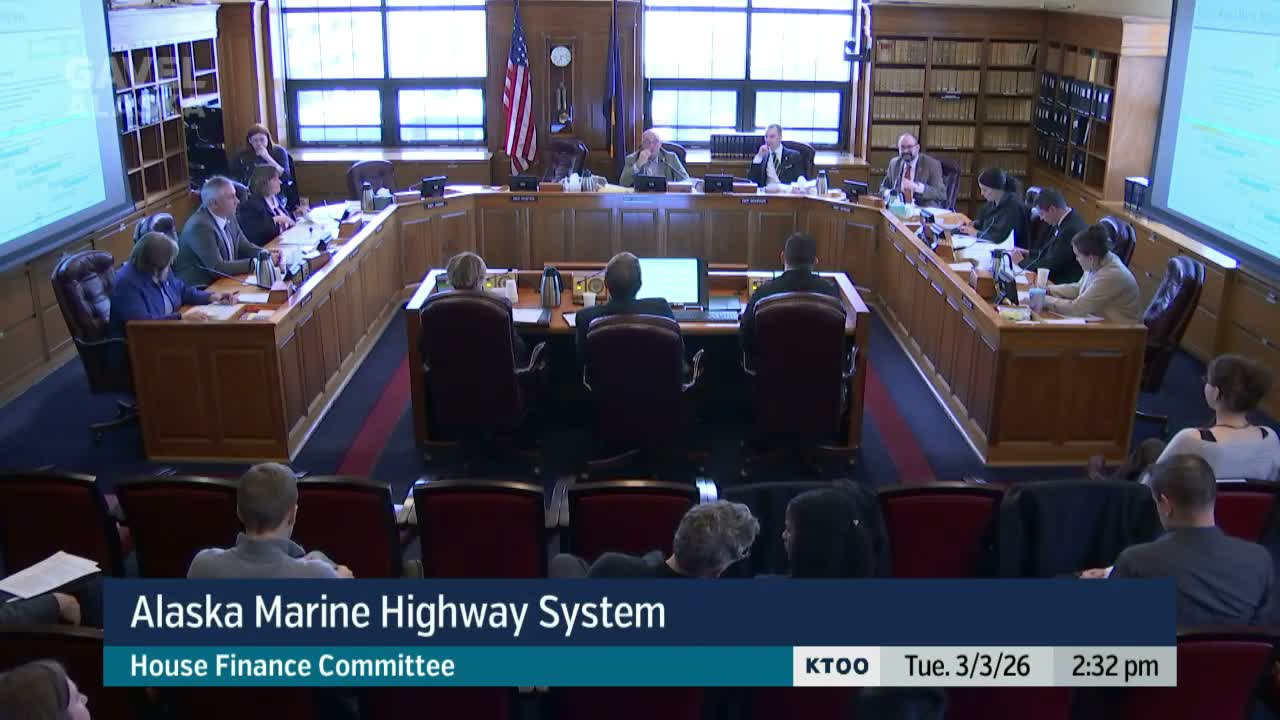
Ryan Anderson, commissioner of the Alaska Department of Transportation and Public Facilities, and director Don Pinone told the House Finance Committee on March 3 that the Alaska Marine Highway System faces a temporary funding gap after the Federal Transit Administration postponed the notice of funding opportunity for the Rural Ferry Service grant.
Pinone said AMHS’s calendar‑year 2026 operating budget is approximately $170,700,000, of which about $77,900,000 is federal authority (roughly 45.6%). He said the department expected the FTA to publish a notice of funding opportunity in March and officials are pressing for an award in August; if the award slips to September, DOT’s exposure would increase materially.
"With the state funds we have, we can continue operations unaltered through July," Pinone said. "If we receive the award in August, we could borrow $14,900,000 of revenue from our fiscal year 27 budget, swap the federal authority forward and bridge the gap. If the award is not made until September, the exposure we would need to cover would be about $29,800,000." (Don Pinone, Director of Program Management and Administration, DOT)
Why it matters: AMHS serves as lifeline transportation for many coastal communities, moving passengers, freight and medical referrals. Committee members pressed DOT for specifics about the system’s operating loss and for contingency steps if federal money arrives late. Representative Stapp cited recent AMHS financial reports and asked how the long‑range plan could address a multi‑million‑dollar structural deficit.
DOT’s longer‑term approach includes fleet recapitalization, terminal upgrades and operational changes such as shorter ferry runs and targeted road‑building where feasible to reduce reliance on ferry service. Anderson said the department has a long‑range AMHS plan that includes replacing aging vessels (he said AMHS’s average fleet age is roughly 40 years) and making docks compatible with modern vessels.
Robert Venables, executive director of Southeast Conference, testified that federal rural ferry funds were designed as gap and modernization funding rather than permanent operating support. "Ferries are so much more than just a transportation conveyance," Venables said, adding that unreliable service has real economic and social costs for remote communities and local supply chains.
DOT said it has a bridge model that relies on available AMHS revenue, swapping federal authority between calendar and fiscal years under a multi‑year appropriation structure it is seeking, and, if needed, tapping other federal sources (for example, Federal Highway Administration ferry boat funds) to cover the remaining gap.
What the department said next: DOT warned the committee that if federal awards do not arrive by September, the agency would need to implement additional cost‑saving measures or schedule modifications. Pinone said DOT is working with the governor’s office and the congressional delegation to accelerate FTA timelines and is prepared to adjust operations if required.
No formal action was taken at the hearing; members requested follow‑up figures showing AMHS operating reports and the department’s long‑range plan excerpts. The committee adjourned at 03:59 PM.