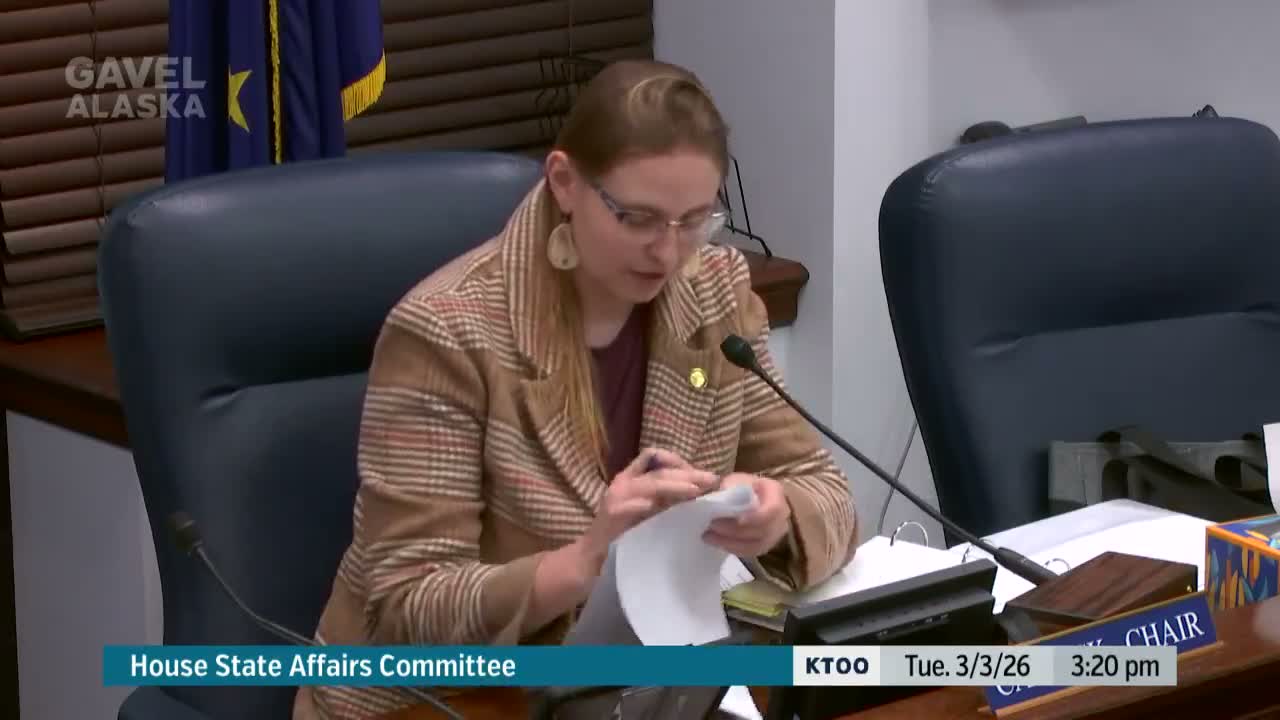
Committee advances flex-time credit bill after debate over caps, preapproval and contract impact
Loading...
Summary
The House State Affairs Committee voted 4–3 to move HB130, which would create a statutory flexible time credit for certain salaried state employees, after adopting two clarifying amendments and rejecting a third that would have added accrual thresholds, reporting and a lower cap.
The House State Affairs Committee in Juneau on March 3 advanced House Bill 130, a measure to create a flexible time credit for classified salaried state employees, after adopting two sponsor-supported clarifying amendments and rejecting a third amendment that would have added stricter accrual rules and an annual reporting requirement.
Representative Andy Josephson, the bill sponsor, was briefly present and left staffer Ken Alper to handle the hearing. Representative Saint Claire moved an amendment to make use of the flexible time subject to supervisor approval; Ken Alper told the panel that the change mirrors existing collective-bargaining language and that the sponsor had no objection. The committee adopted that amendment by voice after Chair Kerrick removed her initial objection.
Representative Holland then moved an amendment to ensure there is a cap on accruals while preserving collective-bargaining authority; Ken Alper again described this as clarifying and consistent with current union contracts and the committee adopted that amendment.
Representative McCabe offered a more expansive amendment that would have limited accrual to hours worked beyond 45 in a week, required preapproval and documentation before credit could accrue, capped annual accrual at 120 hours and required the Department of Administration to report annually to the Legislature on fiscal and operational impacts. "If we're going to put this in statute, we should do it carefully and responsibly," Representative McCabe said, arguing the guardrails would prevent the benefit from becoming an unintended fiscal liability.
Ken Alper, speaking for the sponsor, urged the committee not to adopt that amendment, saying it would convert the bill's intended floor into a ceiling and could undercut existing negotiated terms. He noted both of the main public-employee contracts the staff reviewed use a 200-hour aggregate cap and that supervisors' contracts do not begin accruing until after 45 hours in a week under current agreements, meaning some proposed changes could leave employees worse off.
Committee members debated the trade-off between preserving managerial discretion and placing statutory limits. Supporters of McCabe's approach raised concerns about unchecked accruals and end-of-year operational impacts; opponents warned statute could improperly pre-empt collective bargaining and create seasonal staffing problems.
On a roll call the committee rejected Representative McCabe's amendment 3 by a 4–3 vote. Later, Vice Chair Story moved that the committee report HB130 out of committee as amended with recommendations, fiscal notes and authorization for legal staff to make technical changes; after an objection and roll call the motion passed 4–3.
The bill now proceeds from the House State Affairs Committee with the two clarifying amendments on supervisor approval and a cap consistent with collective-bargaining agreements. Committee members asked the sponsor to upload contract excerpts and related documents to the record for members' review.
Next step: HB130 will proceed to the House floor as a committee-recommended bill; additional amendments are possible as the bill continues through the process.