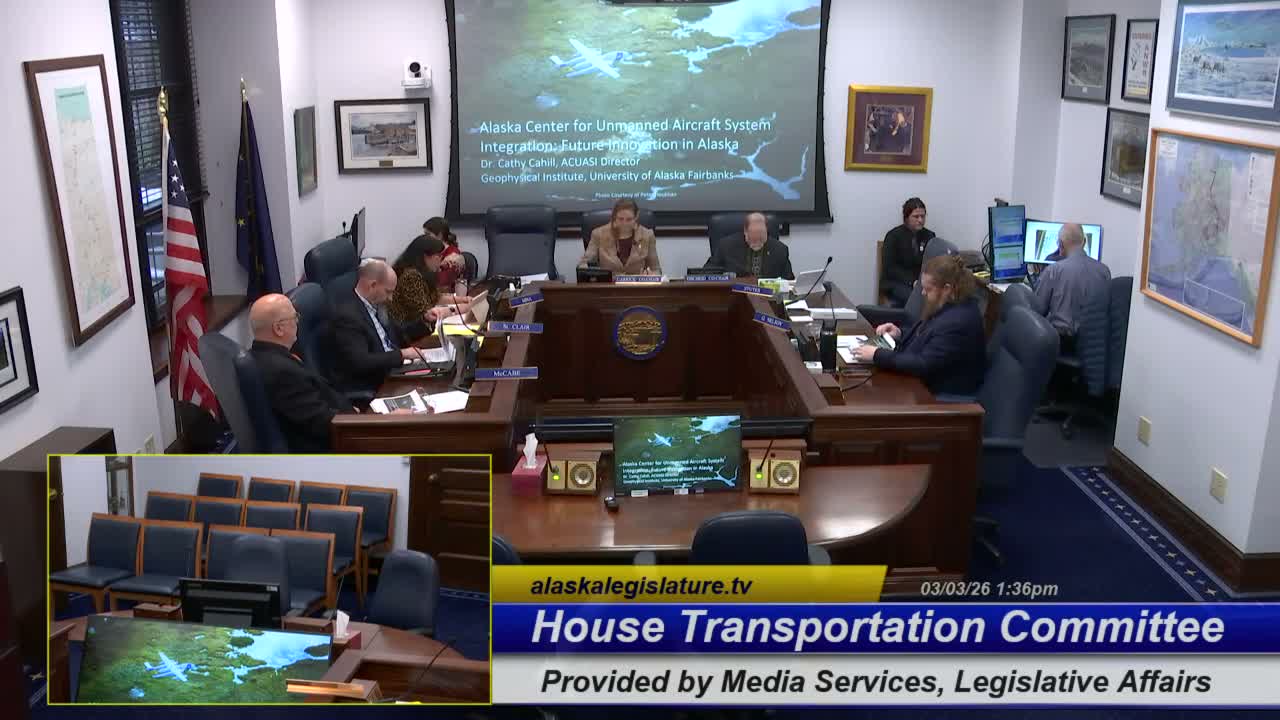
CUAHSI director tells Alaska House committee drones can extend medical and infrastructure services if regulators allow BVLOS
Loading...
Summary
Kathy Cahill, director of the Alaska Center for Unmanned Aircraft Systems Integration (CUAHSI), told the House Transportation Committee March 3 that beyond‑visual‑line‑of‑sight (BVLOS) drone operations, paired with detect‑and‑avoid systems, could speed medical deliveries, monitor pipelines and assist disaster response across rural Alaska.
Kathy Cahill, director of the Alaska Center for Unmanned Aircraft Systems Integration (CUAHSI) at the University of Alaska Fairbanks, told the Alaska House Transportation Committee on March 3 that expanded drone operations could reduce risk and improve service to remote communities if regulators clear longer‑range flights.
Cahill said CUAHSI — one of nine FAA‑recognized test sites — has pursued beyond‑visual‑line‑of‑sight (BVLOS) flights and related research since 2001. "We are an aviation state," she said, arguing that many Alaskan communities rely on air service and that drones could remove pilots from hazardous short‑haul transfers. "If somebody has a diabetic episode in a community served by Fairbanks Memorial Hospital, they will charter a plane to deliver a box of insulin. If we can manage to get it so that we can deliver that with an unmanned aircraft, we've taken a pilot out of the equation so reduced risk and potentially can save lives," Cahill said.
The presentation outlined recent Cold‑weather tests, aircraft acquisitions and technology partnerships CUAHSI says are intended to make BVLOS safe and practical in Alaska. Cahill described a 15‑mile BVLOS mission flown for Fury to transport an environmental water sample for the Alaska Department of Environmental Conservation, noting the flight used observers at each end and streaming video to reduce collision risk. John Robinson of the University of Alaska Fairbanks Geophysical Institute, narrating a video of a Nenana test, described parachute drops of medical supplies from a roughly 900‑lb UAV and said those operations succeeded at temperatures near 18°F below zero.
Why it matters: Alaska's geography — with many communities inaccessible by road — makes long‑range drone logistics a potentially high‑impact application for medicine, emergency response and infrastructure monitoring. Cahill told the committee that solving detect‑and‑avoid and reliable communications is essential to operate without chase aircraft across long distances.
Key details from the session: CUAHSI said it is acquiring Griffin Aerospace aircraft (a "red wing" delivery expected in April) and Windracers Ultra Mark I aircraft (900‑lb maximum takeoff weight, ~200‑lb payload) to support long‑range missions. The center is testing Fordham Technologies R40 radars as detect‑and‑avoid sensors and plans to integrate them this summer. Cahill gave an estimated Windracers price of about $750,000 per aircraft and said a Super Bowlo workhorse used in cold tests costs about $3,540,000; she argued those capital costs amortize compared with repeated helicopter hours.
Cahill also described partnerships and programs supporting operational use: the state Department of Transportation's Skydio X10 drone docks funded through DOT SOAR smart grants, deployments during the Ketchikan landslide and Typhoon Halong responses, and joint work with tribal health organizations and ISER on delivery time studies. She said CUAHSI is pursuing Rural Health Transformation Program (RHTP) planning grants with tribal partners while addressing chain‑of‑custody and hazardous‑materials concerns for medical cargo.
On counter‑UAS work and legality, Cahill said the center uses passive radio‑frequency detection and other layered approaches to identify unauthorized drones, and that the center remains careful to avoid violating federal statutes. "We have stayed nice and clear of violating title 18, title 49," she said, adding that systems are already in place at Fairbanks International Airport and Ted Stevens International Airport to detect incursions into approach paths.
Committee questions focused on endurance, autonomy and costs. Cahill said many operational systems are flown by computer with "a human in the loop" to intervene if needed, and she estimated some small cargo autonomous systems could emerge within three to five years while larger autonomous aircraft will take longer. On staffing and mission cost, she said typical BVLOS missions involve a pilot and observers at each end and that some missions can be run on modest fuel loads.
What wasn't decided: The committee did not take votes or direct staff to adopt policy changes. Members asked the legislative staff to check whether Alaska statute contains a definition for "unmanned aircraft." Cahill said she would follow up after the meeting.
Next steps: Co‑chair Carrick said the committee will continue technology discussions with the Department of Transportation on March 5 at 1 p.m.; no formal committee actions or votes were taken at this hearing.