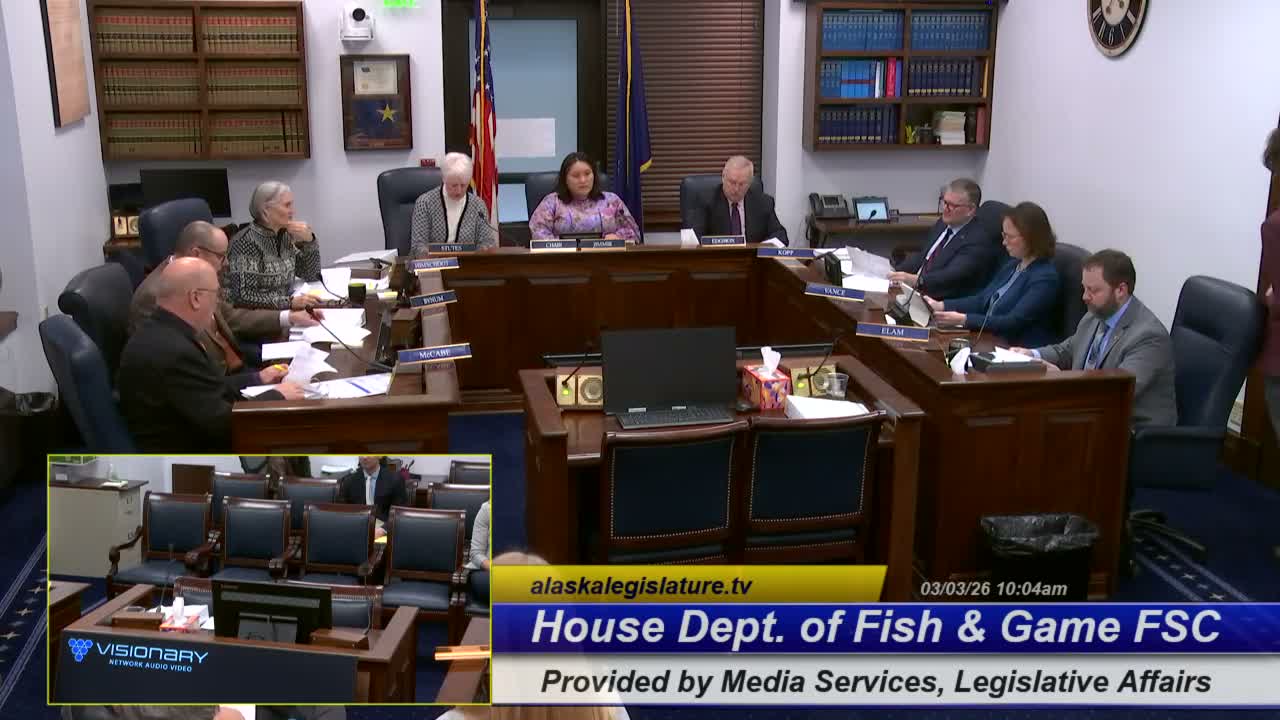
House Finance subcommittee adopts FY27 Fish and Game budget, 5–3, after debate over hatchery funding
Loading...
Summary
On March 3, 2026, the House Finance Department of Fish and Game Subcommittee voted 5–3 to adopt its FY27 operating budget recommendations, approving funding swaps that move some hatchery costs onto federal Dingell‑Johnson receipts and adding three temporary positions for the Commercial Fisheries Entry Commission (CFEC).
The House Finance Department of Fish and Game Subcommittee voted 5–3 on March 3, 2026, to adopt its recommended FY27 operating budget and to move the Budget Action (BA) report out of subcommittee. The package includes targeted funding changes for hatcheries and a set of temporary positions at the Commercial Fisheries Entry Commission (CFEC).
Keenan Miller, committee aide to Representative George Jimmy, walked members through the BA modifications, saying the subcommittee’s changes “were mostly accepted” from the governor’s request and described several targeted adjustments. He said Item 7 adds $400,000 in unrestricted general funds (UGF) to supplant contributions previously made by the Bristol Bay Science and Research Institute to the Port Moller Test Fishery, which Miller described as “used to generate estimates of sockeye salmon stock in age, composition” and as “a core program by the Bristol Bay Fisheries Collaborative.”
Miller also described a set of CFEC funding and authority adjustments (Items 10–15). According to the presentation, the BA replaces some CFEC receipt authority with UGF in the statewide fisheries management allocation to eliminate a projected negative carryforward, provides CFEC the receipt authority needed to fund three positions related to records reduction, permitting and IT modernization, and authorizes a $150,000-per-year draw for three years to support CFEC’s IT modernization project. Miller said the sum of the increments cited in the presentation was about $532,900 and that a $682,800 UGF replacement was part of the adjustments.
Representative Vance questioned why three CFEC positions were being added when CFEC had previously reported unfilled posts. Miller replied that the positions appear on the CFEC organization chart but were not previously budgeted and that the increment is a technical correction to allow CFEC to pay for positions already in use. Miller described the three positions as: a commercial fishing permit clerk (to be colocated in the Bristol Bay Economic Development Corporation and reimbursable), an IT modernization project coordinator to manage vendor and security compliance and keep executive leadership apprised of risks, and a records specialist who has helped reduce an archive of “more than 3,500 boxes” and who is expected to help remove another ~2,000 boxes so the agency can move to digital records and avoid ongoing storage costs.
Representative McCabe pressed the committee on Item 18, which Miller described as replacing $2,243,100 in UGF with federal receipt authority so Anchorage and Fairbanks hatchery allocations can leverage in‑kind construction contributions and draw on Dingell‑Johnson funds to fund hatchery work. Miller said the department has “almost $80,000,000 in leftover federal receipt authority” and likened the authority to “credit card miles,” explaining the swap lets the department use its Dingell‑Johnson authority rather than UGF to finance hatcheries while reprioritizing other Dingell‑Johnson projects.
McCabe said he objected to adopting the BA report at that point because his question about whether the commissioner supported the hatchery funding swap had not been answered: “I have to object because, my question was not answered, and I feel like the commissioner was the best one to answer that question.” Miller replied that the change was made by Representative Jimmy and that the intent was to supplant the fund source rather than add new funding.
Representative Elam asked whether the CFEC positions were reclassified from full‑time to temporary and whether operational need would remain after the positions expire. Legislative Finance analyst Nathan Teal told the committee the positions were not reclassifications; they are new positions added in the current year and the BA increment provides temporary funding so the work can continue until the projects or partnerships that fund them conclude.
After the objection, the committee held a roll call. The clerk read votes that recorded five 'yes' votes and three 'no' votes; the chair announced the subcommittee’s FY27 operating budget recommendation, as reflected in the BA report, was adopted and the BA report was moved out of subcommittee. The subcommittee authorized the Legislative Finance Division to make necessary technical and conforming changes. The meeting adjourned at 10:24 a.m.
Votes at a glance: - Motion to adopt the Department of Fish and Game Subcommittee FY27 operating budget as reflected in the BA report: mover, Representative George Jimmy; outcome: adopted; recorded tally: 5 yes, 3 no. - Motion to move the BA report out of subcommittee and authorize Legislative Finance to make technical/conforming changes: mover, Representative George Jimmy; outcome: adopted; recorded tally: 5 yes, 3 no.
What changed and why it matters: The BA package supplants certain state general fund uses with federal receipt authority (Dingell‑Johnson) for hatcheries and restores or authorizes receipt authority for CFEC projects and positions. The swap frees up UGF in the short term but prompted at least one member to request direct input from the Fish and Game commissioner before adoption. The adoption moves the subcommittee’s recommendations to the next stage of the legislative budget process.