
Senate committee advances bills on water, elections, trusts and agency funding
Get AI-powered insights, summaries, and transcripts
Subscribe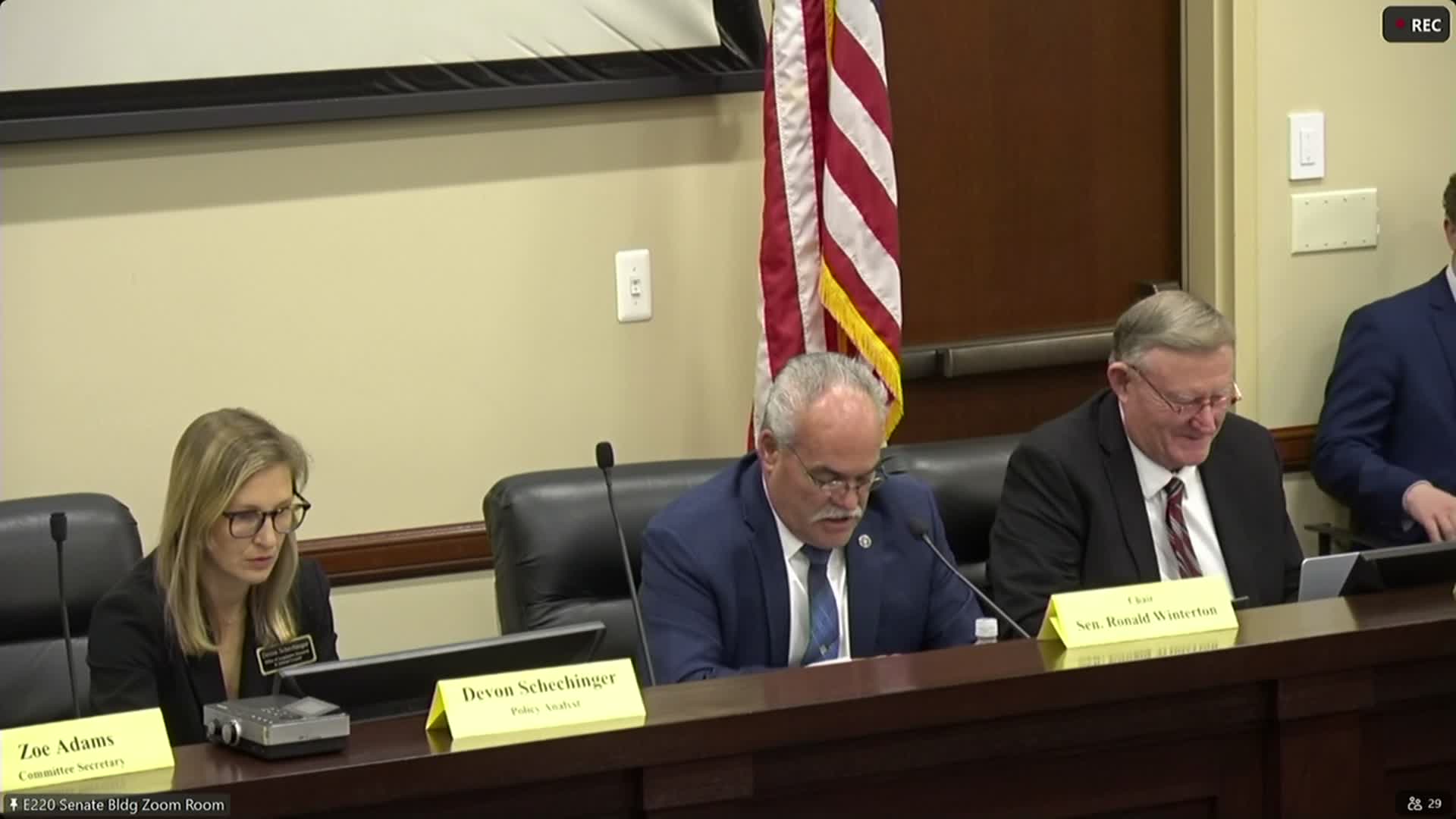
Summary
The Senate Government Operations Committee advanced multiple bills — including limits on new nonfunctional turf in the Great Salt Lake Basin, election-notice and ballot-neutrality cleanups, trust-law clarifications and budgetary measures — after extended public comment and technical amendments.
The Senate Government Operations and Political Subdivisions Committee met on Feb. 27 to consider a batch of bills affecting elections, water use, trust administration and state budgeting, advancing several measures to the full Senate.
Representative Shepherd’s election clean-up bill (House Bill 361, fourth substitute) drew sustained attention from clerks and elections staff but earned broad support after technical fixes and an amendment from Senator Stratton. Ryan Cowley, director of elections in the lieutenant governor’s office, told the committee the measure consolidates and aligns notice and filing rules, makes certain deadlines business days and centralizes several certification steps to reduce confusion for clerks.
On water policy, sponsors and water officials framed House Bill 328 as a narrowly targeted conservation step. Joel Williams, director of the Division of Water Resources, said the measure would apply only to new commercial, institutional and industrial development in the Great Salt Lake Basin and would direct developers to avoid ‘‘nonfunctional turf’’ in small strips and islands where overhead spray irrigation is inefficient. Supporters included water districts and the Great Salt Lake Commission; turf producers and some farmers urged refinements so well-managed turf is not inadvertently penalized.
The committee also advanced trust-law clarifications in House Bill 176, which narrows which roles are treated as trustees under Title 75B and replaces the term 'person' with 'individual' in certain provisions to prevent entities from inadvertently being classified as trustees. Public testimony from estate‑planning attorneys described practical barriers clients face when banks decline to serve as trustees for smaller estates.
Budget and administrative bills also moved forward. The panel recommended substitutes for House Bill 545 (budgetary modifications) and House Bill 513 (a legal retainer services fund for Attorney General legal work). Several measures passed unanimously; others drew a small number of recorded objections but were advanced.
Votes at a glance - HB 176 (trust business modifications): recommended out favorably (committee vote). - HB 457 (annexation of inner-city islands, fifth substitute): recommended out favorably. - HB 409 (legislative leave amendments, second substitute): recommended out favorably. - HB 328 (water usage modifications, first substitute): recommended out favorably after public comment and debate. - HB 361 (election provision amendments, fourth substitute): recommended out favorably after adoption of a technical amendment. - HB 513 (attorney general funding, first substitute): recommended out favorably. - HB 545 (budgetary modifications, third substitute): recommended out favorably. - HB 439 (water planning amendments, second substitute): recommended out favorably.
What’s next: Each bill will be scheduled for further consideration by the full Senate. Several sponsors said they will continue stakeholder conversations during the interim to refine implementation details for clerks, local governments and water providers.