
St. Joseph County drainage board tables dewatering permit after farmers and residents raise groundwater and crop‑damage concerns
Get AI-powered insights, summaries, and transcripts
Sign Up Free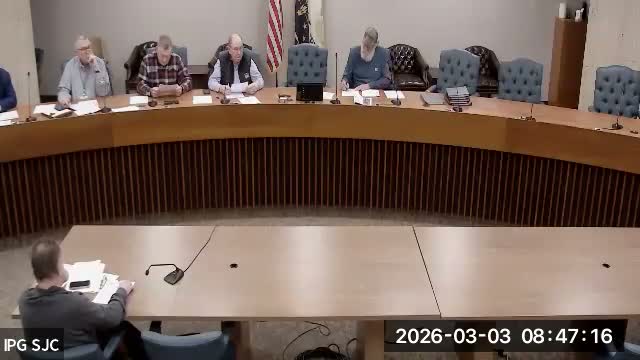
Summary
The St. Joseph County Drainage Board tabled an extension request for a dewatering permit for work near Strawberry Road after hours of public comment about groundwater drawdown, crop damage and monitoring safeguards; the applicant said monitoring is in place and urged coordination with county bridge projects.
The St. Joseph County Drainage Board voted to table a request to extend a dewatering discharge permit for a utility project at the southwest corner of Western Avenue and Strawberry Road after extensive public comment and technical questions.
The applicant, Patrick Phillips of Walbridge, told the board the extension would maintain the existing maximum discharge rate (listed on the permit application as 1,450,000 gallons per hour) while crews use a combination of vertical and horizontal wells and perimeter piezometers to control dewatering during utility installation. "We have piezometers installed entirely around the site for monitoring," Phillips said, adding the company would monitor both on‑site and adjacent public areas.
Why it matters: Residents and farmers said the proposed discharge risks lowering local groundwater and raising downstream ditch levels during planting season, potentially causing crop damage and increased pumping costs. Dan Caruso of New Carlisle told the board, "When you do the math here, 1,452,000 gallons 24 hours a day is about 35,000,000 gallons a day," and urged the board to delay action until more data and public review are available.
Several downstream landowners described past incidents they attributed to prior pumping and said they want written commitments and compensation mechanisms. Brian Bailey said he has a petition with 90 signatures from affected residents and asked whether property owners would be reimbursed for crop losses; "We had crop damage," he said, adding that ditch levels rose during previous dewatering activity.
Applicant response: A company representative for AWS told the board the wetlands on the property "are not hydraulically connected to the aquifer, so dewatering has limited to no effect on the adjacent wetlands," and said third‑party studies support that position. The AWS representative also said the project team has worked with local landowners to install a stream gauge on a downstream property and that pumping reports are reviewed by engineering firms (Lawson Fisher and a WCS licensed EOR) and submitted to the drainage board on a weekly basis.
Board action and next steps: Citing unresolved technical questions, inconsistent items on the paperwork (an apparent discrepancy in the permit's day count) and the fact that the full board was not present, a board member moved to table the permit. The motion was seconded and the board voted to table the request to the next meeting; staff was directed to gather monitoring data, clarify permit language, and invite relevant engineers and stakeholders (including county bridge project managers) to present updates before the item returns.
Other context: Board members and several commenters suggested stronger independent safeguards, such as third‑party verification of monitoring data, automated flow or ditch‑level triggers that would halt pumping, and clearer written commitments about who pays for ditch dredging or crop damages if those are tied to dewatering operations.
The board took no final vote on the permit extension at the meeting; the item was tabled for follow‑up and is scheduled to return when staff reports back with requested technical clarifications and invited parties are present.