
Omaha council hears sharp opposition and staff defense of no‑bid CMAR amendment for $565M Papillion Creek expansion
Get AI-powered insights, summaries, and transcripts
Subscribe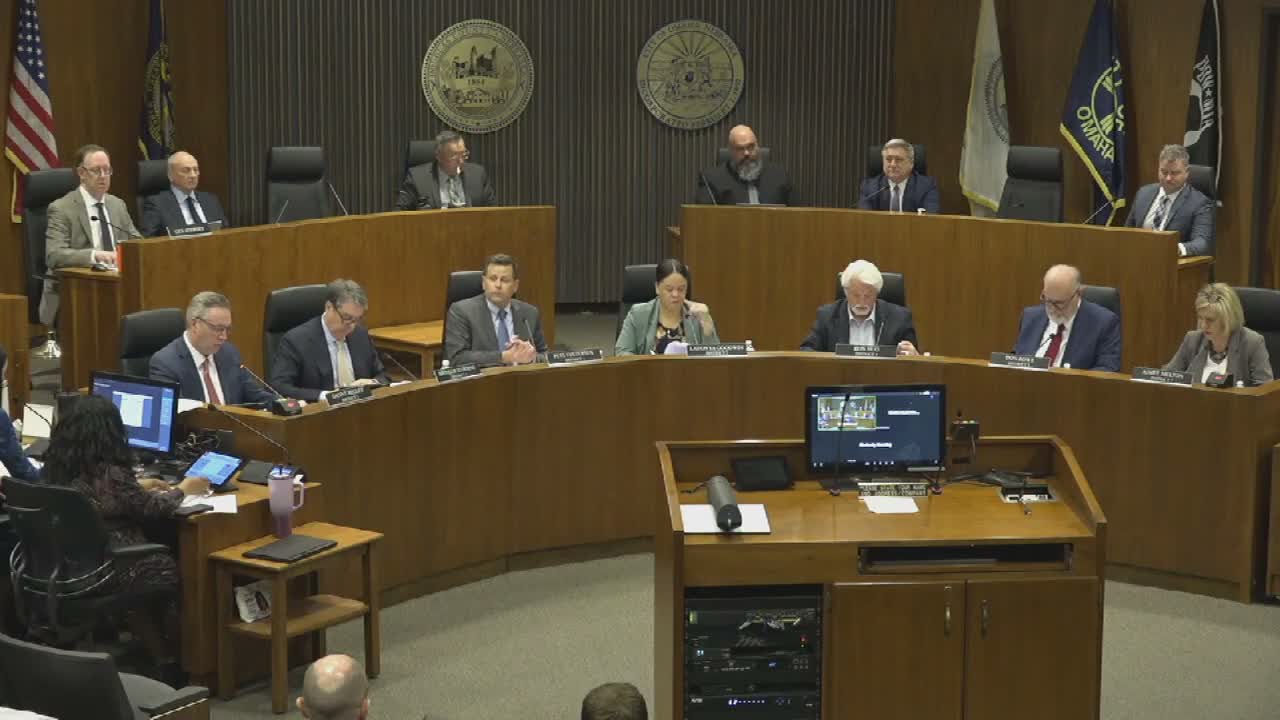
Summary
Council heard hours of testimony and questions on proposed changes to the construction manager‑at‑risk agreement and an $88 million equipment procurement for the Papillion Creek Water Resource Recovery Facility expansion. Opponents warned the amendment removes required competitive bidding and could cost taxpayers tens of millions; staff said third‑party review supports the GMP and the change is allowed under state law.
The Omaha City Council spent a large portion of its Feb. 27 meeting on a public hearing and extended questioning over the Papillion Creek Water Resource Recovery Facility second‑phase expansion and a proposed amendment to the city's construction manager‑at‑risk (CMAR) contract with McCarthy Building Companies.
Public Works Division Manager Jim Tyler told the council the multi‑year project is large and urgent: the city's capital improvement plan lists about $565,000,000 for the program, including a guaranteed maximum price (GMP) for construction in the range discussed with McCarthy and a separate $88,000,000 proprietary equipment procurement the council was asked to approve. Tyler said the work responds to stricter state ammonia and nutrient permit requirements, replaces infrastructure from the 1970s and is sized to meet growth through about 2050.
The hearing produced sharp criticism from taxpayers and local contractors who said the city's amendment to the CMAR agreement effectively removes a bidding safeguard in the original contract and may have allowed the contractor to avoid competitive solicitation for large portions of the work. Jim Veil of the Platt Institute told the council approving the amendment "which eliminates the requirement of competitive bidding, Omaha taxpayers are not afforded the assurances of policy guardrails with the lowest and best bid practices," and pressed the council to reject the change.
Chris Hawkins, president of Hawkins Construction, said an independent estimate his firm prepared shows the requested construction GMP of about $400–411 million far exceeds earlier public estimates (Mr. Hawkins cited a $270,000,000 published RFP estimate) and that the difference cannot be explained by inflation or normal contingencies. "This project you're asking us to approve today is tens of millions of dollars more expensive than it should be," Hawkins said, urging the council to send the work back out for competitive bid.
Supporters of the CMAR approach defended the project delivery method and the staff decision to use CMAR for a complex, phased wastewater expansion. Dan Raskowski of the Mid America Carpenters Regional Council testified that CMAR with a GMP gives taxpayers cost certainty and shifts change‑order risk to the contractor. McCarthy's Jaren Murphy highlighted his firm's local presence and experience on similar Midwest projects and described workforce development and local subcontracting commitments.
Tyler and city staff told council members they used a third‑party estimator (HDR and a Jacobs review) to validate McCarthy's costs during the open‑book preconstruction process. Tyler said the GMP includes an upfront contingency pool of roughly $24,000,000 and that staff believed the open‑book approach provided more transparency into direct costs than sealed‑bid lump sums.
Council members repeatedly pressed staff on two related issues: (1) whether McCarthy or the CMAR solicited bids for scopes McCarthy proposed to self‑perform in the manner required by the original Article 10 of the preconstruction contract, and (2) how fees were applied and calculated. Hawkins and others argued the amendment includes what they called a "fee on fee" result that materially increases total fees compared with the preconstruction contract's fee base. Hawkins showed arithmetic suggesting an additional roughly $2.5 million of fees resulted from applying fee percentages to indirect cost elements.
Deputy City Attorney Ryan Wiesen told the council that Nebraska law governing CMAR (citing Nebraska Revised Statute section 13‑2,912) allows CMAR agreements to be conditioned on later refinements and that the amendment, based on his understanding, reflects a completed preconstruction analysis and the final terms selected for the project. Wiesen said his reading of the process was that public works, McCarthy and the independent estimators had undertaken the open‑book review and subcontractor solicitations and that the amendment documents those final decisions.
Several council members asked staff to supply additional documentation before a vote scheduled for next week, including records that show the solicitation and comparison of subcontractor bids for work McCarthy proposed to self‑perform, the third‑party cost validation reports, a detailed breakdown of how fees and contingency amounts were calculated, and a clearer accounting of work planned for small, emerging and disadvantaged business (SEB) participation. Tyler committed to providing the requested materials at a follow‑up briefing.
The council did not vote on the CMAR amendment or the equipment procurement at this meeting. That vote is scheduled for next week after council members review the supplemental materials staff promised to provide. The hearing record and the council's requests for documentation underscore the procedural and fiscal questions that remain unresolved.