
Senate committee advances constitutional and statutory changes to raise West Virginia homestead exemption to $40,000
Get AI-powered insights, summaries, and transcripts
Subscribe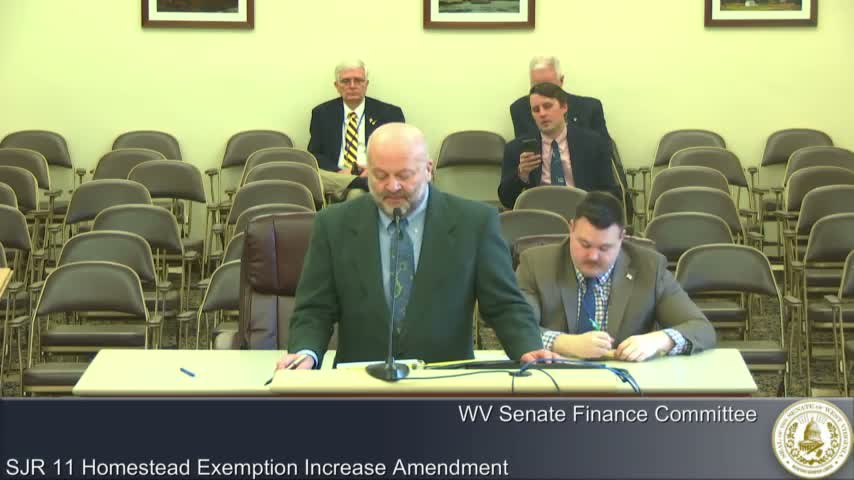
Summary
The Senate Finance Committee adopted a committee substitute to raise the constitutional homestead exemption to $40,000 and reported companion legislation (SB 144) that would raise the statutory exemption and repeal the excess levy rollback; counsel presented a fiscal note estimating roughly $44 million in annual revenue loss.
The Senate Finance Committee adopted a committee substitute to Senate Joint Resolution 11 that would raise the constitutional homestead exemption and reported the measure to the full Senate with recommendation for adoption. In committee the substitute increased the proposed constitutional minimum exemption to $40,000, and counsel explained that any constitutional change would still require voter ratification.
Committee counsel then explained the companion statutory bill, Senate Bill 144, intended to implement the constitutional change in state code. Counsel said SB 144 would raise the homestead exemption from $20,000 to $40,000 for qualifying residents (residency of two years and either age 65 or totally disabled) and would repeal the existing excess levy rollback provision in code. Counsel presented a fiscal note that estimated an initial revenue loss of roughly $44,000,000 annually and described distributional impacts to state and local revenue streams. The transcript records line-item allocations but several of those figures were not clearly recorded in the hearing transcript; counsel identified impacts to the state general revenue fund and to local school boards and county commissions.
Senators debated the policy and distributional effects. "It's been 40 years since the Homestead Exemption was changed," said the senator from Harrison, urging adoption and describing the increase as "real tax relief for seniors on fixed incomes." The senator from the 13th added that the change would address disparate effects on residents in areas where property values have grown rapidly and that the proposal provides some county-level flexibility for further increases if voters approve.
Other senators asked technical questions about repeal of the rollback and how levy rates would be adjusted under the revised code. Counsel explained that current law includes a required reduction in levy rates to prevent total property tax revenue from exceeding a certain percentage above the prior year; the bill would repeal that rollback and give counties different authority to set levy rates subject to constitutional and statutory limits, including voter approval in some circumstances.
The committee adopted the committee substitute and voted to report both SJR 11 and SB 144 to the full Senate with recommendations (SJR 11 for adoption; SB 144 to pass). Counsel noted follow-up work on fiscal particulars may be required before full-Senate consideration.
What happens next: SJR 11, as a proposed constitutional amendment, would move through the legislative process and, if enacted through both legislative houses as required, would go to the ballot for voter ratification. SB 144 would amend state statute if enacted by the Legislature. The Department of Tax was listed in committee discussion as a source of the fiscal estimate and may be asked to provide clarified figures as the measures move forward.
(Attributions: quotes and procedural motions taken from the committee hearing transcript; numerical fiscal estimates reflect counsel's presentation in committee and the transcript's recorded fiscal note.)