Committee advances West Virginia 'reshoring' tax-credit bill to full Senate, refers it to Finance
Loading...
Summary
The Senate Economic Development Committee voted to report the committee substitute for Senate Bill 939, the West Virginia Reshoring Manufacturing Act, to the full Senate with a recommendation to pass and a first referral to the Finance Committee. Counsel said the bill creates a declining, capped nonrefundable income tax credit for qualifying in-state purchases, effective July 1, 2026.
The Senate Economic Development Committee reported the committee substitute for Senate Bill 939 — the West Virginia Reshoring Manufacturing Act — to the full Senate with a recommendation that it pass and be first referred to the Committee on Finance.
Committee counsel explained the bill to the committee, saying the measure would encourage West Virginia businesses to purchase goods manufactured in the state rather than similar goods made outside the United States by allowing eligible taxpayers to claim a nonrefundable income tax credit. "The act will take effect 07/01/2026, covering the taxable years 2026 through 2031," counsel said, and the measure would expire on Dec. 31, 2031 unless reauthorized.
Under the committee substitute, the tax credit is calculated as a percentage of the dollar value of certain purchased goods; counsel said the percentage is 25% in the first taxable year and then declines by 5 percentage points each succeeding year until it reaches 5% in the fifth year. The credit would be limited to $1,000,000 in any taxable year in which reshoring activity occurs, and any excess credit may be carried forward or carried back one year. Counsel said the Division of Economic Development would administer the program in coordination with the Tax Department and would set eligibility requirements, including application to the division, filing required tax returns, payment of taxes owed, being current on state obligations and filing an independent certified public accountant's reshoring activity report with the application.
Bill Bissett, representing the Western West Virginia Manufacturers Association, told the committee his group's members "want to see more manufacturing ... specifically in West Virginia," and described mixed impacts from federal tariffs on member companies' supply chains and markets. Bissett identified Ed Ryan, who helped develop the reshoring program, and Scott Barnett of the law firm Bowles Rice as technical resources accompanying him.
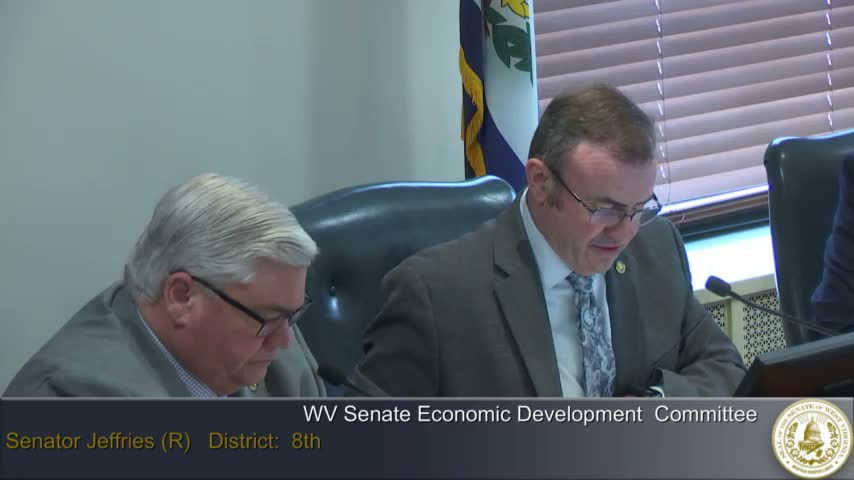
The committee held no amendments and, after debate concluded, the vice chair moved to report the committee substitute to the full Senate with the recommendation that it do pass and that it be referred first to the Committee on Finance under the bill's double reference. The motion was adopted by voice vote. The committee also noted a fiscal note has been requested and that the bill's second reference is to Finance.