Get Full Government Meeting Transcripts, Videos, & Alerts Forever!
Get email alerts on the Safe Streets Presentation topic
No spam. Unsubscribe anytime.
MAC and AECOM present Safe Streets for All plan, outline corridor fixes and funding opportunities for Holland
Summary
The Planning Commission heard a presentation from the MAC and AECOM on a Safe Streets for All safety action plan backed by a competitive federal grant (about $300,000), which identifies high‑injury corridors in the region and proposes short‑ to long‑term treatments and funding pathways for Holland.
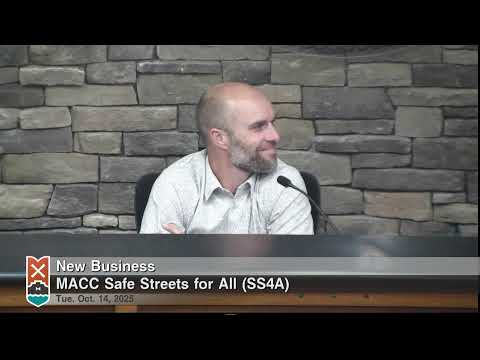
The City of Holland Planning Commission on October 14 received a presentation from the MAC and consulting firm AECOM on a Safe Streets for All safety action plan that the presenters said was funded by a competitive federal grant of about $300,000.
Jason Latham, director of the MAC, told commissioners the MAC assembled AECOM and local stakeholders to combine public input with crash data to produce a safety action plan designed to help communities prioritize street safety projects. "We received the grant ... just over a year and a half ago," Latham said, and the plan was intended to open new construction funding streams for prioritized projects.
Pam Bridal of AECOM described the plan’s data analysis. "About 21% of that roadway system accounted for 77% of all the fatal and serious injury crashes," Bridal said, noting the team used a high‑injury network and a separate high‑risk network (segments with similar roadway characteristics) to identify where investments would have the largest safety return. The plan supplements the city’s corridor study by identifying regionally consistent priorities and by including public input captured through an interactive mapping tool and a public open house.
The presentation outlined a menu of short‑, medium‑ and long‑term treatments. Options ranged from low‑cost changes—improved pavement markings, box‑span signal geometry, and refuge islands—to larger investments such as signals (mast arms or span wires), roundabouts at high‑injury intersections and road‑diet conversions (reducing four travel lanes to three with a center turn lane). The presenters cited evidence from prior projects that road diets can substantially cut crashes; AECOM discussed expected reductions ranging from roughly 29% to, in some studies, as much as 60–70% depending on context.
Latham said the plan includes predictive elements so the MAC can recommend proactive interventions in segments that share characteristics with existing high‑injury sites. He also framed community priorities: "distracted drivers and speed" emerged as top public concerns, and he added, "I think speed kills," arguing that traffic‑calming, streetscaping and refuge islands can help change driver behavior even where statutory limits constrain posted speeds.
The presenters said they can prepare detailed cost estimates for several targeted locations; they highlighted one interchange used to enter and leave Holland from US‑31 as a candidate for signal or span‑wire mast‑arm treatments. During questions, AECOM and MAC staff described the federal Safe Streets funding as a large, competitive program that has provided multibillion‑dollar totals nationally (presenters summarized it in the meeting as $5,000,000,000 over five years and roughly $1,000,000,000 per year) and said awards under that program can be large (presenters referenced up to $25,000,000 per application). Presenters also said local match requirements were typically around 20%.
Commissioners asked about the application process and how the city’s corridor study aligned with the safety action plan; presenters said the MAC’s coordinated data and the corridor work should strengthen the city’s application and noted applicants can request debriefs if an application is not selected.
A resident who lives near Michigan Avenue said slowing traffic there would make parents more comfortable letting children cross the street; commissioners and the MAC discussed how targeted engineering studies (turning‑movement counts, pedestrian counts, warrant analyses) would be needed to finalize designs and refine predicted benefits.
The meeting record shows the commission approved previous minutes earlier in the agenda and adjourned at the end of the session; the transcript does not specify precise vote tallies for those motions.
Next steps identified in the presentation included production of detailed cost estimates for select locations, further engineering analyses to set exact design elements and pedestrian counts, and waiting for the federal grant selection process (presenters said they expected notice in November).