Get Full Government Meeting Transcripts, Videos, & Alerts Forever!
Get email alerts on the Transportation topic
No spam. Unsubscribe anytime.
Manor ISD explores transportation hub stops and attendance-boundary scenarios to save fuel and increase instructional time
Summary
District staff presented early scenarios to reduce daily bus routes (about 30 to roughly 16), cut annual mileage from ~227,000 to ~120,000, and save an estimated $152,000–$190,000 while asking trustees and parents for community feedback on hub-stop locations and safety.
District operations staff presented early-stage proposals to reorganize transportation into hub stops (campus- or neighborhood-based pickup points) and to explore attendance-boundary scenarios for future years.
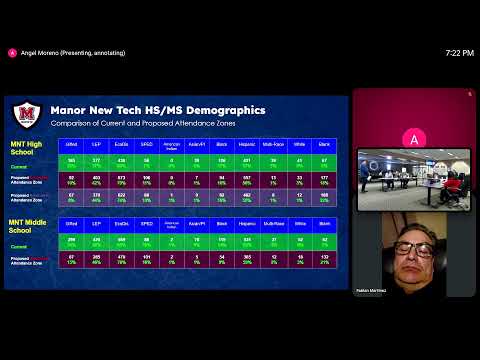
"We're looking at reducing mileage from 227,000 miles a year to a 121,000," said the chief operations presenter, outlining a plan that would shrink route counts (from ~30 routes to ~16 in the example) and reduce fuel use and maintenance. Staff presented two attendance-boundary scenarios for junior high and high school feeders and showed capacity modeling (for example, New Tech Middle School was modeled at 750 seats with roughly 618 in a southeast scenario; some high-school scenarios showed capacity pressures around an 800-seat baseline).
Trustees and board members raised typical questions such as parent walk/drive distances to hub stops (commonly described as half a mile to two miles in the scenarios), potential traffic or congestion near apartment clusters, safety and adult supervision at hub locations, and how hub sign-ups might be administered. Trustees suggested survey methods that include a map-based selection, Skyward outreach, QR postcards on buses, and targeted communications for families who do not use social media.
Staff emphasized the proposals are exploratory and administrative in nature; any attendance-boundary changes would require long-term planning, community engagement and likely span multiple years if pursued. Potential savings presented ranged from about $152,000 in one scenario to nearly $190,000 in another (fuel, maintenance and overtime reductions were the primary components cited).
Next steps: staff said they will gather community feedback, refine route- and savings-calculations, coordinate communications and report back with updated analyses before any formal boundary action is proposed.