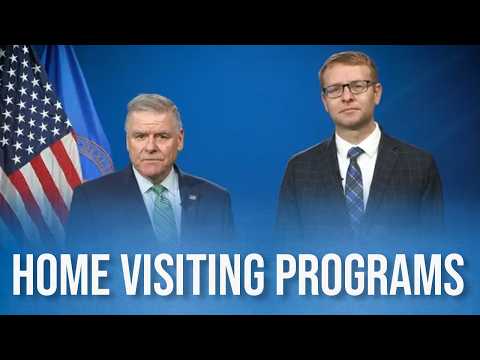
HHS officials highlight home visiting program’s reach and early-childhood benefits
Loading...
Summary
Officials from HRSA and ACF described the maternal, infant, and early childhood home visiting program (MCV) and its tribal arm, saying home visitors screen for maternal depression, support prenatal health and language development, and that participating families show higher daily reading rates; HHS cited nearly 12 million visits since 2012.
Tom Ingalls, administrator of the Health Resources and Services Administration, and Alex Adams, assistant secretary for the Administration for Children and Families, outlined the goals and reach of the maternal, infant, and early childhood home visiting program (MCV) in a short HHS briefing.
"Families across America want the same thing: healthy pregnancies, thriving babies, and children who are ready to succeed," Ingalls said, describing MCV and the tribal MCV program as designed to support those outcomes. He said the programs help home visitors build trusted relationships and tailor support to each family’s strengths and needs.
Adams said many families, including those in tribal communities, face challenges that can lead to referrals to child welfare and foster care. "Home visiting is the backbone of state and tribal prevention efforts," Adams said, adding that the agencies are focusing on prevention to keep families intact when it is safe to do so.
Both officials described services delivered by trained home visitors: screening for maternal depression and children’s developmental delays, supporting prenatal health and parent–child bonding, and promoting early language development. Ingalls cited data from a HRSA roundtable, saying, "83 percent of the children in MCV programs had a family member who read, told stories, or sang to them every day compared to just 41 percent of children nationally."
The briefing also provided a broad measure of scale: "Since 2012, MCV-funded programs provided nearly 12,000,000 home visits across all 50 states, the District of Columbia, and U.S. territories," Ingalls said. The officials directed listeners to mchb.hrsa.gov for more information. The recording is credited as produced by the U.S. Department of Health and Human Services.
The briefing did not specify funding sources, program-by-program outcomes, or evaluation methods underlying the cited statistic. It also did not include questions from other officials or members of the public.