
Harney County court explores options for historic Lincoln Building amid limited funding and rising cost estimates
Get AI-powered insights, summaries, and transcripts
Subscribe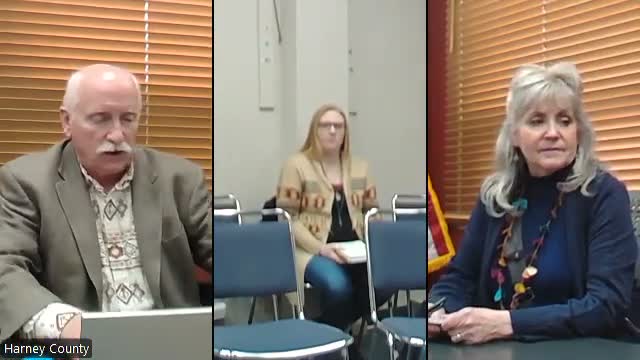
Summary
At a March 5 work session, Harney County court reviewed the Lincoln Building's history of restricted grants and cleanup work, discussed high renovation estimates and possible uses, and agreed to hold a public town hall and building tours to solicit proposals and public input.
Chair opened a March 5 Harney County court work session at 3:01 p.m. and framed the day's discussion around the future of the Lincoln Building, a vacant historic property the county acquired years earlier.
The chair said the county received a $3,000,000 award from the Oregon Justice Department (OJD) that is restricted to court-related elements and requires OJD approval before it can be spent. "The county got $3,000,000 from OJD for court related aspects of the building," the chair said, and added that repeated requests for additional legislative capital-improvement funds were not awarded.
Why it matters: commissioners and community members agreed the building has local significance but faces steep costs and maintenance risks. Speakers estimated a full renovation could run much higher than earlier figures; the meeting referenced prior estimates of roughly $4 million for some floor work and a separate $16 million figure, and participants said a comprehensive modern renovation is likely in the $20 million'$25 million range given current supply and labor conditions.
The court reviewed recent hazard mitigation work. The chair said the county obtained a $500,000 EPA Brownfields cleanup grant and contracted with Oregon DEQ contractors to remove asbestos and other hazards; most asbestos tile was removed, though some small, encased sections remain and are noted in the final report for safety precautions in any future remodeling. "All that's been done," the chair said, describing the remediation as complete for the documented items.
Officials described the building's limited current use and condition: the sheriff's office occasionally uses portions for active-shooter and defensive-tactics training, but the structure has no heating system, plumbing is shut off and likely requires extensive repair, and some wood floors show water damage and buckling. Commissioners warned that an empty building without activity or security could attract trespass or habitation.
Commissioners and attendees discussed a range of reuse ideas. Suggestions included shared "starter" office space or co-op studios for small businesses and artisans, preserving the auditorium and gymnasium for community use, a commercial kitchen, a studio/art center potentially connected to local musicians or arts groups, or outright sale to private investors. One participant urged the county to consider whether private buyers would be required to preserve the auditorium and community spaces as part of any sale.
The court also discussed an economic strategy: staff said they will pursue designation of a local census tract as an opportunity zone and could highlight the Lincoln Building as part of that pitch to attract private investment. Staff cautioned that even with designation, projects must be financially sustainable and that opportunity-zone capital requires payback by whoever uses it.
Next steps: the court agreed to hold a public town hall and building tours in the evening to allow residents to visualize reuse options and to solicit proposals and ideas from community groups, nonprofits and potential investors. Officials emphasized outreach by news, social media and community channels and noted there is no immediate plan to sell or renovate the building; it will be monitored and secured as needed until formal proposals or funding are available.
The work session adjourned with the court noting the Lincoln Building remains a community asset with high restoration costs and that a broader public conversation is the next procedural step.