
Marblehead school leaders present level-funded FY27 budget that would cut staff and programs
Get AI-powered insights, summaries, and transcripts
Subscribe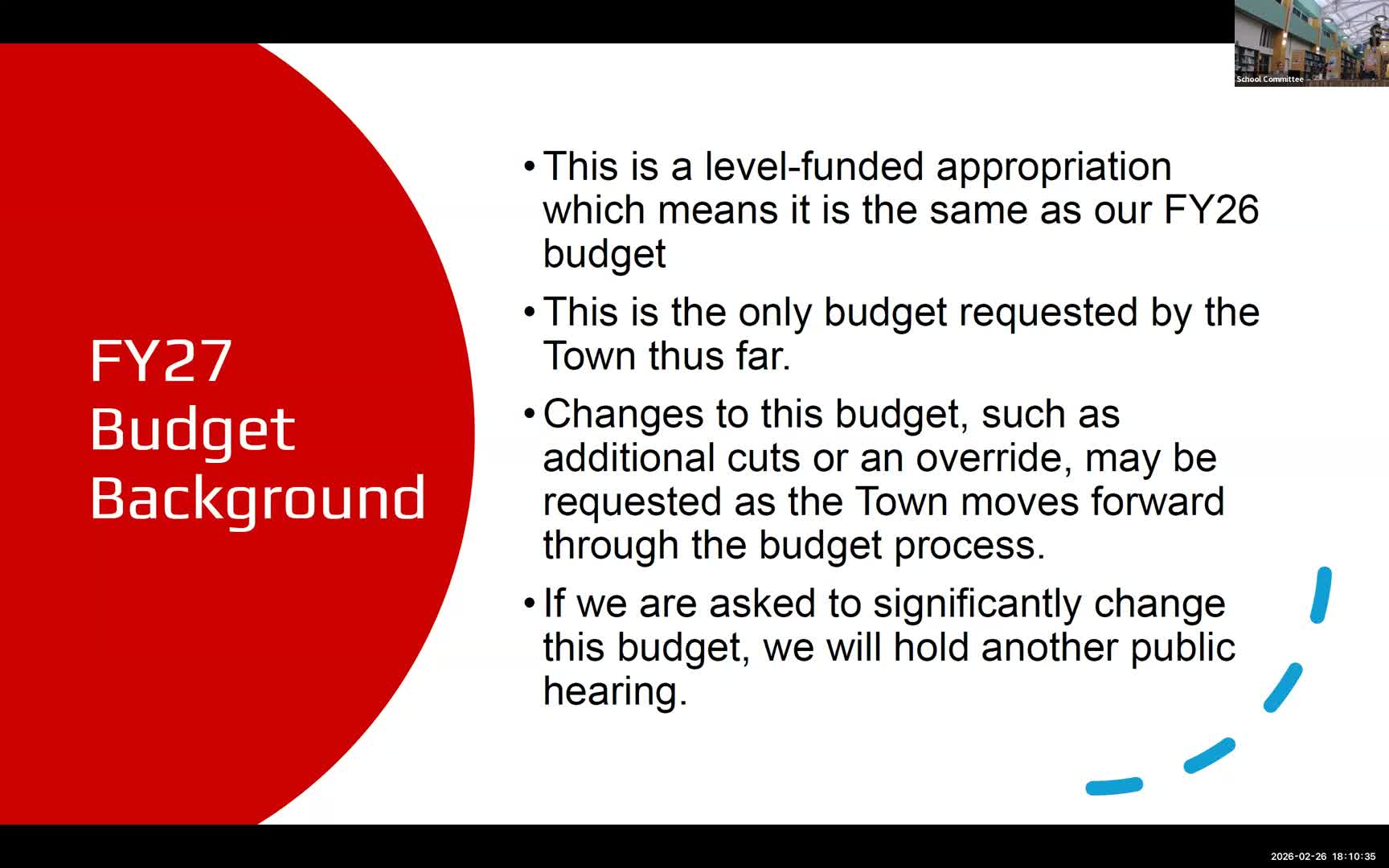
Summary
Superintendent John Roboto presented a level-funded FY2027 budget of $49.12 million that administrators say requires roughly 9.75 teacher FTE reductions and program cuts; teachers and residents urged the committee to pursue an override or other funding to avoid service losses.
Marblehead — The Marblehead School Committee heard a presentation and public testimony on Feb. 26 about the superintendent’s proposed FY2027 budget, which the administration described as a level-funded request of $49,120,285 and said would require staff and program reductions to balance existing contractual salary increases and rising special-education costs.
Superintendent John Roboto told the committee the town asked the district to present a level-funded appropriation and that ‘‘level-funded is the same amount as our current year budget’’ while noting that level services — which would cover salary increases and avoid cuts — would require more revenue. He said major cost drivers include a negotiated 3% salary increase for FY27 and an anticipated 8.25% rise in special-education tuition and transportation.
Why it matters: The administration says without additional town funding or a successful override, the district must reduce positions, scale back some services and use nonrecurring funds to close the gap — decisions that, teachers warned, would affect interventions and students ‘‘on the cusp’’ of meeting expectations.
What the superintendent proposed and why
Roboto said the district has been directed to present a level-funded budget of about $49.12 million and outlined a three-pronged approach that included efficiencies, tapping grants and revolving accounts, and targeted staffing reductions. He described roughly $800,000 of remaining reductions needed to reach the requested figure and listed proposed cuts that together would reduce teacher FTEs by about 9.75, along with other reductions across special-education supports and some high-school and elementary positions.
‘‘We’ve been asked to do that,’’ Roboto said, describing the reductions as necessary to match a level-funded appropriation from the town. He warned that ongoing use of nonrecurring funds and prepaying tuition provides a limited runway and that sustained funding gaps would require deeper staffing cuts.
Enrollment, class sizes and special-education pressures
The administration presented enrollment data showing Marblehead Public Schools had 3,144 students on Oct. 1, 2016 and 2,435 students as of Feb. 2, 2026 — a decline of 709 pupils, or about 23% over the period. Roboto said teacher FTEs fell from about 263.9 to a projected 215.4 over the same span (a roughly 19% reduction), and that special-education tuition and transportation remain a volatile, growing cost.
Finance staff and committee members explained prior practice of prepaying out-of-district special-education tuitions at year-end (the district has been prepaying up to about $1,000,000) to stabilize the budget, but warned that treating prepaid amounts as a current-year deduct would lower next year’s baseline and create a larger shortfall in FY28.
Public testimony and committee reaction
Teachers, parents and residents who spoke at the hearing urged the committee to avoid cutting intervention and special-education supports. Sarah Matusa, who identified herself as a teacher with nearly 20 years in Marblehead, said, ‘‘The level funding budget is putting us in quite a pickle,’’ and warned that cutting math-interventionists and other positions risks students slipping through the cracks.
Samantha Rosado urged the committee to recommend a fully funded budget or an override, arguing that recurring needs — salaries and services — cannot be sustained by one-time measures. Multiple committee members said they support fully funding schools in principle but emphasized that any override campaign would require clear community education and accurate facts to succeed.
Options discussed
Committee members and administrators discussed several steps to reduce near-term pressure without structural revenue increases: drawing more on kindergarten and pre-K revolving accounts, continuing prepayment practices at the current $1 million level, pursuing utility and copier savings, and more active recruitment and retention strategies to recapture enrollment (including earlier outreach for kindergarten and pre-K). The committee also left a placeholder on the warrant for a potential general override if that path is chosen.
Formal process and next steps
The committee opened the public hearing by roll call and may deliberate and vote on the budget at a subsequent meeting prior to town meeting. Committee members emphasized they must present a budget the committee believes is necessary for students while also working with the town and finance committee to deliver a balanced appropriation to town meeting. If the school committee decides to pursue an override, members said it would require coordinated community outreach and a clear plan explaining what additional funding would buy.
The meeting concluded with the committee approving a consent agenda (schedule of bills and minutes) and voting to enter executive session on collective bargaining and potential litigation. The FY2027 budget remains under committee deliberation; no final appropriation was adopted at the Feb. 26 hearing.
What to watch
- Whether the committee votes next month to present a different recommendation to town meeting or to place an override question on the warrant. - Any follow-up budget revisions driven by town revenue projections, finance-committee consultations, or new information about enrollment and special-education placements.
Sources: Presentation and public hearing at the Marblehead School Committee meeting, Feb. 26, 2026; direct quotes from speakers at the hearing.