U.N. warns Middle East fighting is causing widespread civilian harm and risks wider escalation
Loading...
Summary
At a U.N. noon briefing, the secretary-general warned that unlawful attacks across the Middle East are causing heavy civilian suffering, displacing tens of thousands and threatening to spread beyond the region; U.N. agencies reported school and health‑care attacks, a hit on a UNOPS fuel tanker bound for Gaza, and mass movements in Lebanon, Iran and Syria.
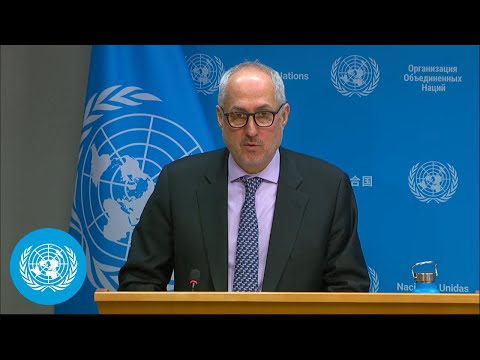
Stephan, the U.N. moderator, read a statement from the secretary-general on the humanitarian toll of the recent Middle East fighting and warned it “could spiral beyond anyone’s control,” urging an immediate return to serious diplomatic negotiations.
The briefing listed multiple, concurrent humanitarian crises. In Lebanon, widespread displacement orders have forced more than 100,000 people into collective centers, health services in parts of south Beirut were reported evacuated and nonoperational after attacks on 5 March, and U.N. peacekeepers (UNIFIL) have observed strikes toward Israel as well as Israeli air strikes and ground movements across the Blue Line, Stephan said.
In Gaza, Stephan said the Kerem Shalom (Kerem Abu Salem) crossing remained open for the delivery of approved humanitarian supplies while other crossings, including Rafah, remained closed; medical evacuations, rotation of humanitarian staff and returns from abroad were suspended at several crossings. Inside Gaza, partners are prioritizing emergency care, maternal and neonatal services, communicable‑disease management and trauma care, while carefully managing fuel supplies.
Stephan said a UNOPS fuel tanker en route to collect fuel for distribution inside Gaza was hit; no one was injured. Jorge Moreira Da Silva, head of UNOPS, called for a full investigation into the incident and for fuel deliveries to be allowed to proceed safely and without interruption to sustain humanitarian operations.
The U.N. also cited large movements and attacks elsewhere in the region. In Syria, UN teams reported more than 30,000 people crossed from Lebanon over the past week and U.N. personnel were present at border crossings to monitor movements and provide assistance when appropriate. In the West Bank, the briefing said increased checkpoint closures and road gates have restricted access to services and work; operations and violence by settlers and security forces have resulted in casualties and displacement, with eight Palestinian families (about 45 people) forced to leave their community near Nablus following attacks and intimidation from a newly established illegal outpost.
Turning to Iran, Stephan cited UNICEF’s concerns about the impact on children, saying ‘‘approximately 180 children have reportedly been killed,’’ and referenced a reported strike on an elementary school in Minab on 28 February. He said the World Health Organization had verified 13 verified attacks on health-care sites as of the previous day and that UNHCR’s initial estimate of roughly 100,000 people leaving Tehran in the first two days of the crisis had since been surpassed; he described the U.N.’s ability to move in active conflict zones as severely limited.
The U.N. assistance mission in Afghanistan also reported civilian casualties linked to cross‑border clashes between Pakistan and Afghanistan’s de facto authorities: from the evening of 26 February through 5 March the mission verified some 185 civilian casualties, including 56 killed and 129 injured or affected by indirect fire and aerial attacks; the mission said 55% of recorded casualties in that period were women and children. UNHCR was cited as reporting roughly 115,000 people internally displaced in Afghanistan and about 3,000 in Pakistan.
When pressed during the question-and-answer period about how the situation could become even more uncontrollable, Stephan said that risks include further civilian suffering, threats to state cohesion, and disruption around strategic chokepoints such as the Strait of Hormuz that would raise energy and food prices, worsening conditions for vulnerable populations. A reporter noted public comments by U.S. domestic leaders calling for unconditional surrender by one party; Stephan said the secretary-general will continue to use his contacts with member states to push for negotiations.
Edie, a reporter, cited a morning comment attributed to President Trump that “Iran must surrender,” and asked what the secretary-general could do to promote negotiations in that context. Stephan reiterated the U.N.’s priority of pushing for a return to negotiations but declined to predict outcomes.
The briefing closed with a note that the foreign minister of Azerbaijan had addressed a letter to the secretary-general describing a drone attack in the Nakhchivan Autonomous Republic; the letter will be circulated to the General Assembly and the Security Council.
What happens next: the U.N. says it will continue diplomatic efforts and humanitarian coordination, seek fuller information about the tanker incident and press for safe, sustained access for relief supplies. The moderator left to bring the U.N. emergency relief coordinator, Tom Fletcher, to address further humanitarian details.