
Select Board advances placeholder article to transfer town land for 100% income‑based affordable housing
Get AI-powered insights, summaries, and transcripts
Subscribe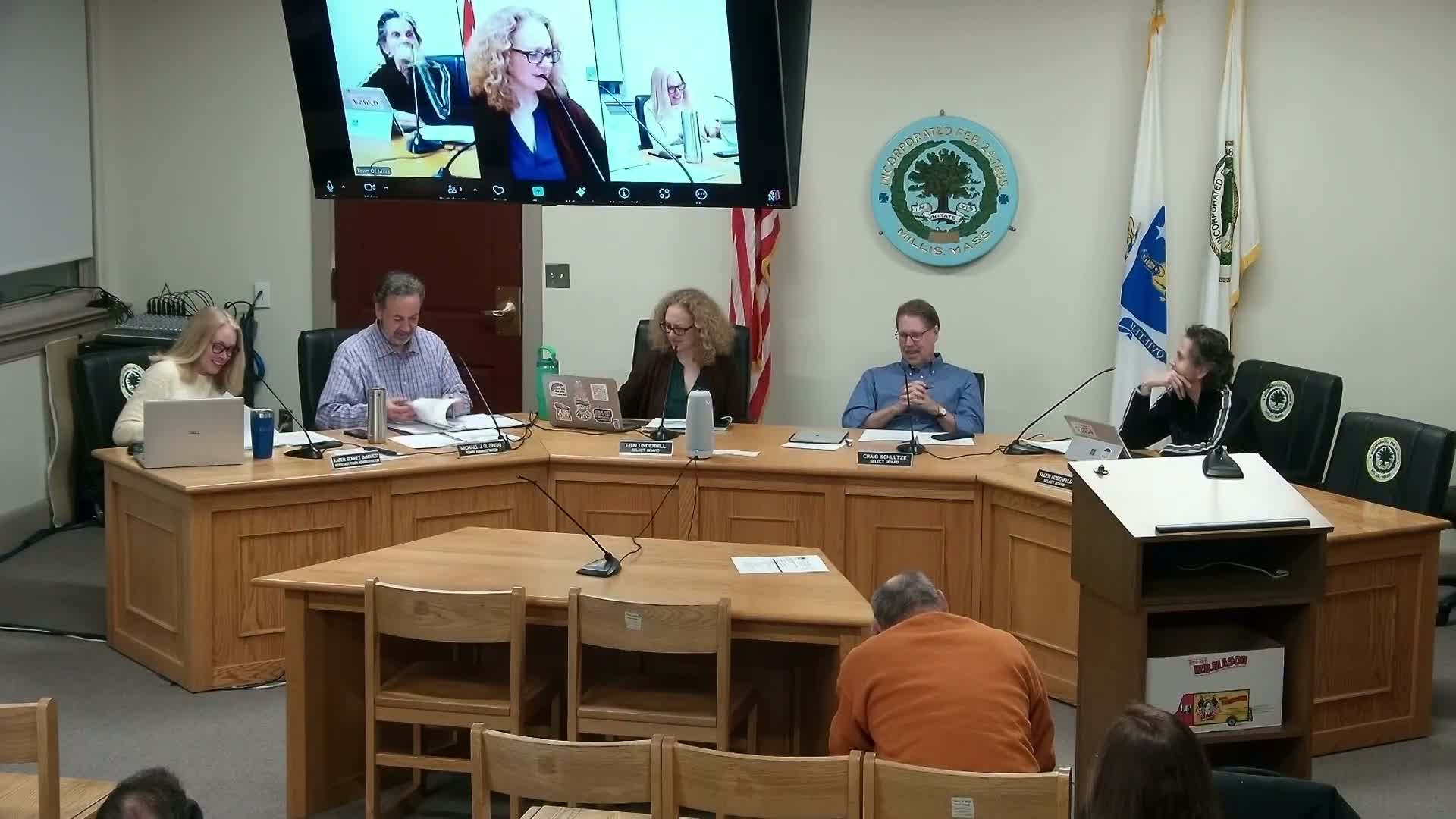
Summary
Millis Housing Authority and MAPC asked the Select Board to transfer town‑owned land (Braun or Cassidy parcels) so the authority can build housing kept at 100% income‑based rents; the board voted to place a placeholder article on the May town‑meeting warrant and schedule further public outreach and site hearings.
Millis Select Board members heard a presentation from the Millis Housing Authority and the Metropolitan Area Planning Council on March 2 and voted to place a placeholder article on the May 4, 2026 annual town‑meeting warrant to transfer a town‑owned parcel to the Millis Housing Authority for the construction of income‑based affordable housing.
Mariela Espinosa of the Millis Housing Authority told the board the proposed units would be priced based on residents’ ability to pay (the presenters used 30 percent of gross adjusted income as the target affordability measure) rather than the more common area‑median‑income bands. Espinosa said that approach would better serve residents she described as “truly unable to pay rents that are 80% of AMI.”
Javier Gutierrez of the Metropolitan Area Planning Council said MAPC will lead outreach, and announced two open houses: April 6 at the Millis Public Library (evening) and April 15 at 10 a.m. at the Millis Housing Authority. He said the planning team will also conduct broader town outreach and technical sessions to explain funding, tax‑credit mechanisms and the developer procurement process.
Candace Avery, executive director of the Millis Housing Authority, described the local demand cited in the presentation: the authority currently manages 73 elderly/disabled units and 10 family units (83 units total) and reported long waiting lists (presentation cited roughly 2,500 family applicants and about 5,000 for elderly/disabled units). Avery said the housing authority expects developers to secure grant funding, tax credits and other financing for construction; the authority would retain the land and typically use a ground‑lease structure so a developer builds and manages the project under terms preserving affordability.
Board members asked technical questions about ownership, service levels, accessibility and infrastructure. Select Board members expressed the need for further town input and site‑specific review: several members said they want to hold additional public hearings and examine wetland delineation and pump‑station capacity prior to finalizing which town parcel will appear on the warrant. Town counsel’s office was reported to have reviewed property restrictions for the Cassidy site and found the proposed transfer allowable; board members requested that legal opinions and the wetlands assessment be made available to the public.
After public comments supporting the transfer, the board voted unanimously to place an article on the May warrant to transfer a parcel to the Millis Housing Authority; the motion specified that the exact parcel (the board and presenters discussed Cassidy and Braun as the two candidates) would be chosen at a subsequent meeting and publicized in advance so residents can comment. The board directed staff to publicize the April open houses and the follow‑up meeting and to post the wetland reports and other technical materials on the town website.
What’s next: the board expects to select the specific parcel at a later meeting (members referenced March 23 for further discussion), to continue public outreach and to present a final, parcel‑specific warrant article before town meeting.