Get Full Government Meeting Transcripts, Videos, & Alerts Forever!
Get email alerts on the Rezoning topic
No spam. Unsubscribe anytime.
Red Bank advances two rezoning ordinances to allow duplex development
Summary
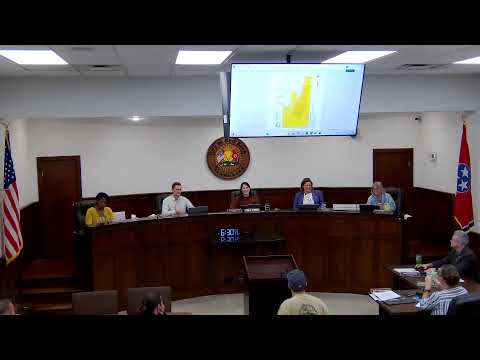
The Red Bank Board of Commissioners moved two rezoning ordinances on to second reading, clearing the way for duplex development at 520 Gadd Road and 3390 Easton Avenue after staff presentations and applicant remarks; planning staff recommended approval for both.
The Red Bank Board of Commissioners on first reading advanced two zoning changes that would allow duplexes at 520 Gadd Road and 3390 Easton Avenue.
Staff told the commission that 3390 Easton — a lot where a structure burned and was later condemned — already fits the surrounding pattern of R-2 development and that both the planning commission and staff recommended approval. “The planning commission did recommend approval, unanimously, and the staff recommendation is also approval,” a planning staffer said.
Gordon Logan, the applicant for 3390 Easton and a Red Bank resident who described himself as a local builder, told the commission he bought the burned property to remove an eyesore and build a duplex. “My name is Gordon Logan, and…those units right there will be high threes, low fours,” he said, describing each unit as roughly 1,900 square feet with three bedrooms and two bathrooms for sale rather than for rent.
On 520 Gadd Road, staff described the parcel as a greenfield infill site where the applicant proposes duplex units to mirror nearby development. Planning staff noted that adding duplexes “would increase traffic at the Royal Crest and Gadd Road intersection” and recommended a study of traffic patterns as part of continued review.
Commissioners voted to carry both ordinances on first reading; the measures were identified as Ordinance 26-1300 (520 Gadd Road) and Ordinance 26-1301 (3390 Easton Avenue). Second and final readings are scheduled at the next meeting.
Why it matters: Both measures would increase local housing density by allowing two-unit buildings where single-family homes previously predominated. Commissioners and staff framed the changes as modest density increases intended to add housing supply while flagging traffic and steep-slope issues as points for follow-up.
What’s next: Both ordinances passed first reading and will return for a second reading and final vote at the commission’s next meeting.