Council committees advance motion to tighten rules on pretextual traffic stops after community testimony
Loading...
Summary
After hours of public testimony and data presentations, Los Angeles council committees voted to send a motion forward asking the Police Commission to limit pretextual stops for equipment and administrative violations, restrict consent searches during such stops, and require clearer body-worn-video articulations.
Los Angeles city council committees on Thursday advanced a proposal to strengthen restrictions on so-called pretextual traffic stops after lengthy public comment and competing presentations from advocacy groups, the Chief Legislative Analyst and the Los Angeles Police Department.
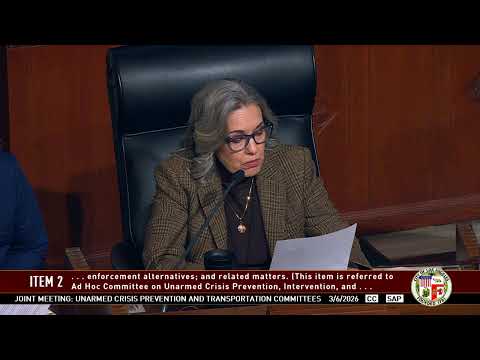
The ad hoc committee on Unarmed Crisis Prevention Intervention and Community Services approved a motion to ask the Board of Police Commissioners to amend LAPD policy to prohibit pretextual stops for most equipment and non-moving administrative violations, curb consent-based searches during those stops except where a warrant or probable cause exists, and require officers to articulate the basis for a stop on body-worn video. The motion passed in the ad hoc committee 3–1 (Blumenfield, Hernandez and Price voted yes; Lee voted no; one member was absent). The companion vote before the Transportation Committee sent the item forward with no recommendation.
The measure comes after hours of public testimony from residents and community organizations who described repeated stops they said were unnecessary, humiliating and sometimes dangerous. "We won't stop here," said Sequeria McCoy, who told the committees she lost a family member after what she called a pretextual stop; Brian Jointer described being pulled over at gunpoint with his teenage sons in the car and later released without citation. PushLA, the coalition advocating the ban, summarized research and city stop-data analyses showing persistent racial disparities and low discovery rates when officers conducted consent searches during minor-violation stops.
PushLA speakers urged a categorical approach: remove entire categories of non-safety equipment and administrative violations from officers' authority to stop motorists, paired with alternatives such as mail-based notices and investments in safe-street infrastructure. "These stops are not advancing traffic safety," PushLA's data presentation concluded, citing sustained rates of minor-violation stops and discovery rates indicating that most consent searches do not turn up contraband.
LAPD officials urged caution. Captain Shannon White and senior department staff told the committees that pretextual or investigative stops remain an operational tool, emphasized that officers must articulate reasonable suspicion or probable cause when appropriate, and pointed to department audits and training as safeguards. The department said its internal reporting shows a lower share of stops classified as pretextual than the PushLA analysis, and warned that overly restrictive rules could hamper the department’s ability to locate wanted suspects or recover firearms.
Council members pressed both sides on specifics: what violations would be eligible for mail notification, how to preserve traffic safety when equipment actually creates hazards (broken brake lights, for example), and how audits and body-worn-video entries would be enforced. The City’s Chief Legislative Analyst presented a data brief disaggregating stops by council district and age and noting concentrations of stops in certain districts; the city’s inspector general announced a planned audit of pretextual-stop practices and pledged a report within six to eight months.
Under the motion, the Board of Police Commissioners would be asked to amend Department Manual section 1/240.06, to: prohibit pretextual stops of motorists and cyclists except when the violation poses a significant and imminent safety risk; prohibit consent-based searches during pretextual stops absent a warrant or probable cause; require clear articulation on body-worn video before questioning; and study a mail-notification system to address certain non-safety violations. The motion also requests semiannual reporting by the inspector general on data and compliance trends.
Next steps: the motion will be transmitted to the Board of Police Commissioners and relevant city departments for consideration and implementation planning. The inspector general’s promised audit and the CLA’s datasets will be material to any final policy drafting and implementation timeline.