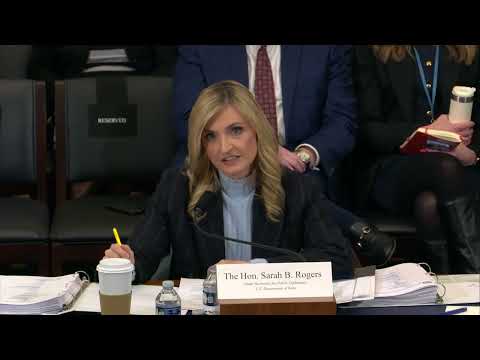
Undersecretary for Public Diplomacy outlines priorities, cites safety concerns amid reported U.S. operations in Iran
Loading...
Summary
The Undersecretary for Public Diplomacy told the House Committee on Foreign Affairs that the State Department is prioritizing the safety of U.S. personnel and exchange participants amid reported U.S. operations in Iran, and described a new strategic plan, tighter grant approvals, and efforts to counter foreign propaganda and online harms.
The Undersecretary for Public Diplomacy told the House Committee on Foreign Affairs that protecting U.S. personnel and citizens overseas is the State Department's top priority amid what the witness described as U.S. military operations in Iran. "As the president has said, The United States is conducting military operations in Iran under operation epic fury to eliminate threats posed by the Iranian regime to America, our forces, and our partners," the Undersecretary said.
The testimony focused on how public diplomacy tools support that priority and broader foreign policy goals. The Undersecretary said the Bureau of Educational and Cultural Affairs is "working around the clock" to support American exchange participants and that global public affairs communicators are ensuring safety guidance reaches U.S. citizens via social media and the Smart Traveler Enrollment Program (STEP).
The witness framed freedom of expression as central to the bureau's mission and said it is "not a partisan issue," adding that the department has advocated in Europe and the U.K. against extraterritorial enforcement of censorship laws affecting Americans. The Undersecretary also listed emerging challenges the bureau is addressing, including "threats to child safety online, deep fakes, antisemitism, and genuine anti American propaganda operations by foreign actors."
Pointing to organizational changes, the Undersecretary said a new public diplomacy strategic plan due next month will place "sovereignty, security, and economic renewal" at the center of foreign policy communications. To ensure accountability for spending, the witness said ambassadors and their public diplomacy teams now follow a new grant approval process so "every single one of those dollars is spent wisely." The Undersecretary said "all spending is tracked, approved, and targeted to advance U.S. policy objectives" through rigorous monitoring and evaluation.
On programming, the Undersecretary described two principal tools: long‑term relationships cultivated through exchange programs and strategic messaging. The witness cited programs by name, saying, "Thanks to programs like Fulbright, Gilman, and IVLP, we get to make deals with people we know," and said the Bureau of Global Public Affairs is using artificial intelligence and analytics to measure effectiveness and identify trends. The department has also implemented unified branding guidelines to associate U.S. programs abroad with the American flag, the witness said.
The Undersecretary summarized regional priorities—defending freedom of expression and countering foreign influence in Europe, emphasizing U.S. technological leadership in the Indo‑Pacific, and building partnerships in the Middle East and Africa—and said the department is using major international events such as the FIFA World Cup and the Los Angeles Olympics, along with World Expo pavilions and an NFL partnership, to advance U.S. interests.
The hearing record contains the Undersecretary's statements as delivered; the committee record does not provide independent confirmation of operational or classified details the witness referenced, including the operation name the Undersecretary cited. The Undersecretary closed by reaffirming stewardship of taxpayer funds and thanking the committee for its partnership.